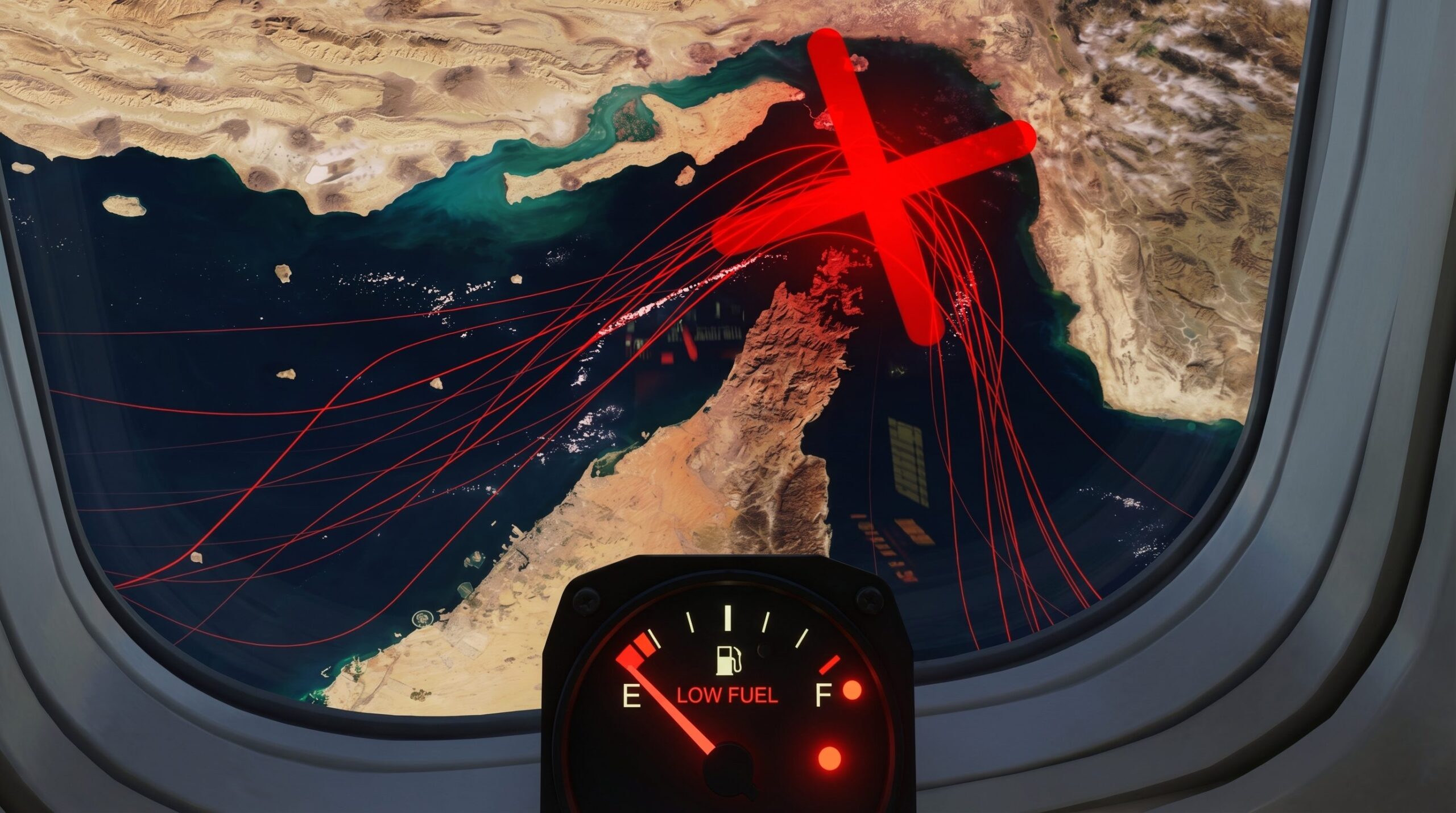
If you’re planning a flight this summer, there’s some news that deserves your attention. Last April 9th, ACI Europe – the association that represents beyond 600 European airports – wrote a formal letter to two commissioners of the European Union raising a specific alarm: if the passage through the Strait of Hormuz does not recover stably within three weeks, one systemic shortage of aviation fuel will become a reality for Europe. Heavy words, which deserve an explanation. Why can a stretch of sea less than 40 kilometers wide, on the other side of the world, call into question our summer flights?
The most important bottleneck on the planet
The Strait of Hormuz it is a space of water narrow between theIran el’Omanand represents the only outlet for Persian Gulf towards the rest of the world. Ships carrying crude oil from Saudi Arabia, Iraq, Kuwait, Qatar and the United Arab Emirates pass through here: practically all the oil and derivatives that leave that region must necessarily pass through here, just under 20% of global crude oil traffic.
Since, at the end of February 2026, the US and Israeli military operations against Iran, cross-strait trade has collapsed. Before the war they passed on average 138-140 ships per day. In the most critical days of the conflict we reached one or zero oil tankers in transit in 24 hours. The agreement of truce reached on 8 April it only formally reopened the passage. Iran currently conditions transit with permits and tolls – up to two million dollars per vessel – and tracking data shows that traffic remains at just a few passages a day, far from normal levels. As he summarized the CEO of ADNOCan Emirati oil company «the Gulf is not open, it is controlled».
Why is there no kerosene?
This is where the specification comes into play vulnerability of aviation fuel. THE’Europe imports approximately 40% of its jet fuel needs from refineries in the Persian Gulf, and that fuel arrives by sea, right through the Strait of Hormuz. It is not crude oil to be refined but a finished product, ready to be loaded onto planes.
To understand the scale of the problem, an example is enough. The refinery Al-Zourin Kuwait, is one of the largest plants in the Middle East which alone supplies approximately 10% of all European imports of aviation kerosene, according to Energy Intelligence data.
Kuwait, UAE and Bahrain are all stuck inside the Gulf, unable to ship. The result is that jet fuel prices have more than doubled compared to pre-conflict levels. It’s been around since $830 a ton beyond $1,500-1,800 per ton in recent weeks. Fuel physiologically represents between 20% and 40% of an airline’s operating costs, an impact of this size cannot remain invisible to passengers.
The situation in Italy: alarmism to be avoided, but attention to be maintained
Here we need to be precise, because the boundary between information and alarmism in this case is thin.
In Italysome airports – including Milan Linate, Venice, Bologna, Treviso, Brindisi – have introduced fueling limitations for non-priority flights. The supplier Air BP Italia has communicated to the companies, via aeronautical bulletin, that the distribution will be limited with absolute priority to medical flights, state flights And long-haul routes.
The president of ENAC, Pierluigi Di Palmahowever, toned down his tone by recognizing that the Gulf crisis is creating structural pressure, but attributing the immediate difficulties mainly to the Easter traffic peak, excluding an immediate emergency. No cancellations have been officially attributed to kerosene shortages so far.
So how are things really? Suppliers, including Ryanair, say they can guarantee supplies until mid or late May. After that, if the strait does not significantly unblock, the situation becomes more critical. The state strategic reserves (those that are activated by an institutional decision, not automatically) guarantee Italy an autonomy estimated at around seven months (similar figure to Germany). Portugal, for comparison, is estimated at around four months. Therefore there are bearings, but they are not inexhaustible and the situation must be monitored.
What do we risk for summer 2026
We will not see a total blockade of air traffic. But ignoring the situation would be equally wrong. Here’s what can actually happen.
- On the cancellation frontsome companies have already made decisions. SAS canceled over a thousand flights in April, Ryanair has said it will evaluate cuts if the crisis prolongs, Lufthansa is working on contingency plans which include the possible temporary parking of part of the fleet. Smaller airports, with less storage capacity and without logistical alternatives, are the most vulnerable.
- On the price frontthe increase in energy costs will partly end up on tickets. Those who have already purchased a ticket should not suffer subsequent increases. But those who buy now or in the next few weeks could find higher rates. It is good to know that if a company cancels a flight due to fuel shortage, this could be classified as “exceptional circumstance” pursuant to European regulation 261/2004, exempting the company from compensation of up to 600 euros, while maintaining the obligation to refund the ticket.
- Then there is the practice of the so-called tankering: some companies are taking on board all the fuel needed for the return flight at departure, so as not to depend on refueling in risky stopovers. This increases the weight of the plane, increases i consumption and it can cause delaysthis is an emergency solution, not a sustainable system.
And biofuels?
The question arises spontaneously, couldn’t i be used sustainable aviation fuelsthe so-called SAF? The answer is: not immediately. SAF production is still structurally limited, it covers a tiny share of global needs of jet fuel, and its market cost is on average about double that of fossil kerosene which has already become more expensive. The European ReFuelEU Aviation regulation, in force from 2025, imposes a minimum share of 2% of SAF in the airport refueling mix, but precisely in this market context the companies are asking for this to be postponed. SAFs are a correct strategic direction for the long term, but they are not a lever that can be counted on to manage this crisis.
What does this story teach us
What is happening around the Strait of Hormuz tells us something that goes beyond the current crisis. European air transport it depends on a single waterway forty kilometers wide for a significant share of its fuel. Europe has reduced its own over time internal refining capacityand it has stopped producing enough kerosene for himself. When that waterway closes – due to war, political tension, whatever reason – the logistics chain breaks down within weeks.
The current situation is serious but not yet criticaland there is still room for one diplomatic solution before the summer is compromised. But the fact that three weeks of lockdown is enough to put the tourist season of an entire continent at risk tells us something about the fragility of a system that we took for granted.
How much do we have to depend on a single waterway to get around? And what kind of energy autonomy do we want to build for the future?
