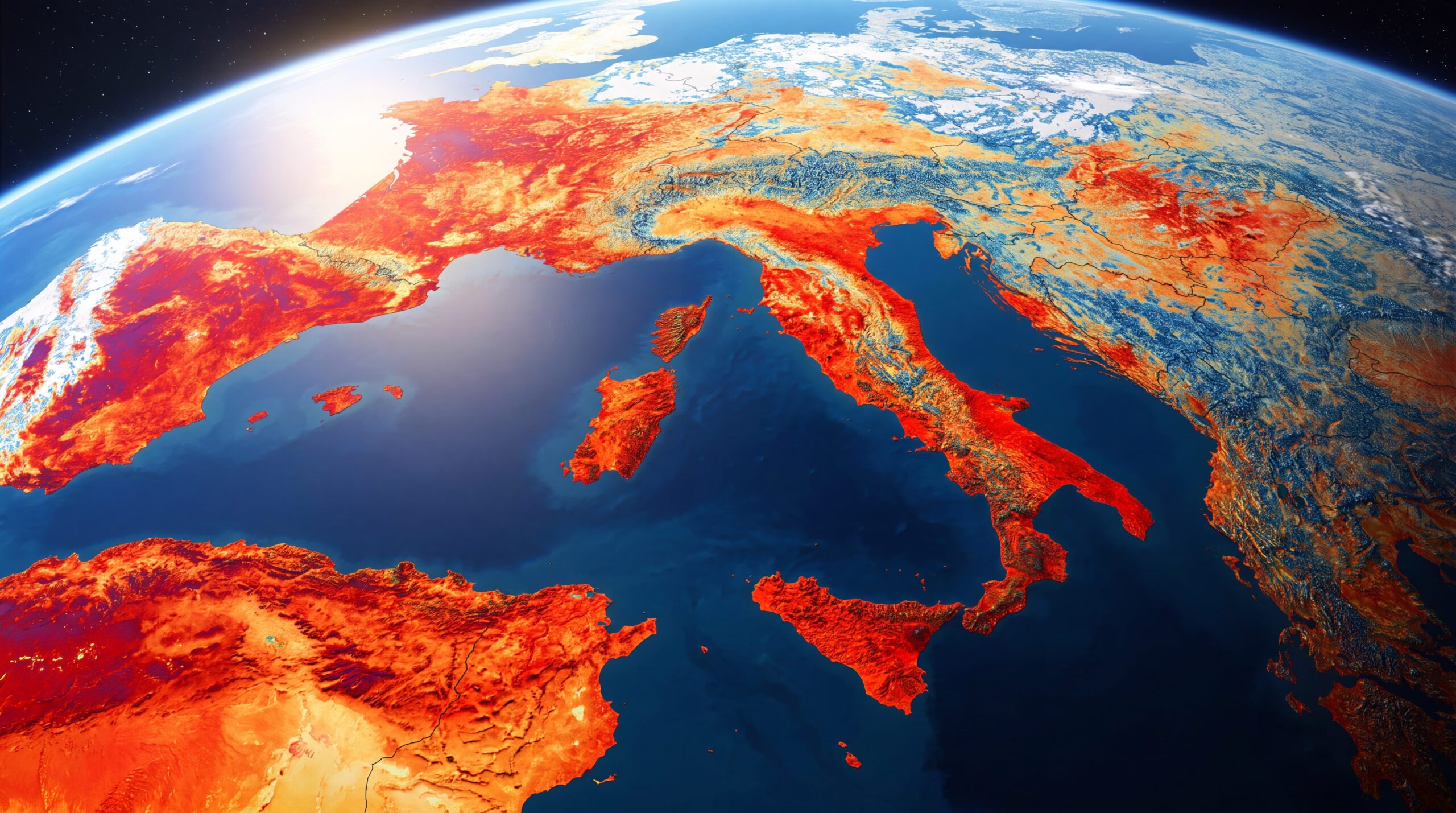
What we have experienced in the last few days has been theheat wave most powerful ever recorded in Europe. Fifty years ago, in 1976, such an event would have been practically impossible. Today it has become normal. And the problem is not so much this specific event – which killed around 1,300 people in one week – but the fact that we are only at the beginning. Ahead of us are decades in which these events will be ever more likely, ever more intense, and ever longer.
“It was always hot”: the problem is not the single event
We often hear that “these events are cyclical” or that “it has always been hot”. And it’s true: every summer it’s hot cyclically, and subtropical anticyclones have always been there. The problem is not the single event. The problem is that over the years the number of these events is increasing, both in frequency, intensity and duration.
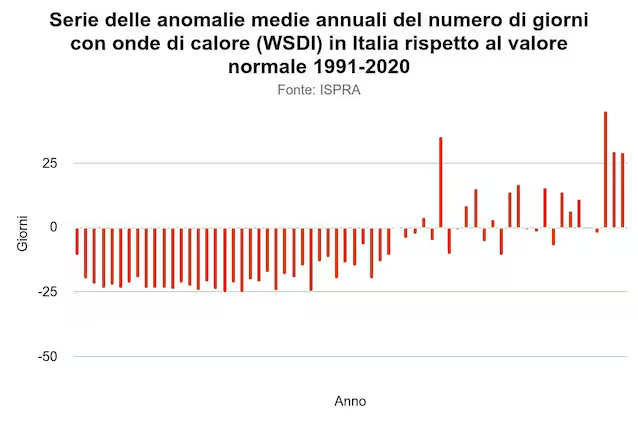
The ISPRA graph updated to 2024 is quite clear: in Italy the days with heat waves are constantly increasing over time.
And it’s normal for this to be the case, because you can’t escape from it atmospheric physics. Burning fossil fuels means emitting carbon dioxide as waste gas. And if you increase the concentration of CO₂ from 320 ppm in 1960 to 430 in 2025, the atmosphere is capable of absorbing energy in quantities that are difficult even to imagine.
Do you have any idea how much energy is needed to heat the rooms of our house in the winter? A lot, and the bills remind us of this well. Now imagine how much it takes to warm all the air around the world by just 1°C. All this energy remains here, trapped in the atmosphere, and transforms into extreme events over time.
Without fossil fuel emissions, this heat wave would have been 3.5°C cooler. This is what the new report from World Weather Attribution (WWA) says, which studies how the climate crisis influences the intensity and probability of extreme weather events. Emissions have worsened this heat wave in Europe. It’s not an opinion: it’s what emerges from climate models.
Cities and heat islands
The damage was seen especially in large cities, where so-called heat islands form. Overbuilding doesn’t help in all this. We measured temperatures in the sun on the afternoon of June 21, 2026 on the asphalt: more than 65°C. In the shade, always on the asphalt, around 38°C.
Cities are not ready to face such events. More trees and more urban greenery would be needed to lower local temperatures and limit heat islands, one of the main causes of death from heat. But it’s not enough.
Italy is the most vulnerable country in Europe
Italy suffers more than anyone for a specific reason: we are a country with a very high average age, around 48 years. 25% of the population is over 65 years old, and for every child under 6 years old there are 6 elderly people. For comparison, the average age in Europe is 45, in Asia 33.
It is no coincidence that Italy is the country with the most heat-related deaths in Europe: on average over 3,000 each year, ahead of Germany and Spain. And 94% of European regions are getting worse every year.
The invisible damage
Heat waves don’t just strike with heat stroke. They silently hit everything.
They affect those who live in houses without air conditioning, those who cannot afford to stay cool, those who work in the fields or in construction and cannot stop. They affect the bills of those who keep the air conditioner on all day. They affect everyone’s sleep quality, because tropical nights — with minimum temperatures above 20°C — prevent us from resting and recovering. They affect psychophysical health: scientific literature documents an increase in emergency psychiatric hospitalizations during heat waves, for mood disorders, suicidal behavior and anxiety disorders.
Heat waves are not anomalies. They are the new normal.
What can we as individual citizens do
We often think that the contribution of one individual is not enough to change a trend. And it’s true that a single behavior can’t change things then and there. But if the change becomes cultural, things really start to change. And for it to become cultural, it is necessary for every single citizen to take an interest in common life. It can do this on two levels.
The first is personal: evaluate your environmental impact. What we eat, how much we travel, how many intercontinental flights we take, how many clothes we buy, how much we waste. Everyone according to their own possibilities.
The second is political: important decisions pass through the institutions, but it is we who decide, with the vote, who will represent us and what vision on the climate crisis will be carried forward. In democracy, sovereignty belongs to the people. And we are the people.
And then there is something that is often underestimated: talking about it. Tell these things to friends, family, on social media. Not to convince anyone or be a know-it-all, but because cultural change happens exactly there. We need more information, more awareness, more participation.
You just need to be attentive citizens and aware of what you can do.
