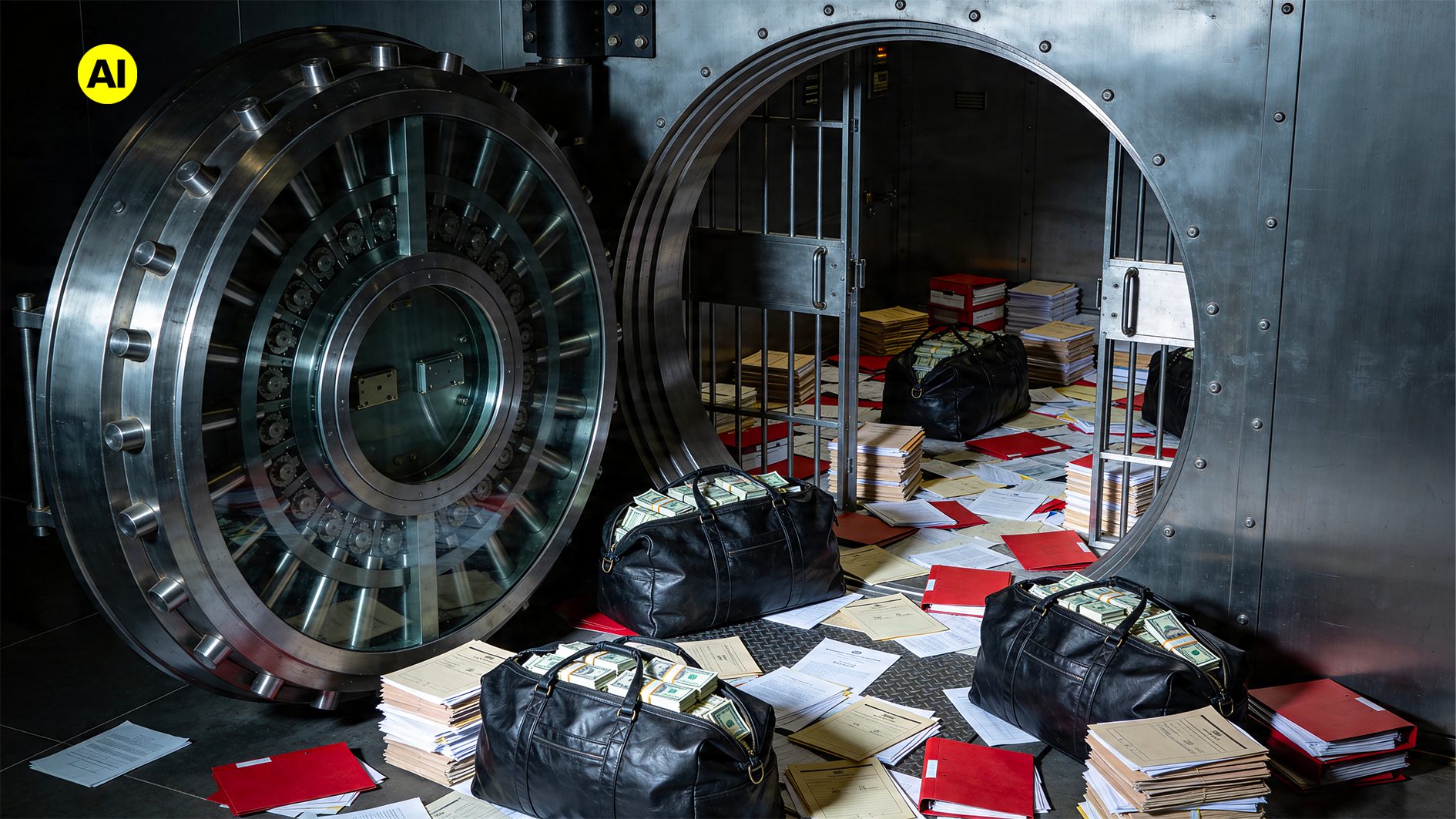
There have been many major robberies in twentieth-century Italy, from the one in Via Osoppo, Milan, in 1958, to the undisturbed theft from the vault of the Court of Rome in 1999.
Last April 16th, a robbery took place in Naples that could earn a place among those that will be remembered: a group of thieves, masked with tights, attacked the Crédit Agricole bank in Piazzale Medaglie d’Oro, in the Arenella residential district. The gang of robbers, equipped with fake weapons, took 25 people hostage, who were then released, and took away dozens of safety deposit boxes from the branch’s vault, before escaping through the sewers. The loot has not yet been quantified. And while the police searches continue, for the moment without result, it is worth retracing the series of illustrious robberies that have occurred in Italy over the last century.
The coup of the via Osoppo gang (Milan, 1958)
Milan, Thursday February 27, 1958: a group of criminals in blue workers’ overalls and balaclavas carried out a robbery of an armored car for a loot of 114 million lire in 5 and 10 thousand lire banknotes. The seven men had long studied the route of the armored car of the Banca Popolare di Milano, which transported the load from the streets of the center to the outskirts, three times a week.
The assault of the 7, led by Ugo Ciappina, a former GAP partisan, arrested by the SS in 1945 and already an experienced thief in the Dovunque Gang, was launched between via Osoppo and via Caccialepori, after two other unsuccessful attempts: the gang blocked the armored vehicle by staging an accident with a car and blocking the passage with another van, and completed the robbery in just a few minutes, without even firing a shot. A lady tried to stop the thieves by throwing flower pots at them, in vain.
The gang was identified and arrested a few years later due to a gross mistake: after the robbery the thieves had in fact thrown the suits into the Olona river, which they found when the latter was dried up for work.
The robbery of the Marseillais in via Montenapoleone (Milan, 1964)
Among the most famous robberies in Milan, there is the one carried out by the Marseillais clan, which took place on 15 April 1964, which anticipated their arrival in Rome in the Seventies, where in just a few years they became a real criminal power. The eight bandits armed with machine guns, led by Jo le Maire (born Giuseppe Rossi), emptied the Colombo jewelery shop in Via Montenapoleone in a few minutes, for a loot of 200 million lire. They fled in a car and were arrested eight days later.
The robbery of the Banco di Napoli (Milan, 1967)
September 25, 1967 is still remembered today as a bloody afternoon, in which there were deaths and injuries. There Cavallero Bandcoming from the Turin suburbs and sympathizing with the left-wing anarchist area, already had several robberies on his CV. Donato “Tuccio” Lopez, Adriano Rovoletto, Sante Notarnicola and Piero Cavallero, stole several million lire, collected in a plastic bag, in the attack on branch 11 of the Banco di Napoli in Milan, in Largo Zandonai.
Having escaped with the stolen goods in a stolen car, the four robbers were chased by the police, with whom they engaged in a firefight in which some passers-by were killed: the deliveryman Virgilio Odoni, the 17-year-old student Giorgio Grossi and Franco De Rosa, who was hit by a bullet while he was aboard his car. In addition to the victims, there were a dozen injured, some of them seriously. A few days later Roaldo Piva, who had helped the police in capturing one of the criminals and recovering the stolen goods, also died: his heart couldn’t handle it.
The Brink’s Securmark Vault Robbery (Rome, 1984)
The robbery of the Brink’s Securmark vault in Rome, in Via Aurelia, was successful Saturday 24 March 1984. The loot? 35 billion lire. The thieves took advantage of a perfect diversion: that day, in fact, the streets of Rome were invaded by around 700 thousand people, heading towards Piazza San Giovanni for Luciano Lama’s rally, organized by the Italian Communist Party and the CGIL against the cutting of the escalator of Bettino Craxi’s government. In fact, the police were busy ensuring public order in view of the demonstration and the thieves could have acted almost undisturbed.
It was he who led the charge Antonio “Tony” Chichiarellia forger linked to Roman criminal circles and terrorism – with links also to the Moro case. To mislead the investigation into the robbery, false press releases were spread, including one signed by the Red Brigades who claimed responsibility for it. The evening before, the gang of 4 men with covered faces took Franco Parsi, a security guard who was forced to open the vault. Investigations in the following months led to Chichiarelli, who in the meantime however had been killed in an ambush. The stolen goods were never recovered.
The post office van (Turin, 1996)
It could have been the perfect heist: three scammers, 2 billion and 52 million lire in cash to share and an escape to Costa Rica thanks to false documents. The protagonists of the story are Domenico Cante and Giuliano Guerzoni, two drivers of the Italian Post Office in Turin, who every day collected bags of money from ten post offices with an armored van under guard, and their accomplice Enrico Ughini.
The plan was simple: replace the money transported with the help of the third accomplice, hidden in the safe compartment of the van, with wads of waste paper, then bury the money and recover it before the escape to Costa Rica, scheduled for the following day. It was implemented on June 26, 1996, successfully, or almost, given that 577 million were forgotten inside the van. That same evening Cante killed the two accomplices with the help of Ivan Cella, with pistol shots, according to some due to an argument, according to others with premeditation. The following day Cante, without an alibi, was arrested. Sentenced to over 28 years in prison, he died in Turin in 2004. Cella attempted to escape, but was captured in Bolivia, from which he was extradited. In 1998 he was in turn definitively sentenced to 28 years and 8 months in prison.
The theft from the vault of the Court of Rome (1999)
In the night between 16 and 17 July 1999Massimo Carminati and his seven accomplices robbed the vault of the bank inside the Court of Rome, in the judicial citadel of Piazzale Clodio. A quantified hit for approximately 18 billion lirecarried out in one of the most heavily guarded places in the country without the use of weapons and without break-ins or alarms, thanks also to the connivance of some corrupt police officers and a bank employee. The operation began around 6pm, ending undisturbed at 4.30am the following morning.
Carminati, former member of the Nuclei Armati Rivoluzionari, linked to the Banda della Magliana, years later accused of being at the helm of Mafia Capitale, was at the time on trial for the murder of the journalist Mino Pecorelli in 1979 (he was later acquitted) and was on trial for misleading the investigation into the Bologna massacre of 1980. Of the almost 1000 safes present in the vault, only a few were taken 147, registered to judges, magistrates, lawyers and managers of the judicial administration. Inside there were large sums of money, but above all documents, with which the thieves filled 25 bags.
