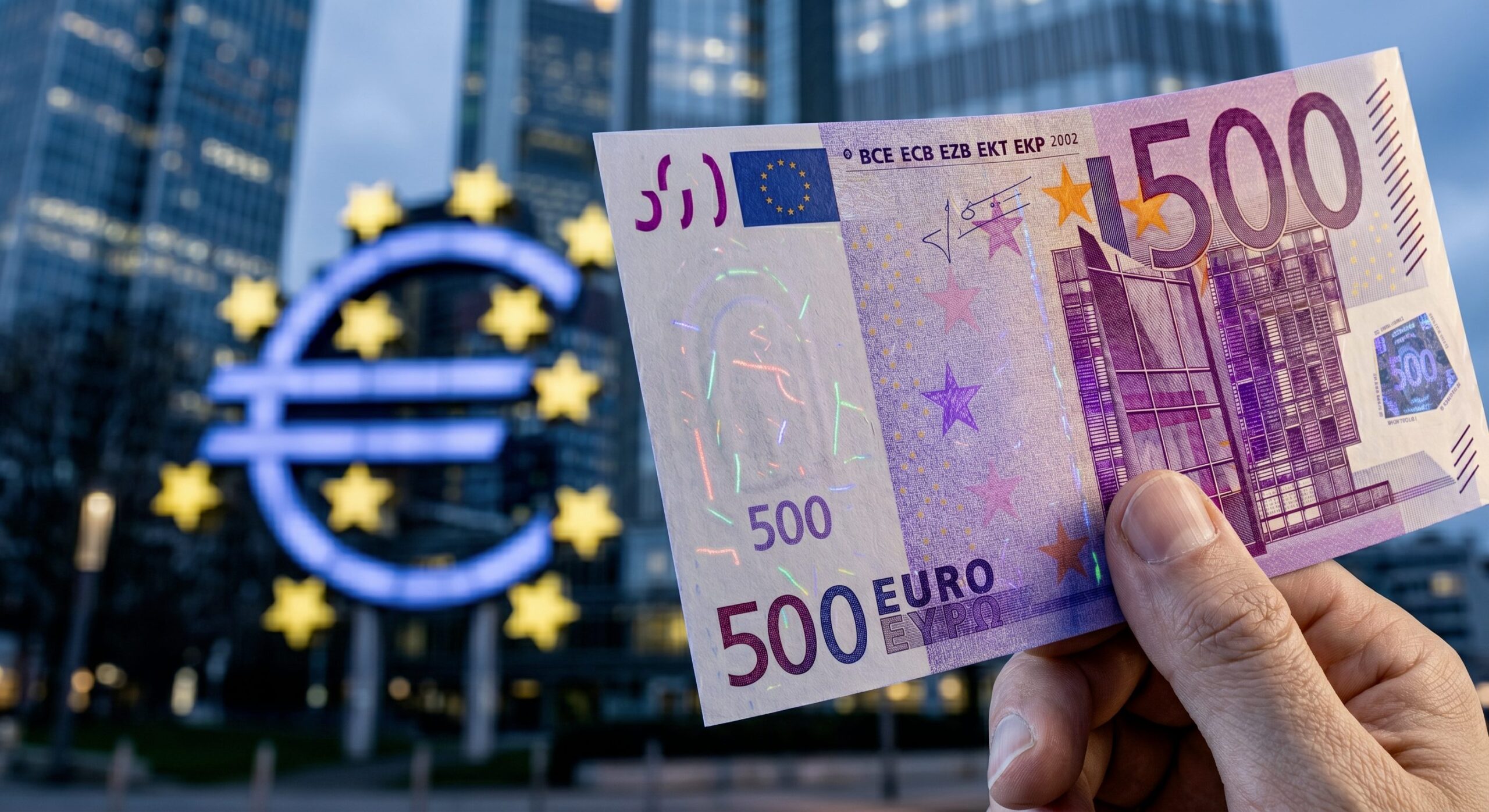
In the last few hours several reports have been circulating according to which the European Central Bank would have decided to withdraw 500 euro banknotes. In reality, things are not exactly like this: the ECB, in fact, did not initiate any proceedings to remove all €500 denominations from the Eurozone, nor has it announced any intention to do so – not in the short term, at least.
The misunderstanding probably arises from the fact that, within the EU, There are actually fewer €500 banknotes in circulation: this is why since 2019 all Eurosystem banks have stopped producing them and distribute them, after the Governing Council of the ECB decided in 2016 do not include the 500 euro denomination in the second series of banknotes (the so-called “Europa” series). The decision was adopted «taking into account the fears that this banknote could facilitate illicit activities», such as money laundering or drug trafficking, given that the high value would allow large sums of money to be transported in a small space.
In any case, as also confirmed by the Bank of Italy, the 500 euro notes are still in circulation they will continue to have legal tender and therefore they can be used normally as has already happened in 2019: «The €500 banknotes, like all other euro banknotes, they will always maintain their value and can be exchanged at the Central Banks of the Eurosystem without time limits».
The €500 banknote is not out of circulation: what to do with the ones in our possession
The decision to stop production of €500 banknotes dates back to May 4, 2016when the Governing Council of the ECB established that the cut from 500 euros would not have been part of the new Europa series. As reported by the Bank of Italythe central banks of the Eurosystem (i.e. of the countries that adopt the euro as their currency) continued to distribute 500 euro notes until January 26, 2019 (except the German Central Bank and the Austrian Central Bank which, to ensure a smooth transition, continued the issuance until 26 April 2019).
For the past 7 years, therefore, 500 euro banknotes have no longer been produced within the Eurozone: the ECB had justified the decision to exclude them from the new series «taking into account the fears that this banknote may facilitate illicit activities». The 500 denomination, the highest among all the main currencies in the world, had in fact long been considered a particularly suitable instrument for money launderingal drug trafficking and to thetax evasionprecisely because it allows you to transport large sums of money in little space.
As highlighted during an interview also by the Prosecutor at the Court of Naples, Nicola Gratteri1 million euros in €500 banknotes weighs approximately 1.2 kg; on the contrary, 1 million dollars in cash can weigh up to 5 times more.
But, so, what to do if we still have 500 euro banknotes? These cuts, in reality, continue to be legal tender and can be used for payments and also as a store of value. This means that, at least for now, the €500 they will retain their value And it will not be necessary to change them.
What will the new design of euro banknotes look like?
While the 500 euro denomination remains in circulation despite no longer being produced, the ECB is also carrying out a process of complete redesign of euros, which will concern all the denominations currently in production – therefore those from 5, 10, 20 and 50 eurosbut also 100 and 200 euros.
As confirmed by the ECB, after an initial phase of public consultation and topic selection, the Governing Council identified in November 2023 two possible themes for the new banknotes: “European culture” And “Rivers and birdsIn the first case, the proposed motifs depict personalities from the European cultural heritage – including Maria Callas (5 euros), Beethoven (10 euros), Marie Curie (20 euros), Cervantes (50 euros), Leonardo da Vinci (100 euros) e Bertha von Suttner (200 euros). In the second case, the proposed motifs mainly represent European natural landscapes with different species of birds, accompanied by headquarters of the EU institutions on the back.
The final decision on the new look of the banknotes is awaited by the end of 2026but it will still be several years before the new euros actually enter circulation.
