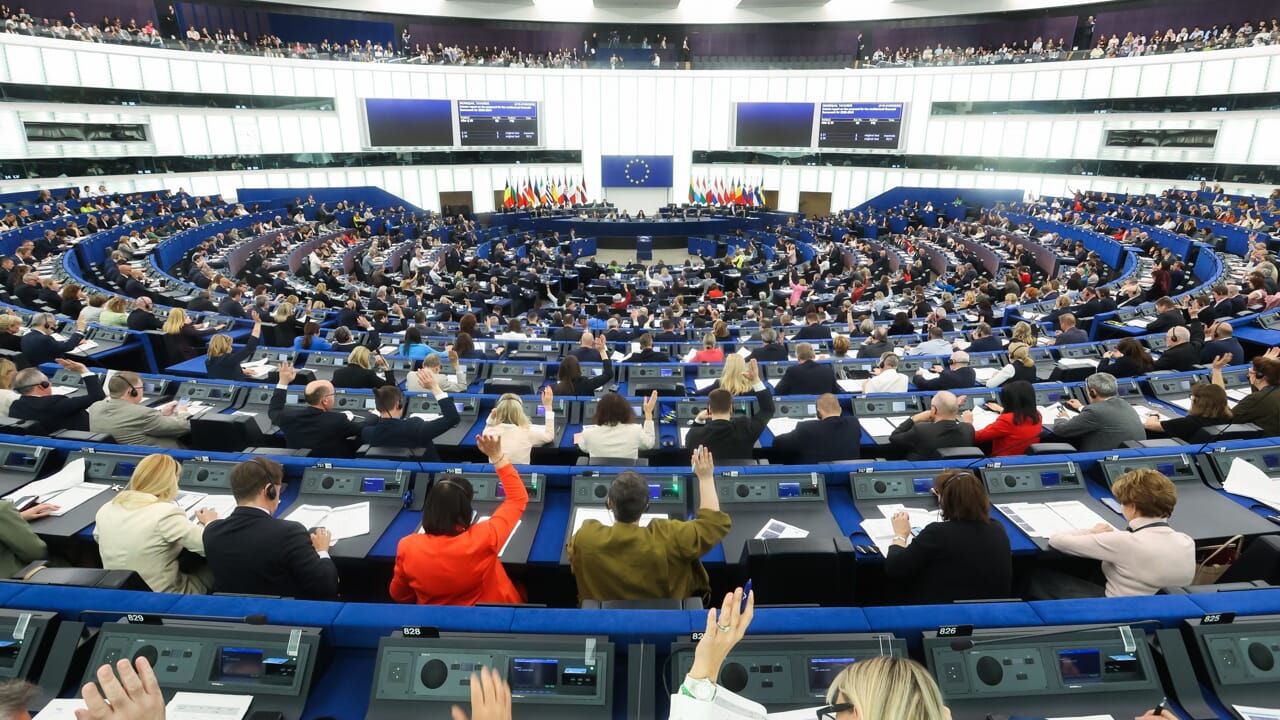
The European Parliament wants to bring the EU’s long-term budget to over 2 trillion euros, a demand that will lead MEPs to clash with the frugal government front in the Council, led by Germany. The Strasbourg Plenary approved its negotiating position on the Multiannual Financial Framework, valid for the period 2028-2034, with 370 votes in favour, 201 against and 84 abstentions.
The central request is a 10 percent increase compared to the European Commission’s proposal, bringing the total to around 2,014 billion euros in current prices, equivalent to 1.27 percent of the EU’s gross national income.
To this ceiling is added separately the repayment of the debt contracted with the post-pandemic recovery fund, the so-called NextGenerationEu, which Parliament requests be accounted for outside the financial framework ceilings. A request that has already seen opposition from Berlin. A large increase “does not fit the big picture” at a time when capitals are being asked to tighten their belts, German Chancellor Friedrich Merz said last week.
Among the priorities highlighted by the Chamber: defence, competitiveness, territorial cohesion and agriculture. On the revenue front, MEPs say that the approval of the budget is linked to the introduction of new Union own resources, believed to be capable of generating at least 60 billion euros per year.
“The European Parliament defines the level of ambition and timing of the new budget. We have adopted a strong position, balancing new and traditional priorities with a moderate increase of 10 percent. We invite the European Council to step forward, follow up on our proposals and agree on a solid and timely budget. We are ready to engage in negotiations”, said co-rapporteur Siegfried Mureşan, Romanian People’s Party.
The new budget
The multiannual financial framework is the instrument with which the European Union plans its expenditure over a seven-year horizon. It sets commitment and payment ceilings for each major expenditure item, essentially defining how much each community policy can receive in the period considered. The framework in force, relating to the period 2021-2027, has been put to the test by major crises. Post-pandemic inflation, the war in Ukraine and migratory pressures have eroded the real value of available resources, forcing institutions to make extraordinary use of the flexibility tools provided by the regulation.
And to deal with the crisis triggered by the pandemic, EU governments have approved NextGenerationEu, the 750 billion euro instrument launched in 2020 to deal with the economic consequences of the coronavirus: around 390 billion in non-repayable grants and around 360 billion in loans to member states. The loan money was taken on the market, and part of their repayment falls on the 2028-2034 period, taking resources away from ordinary programs.
10 percent more
The European Commission, in July 2025, presented a proposal that appeared ambitious in face value: over 2 trillion euros. In reality, at constant 2025 prices, the total fell to around 1,763 billion, with a real increase for EU programs of less than a tenth of a percentage point of gross national income. For Parliament this is de facto “a budget freeze in real terms”.
The parliamentary position brings the total to 2,014 billion euros in current prices, equal to 1,789 billion in 2025 prices. The 10 percent increase compared to the Commission’s proposal corresponds to approximately 197 billion more. Parliament requests that this figure be distributed in a balanced way between the three large blocks of operational spending: social and cohesion policies, competitiveness and security policies and external action.
Parliament also calls for NextGenerationEu’s debt repayment, amounting to 0.11 percent of gross national income, to be accounted for separately.
The EU budget is financed today through three main channels: a share of the customs duties collected by member states on imports from third countries, a percentage of the national value added tax, and a proportional contribution to the gross national income by each country, which today covers around 70 percent of total revenue. And this is why governments are against any increase.
But in order not to weigh too heavily on government coffers, Parliament also calls for the introduction of new “own resources”: revenues that flow directly to the European budget, generated by levies on activities with an intrinsically cross-border dimension, such as large digital platforms, online gambling, carbon-intensive imports or capital gains from crypto-assets. Together, according to the House’s calculations, these sources should generate at least €60 billion a year. Parliament considers them a non-negotiable condition: without agreement on new revenues, MPs will oppose any agreement on the budget.
Cohesion and agriculture
Another heated political confrontation will take place around the Common Agricultural Policy (CAP) and cohesion policy. The Commission has proposed merging them into a single fund and assigning them on the basis of national plans agreed with governments, thus removing decision-making power from local institutions, within a new instrument called “National and regional partnership plans”. Parliament rejects this approach, calling it a de facto “renationalisation” of EU policies.
“The common agricultural policy, the cohesion funds, Horizon Europe, Erasmus+ are not legacies of the past, but the foundation of European solidarity and the engines of our future. Ambition without resources is empty, which is why we have adopted a strong position on the next budget, balancing new and traditional priorities with a moderate increase and introducing new own resources”, said the Portuguese socialist Carla Tavares, co-rapporteur for the position of the Chamber.
For the CAP, the Strasbourg Chamber asks for an allocation of 433 billion euros at current prices (385 billion at 2025 prices), with an increase of 139 billion compared to the Commission’s proposal. For the structural and cohesion funds the figure is almost 307 billion, of which 248 for the European Regional Development Fund, 47 for the Cohesion Fund and almost 12 for European territorial cooperation (Interreg, the program that finances cross-border projects between regions of different states). For the European Social Fund, absent as an independent item in the Commission’s proposal, Parliament is asking for 124 billion, restoring an instrument designed for employment, training and social inclusion.
Defense and competitiveness
For the first time explicitly, defense is included among the structural priorities of the EU budget. It is not a question of directly financing national armies, which the European Treaties do not allow, but of supporting the industrial and technological base of defence, military mobility, dual-use civil and military technologies, and crisis preparedness. Parliament calls for “clearly identifiable appropriations” for defence, with eligibility criteria consistent with European added value and interoperability between national systems.
At the center of the new spending architecture is the European Competitiveness Fund, an instrument which in the Commission’s proposal concentrates resources for research, innovation, green and digital transition, infrastructure, health and culture. Parliament is asking for a further allocation: 264 billion euros at current prices versus the 234 proposed by the Commission. Within this figure, funds are explicitly “reserved” for Horizon Europe (the research and innovation program, increased to 200 billion), for the European mechanism for civil protection and response to health crises, for Erasmus+ (47 billion) and for AgoraEU, the new program dedicated to culture, media and democracy.
Transparency and control
Alongside the numbers, Parliament has made a series of institutional requests regarding the way in which the budget should be managed and controlled. Strasbourg denounces a tendency of the Commission to shift public policy choices from basic regulations (adopted with the ordinary legislative procedure, which includes Parliament) to its own annual work programmes, removed from the parliamentary co-decision maker. This practice, the deputies warn, “weakens democratic responsibility and marginalizes the role of Parliament in political decisions”.
A reduction in the threshold within which the Commission and the Council can modify program allocations without parliamentary approval is then requested: from the 20 percent proposed by the Commission to 5 percent.
Finally, Parliament reaffirms that respect for the rule of law remains a necessary condition for accessing EU funds, calling for a unitary and coherent framework for all conditionality instruments, and insisting that the final beneficiaries, businesses, local authorities, civil society organizations, are not penalized for violations committed by their respective national governments.
