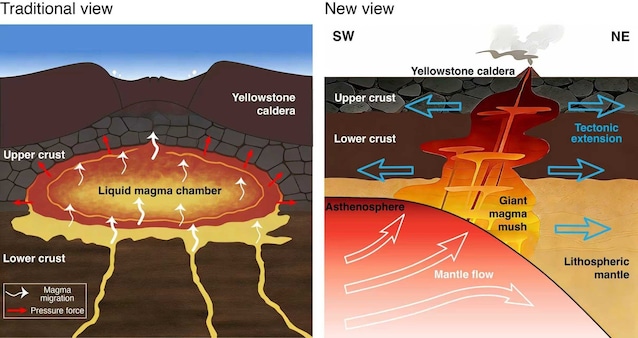
A team of Chinese and US researchers has explained it comprehensively for the first time the origin and feeding of the magmatic system under the Yellowstone volcano calderain Wyoming (United States), one of the most dangerous active volcanoes in the world. The study, published in the journal Scienceshows how what fuels the magmatic system is not just a column of magma coming from the mantle as was believed, but above all the movement of lithospheric plates which facilitates the ascent of the magma upwards along an inclined path. This involves the presence under the caldera of a complex power network and constantly evolving and not of a single magma chamber. The study also highlights how the magma is too little molten to determine an eruption in the short term.
What the magma system of the Yellowstone volcano is like
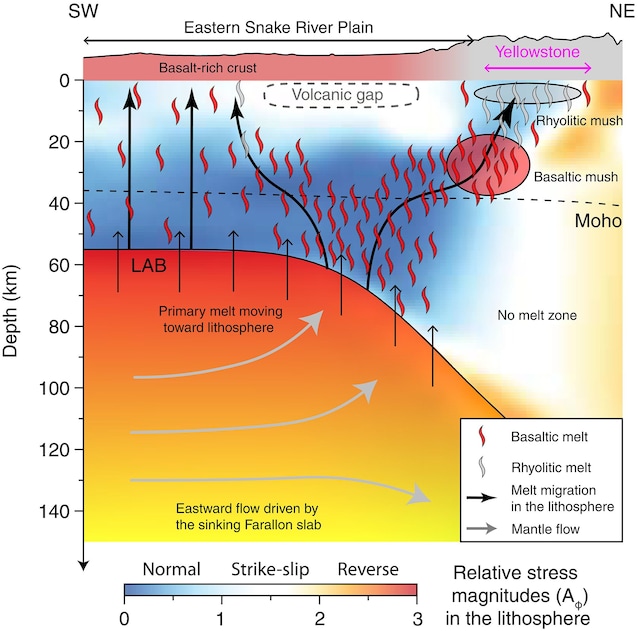
The Yellowstone volcano is continuously monitored and the subject of multiple researches, since it has caused in the past very violent eruptions. Recent studies have located the caldera underneath seven magma reservoirs at depths included between 4 and 47 kmcontaining approx 400km3 of magma. Until now it had been assumed that the main source of this magma was the rise of a vertical column of hot material from the mantle linked to the presence of a hot spot, or hot spots. Now the new study provides evidence that the feeding mechanism is much more complex. To understand this better, researchers developed a three-dimensional model which integrates geological, geophysical and geochemical data to simulate the structure of the magma system beneath the caldera. The simulations have shown that it is mainly determined by tectonic forces. In particular, it is the movement of the North American plate above the hot spot it originates areas of weakness through which magma can easily rise. The result is the formation of a duct network also inclined which add to the vertical flow of the hot spot. The complexity of these mechanisms is the basis of migration of volcanic activity of Yellowstone which over time, with the movement of the North American plate towards the southwest, moves towards the northeast.
What are the implications of the discovery
The tectonic component, and therefore the complex geometry of the system, favors a non-regular accumulation of pressure which explains why Yellowstone periodically gives rise to explosive eruptions, sometimes destructive. The study has verified that, contrary to what one might imagine, under Yellowstone there is not a “lake” of magma completely in the molten state, but a only partially fluid materialrich in solid crystals. The current percentage of molten magma it is not enough to trigger an eruption in the short term.
Our study provides the first comprehensive explanation of how magma systems beneath supervolcanoes form and evolve
said Liu Lijun, one of the study’s authors.
According to another author, Cao Zebin, the mechanism could apply to other major volcanic systems around the world, including the Toba volcano in Southeast Asia and the Altiplano-Puna volcanic complex in South America. In the future the model could be used for predict volcanic eruptions and reduce associated risks.