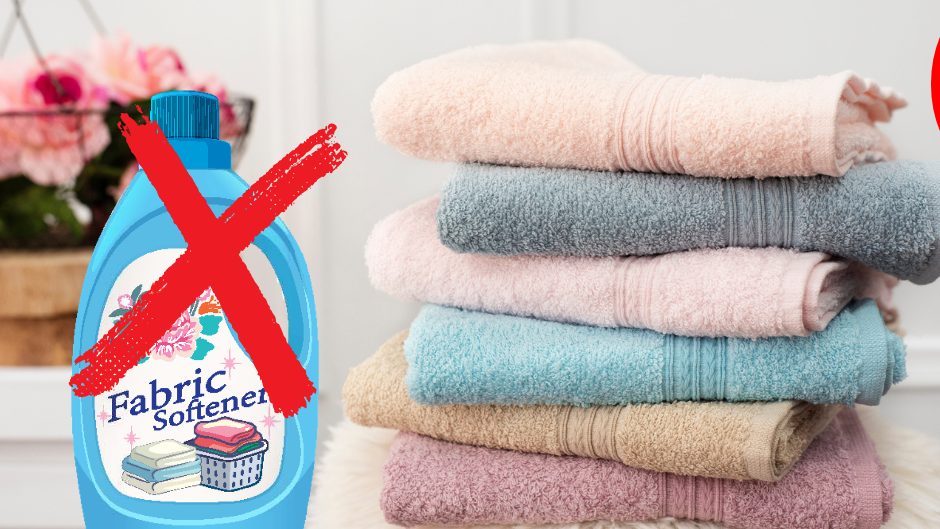
We often hear that fabric softener in the washing machine should be used with caution: in fact, its use is not always recommended. Particular attention should be paid to towels and would be better to avoid it: how Indian the studies published on Journal of Oleo Science And TechConnectit is true that fabric softener makes fabrics softer, but at the same time reduces their ability to absorb waterwhich is exactly there main function of a towel. The reason is chemical: the substances contained in fabric softeners can form a kind of “film water repellent on the individual fibers of the fabrics, making them less wettable: It is not a uniform, continuous layer, but a microscopic coating that attaches to individual fibers. The result? Very quietly the towel will lose its absorbent abilities water effectively, losing, over time, its main function and leaving that annoying sensation of still damp skin.
What is fabric softener used for washing clothes from a chemical point of view?
The fabric softener was created to improve the sensation to the touch of the fabrics. On a chemical level it mainly contains cationic surfactantsmolecules – like those of soap – with a “hydrophilic” part (which loves water) equipped with a positive charge and a long “hydrophobic” tail (which instead repels water).
When clothes are washed, these molecules stick to the fibers (especially at cotton) and are arranged in an orderly manner: the “charged” part binds to the surface of the fabric, while the hydrophobic tails they remain outside. In this way, with the surfactants positioned between one fiber and another, the friction between them decreases and the fabric becomes softer/slippery to the touch: it’s as if the surfactant molecules acted as “molecular lubricant” between one fabric fiber and another and also interfere with the natural bonds that cotton fibers form between each other, making them flow more freely. Precisely because the hydrophobic tails of the surfactants “point” to the outside of the fibers, even the fabric surface becomes at the same time more hydrophobic. Simply put: less capable of absorbing water. For these reasons, the fabric, after several washes in the washing machine with the addition of softener, will be smoother to the touch and more comfortable, but less effective at absorbing water.
Because it is not recommended on towels
This is where the main function of the towel comes into play, i.e absorb water quickly: the continuous use of fabric softener, over time, it inevitably compromises this ability. Experimental studies, including one published in Journal of Oleo Sciencedemonstrate that the water-absorbent capacity of fabrics, particularly cotton, decreases significantly after repeated use of fabric softener in the washing machine: the more surfactant molecules accumulate in the fabric, the lower the towel’s ability to absorb water becomes.
Little by little, a real hydrophobic surface forms which hinders the penetration of water into the fibers of the towel. If we then try to dry ourselves after a shower, not only is the water not adequately “subtracted” from our skin, leaving us a little clammy, but we will find many droplets on the surface of the towel and not adequately “trapped” (absorbed) within it. In short, an unpleasant situation incomplete drying: terrible!
Obviously, the fabric softener It’s not “wrong” at allbut on towels it becomes counterproductive. It is clear that if it is used by mistake once you don’t have to throw away the towel. First of all – like real scientists – a wettability test! After the shower we try to dry ourselves and observe whether our bath towel or our bathrobe still perform their function: if they dry as before, no problem, otherwise we should use the spare towel that we will have prepared before starting the test. Let’s remember that it is not a single use of fabric softener which definitively compromises its function, but repeated use of fabric softener on the same towel.
