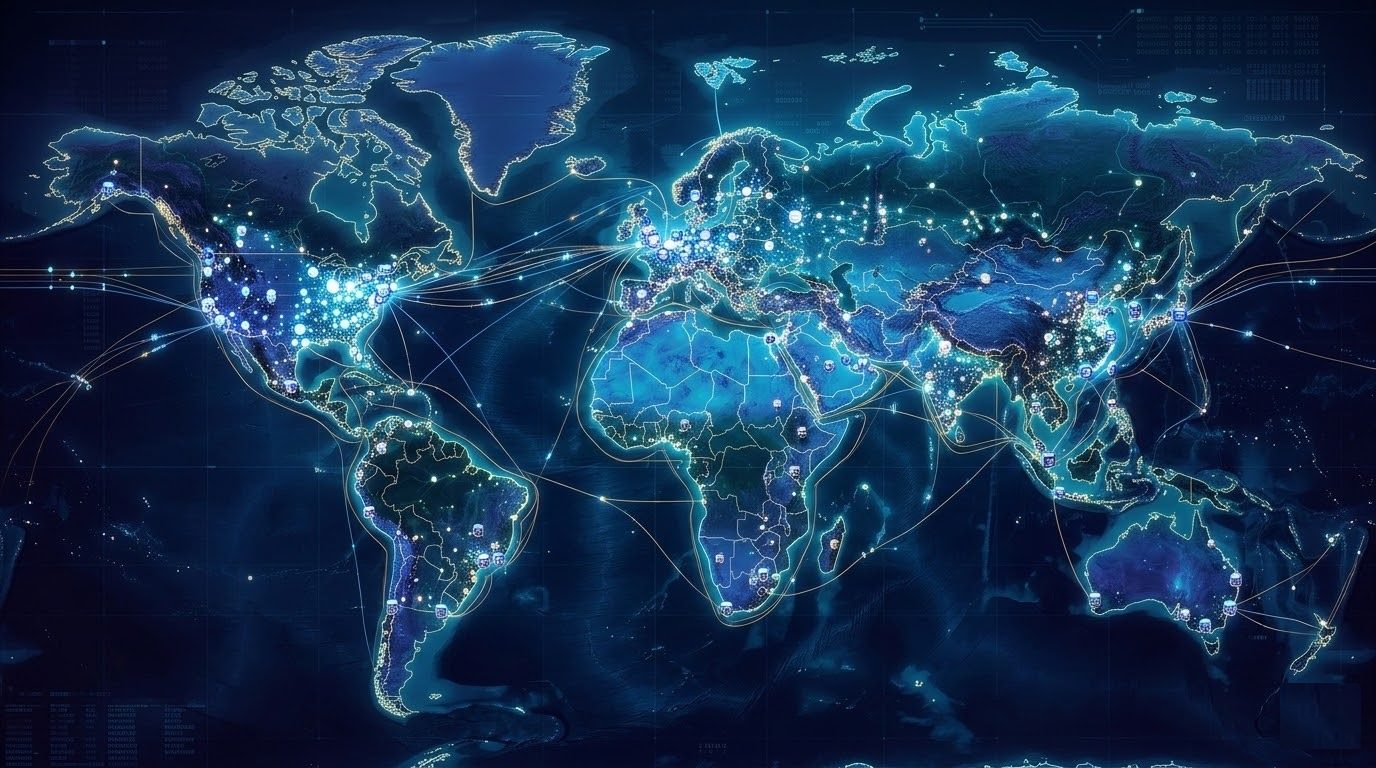
Every online search made, every streaming video watched, every message sent passes through physical infrastructure: i data centers. With this term we indicate large technological structures that host servers (i.e. computers designed to provide services to other computers across a network) as well as data storage systems, network equipment and complex cooling systems. In other words, it is the buildings that make the Internet and digital services that we all use every day possible. Looking at the updated numbers at November 2025 published by Statesmana very clear geography of this global infrastructure emerges: the United States clearly dominate global distribution, while Europe represents one of the most important hubs outside of North America. Even in Italy the presence of these structures is significant, although it is not yet comparable to that of the main global hubs.
Data centers are at the heart of the digital economy: they store, process and distribute enormous amounts of information that power services such as cloud computing and increasingly also applications related to artificial intelligence. The geographical distribution of these structures is not random: it depends on the presence of large technology companies, the quality of energy and network infrastructures and, in some cases, also on data management regulations. By observing the countries with the greatest number of data centers we can therefore read a real “map” of the most powerful and influential geographical areas from a digital point of view.
The top 20 countries with the highest concentration of data centers
- United States of America: 4165.
- United Kingdom: 499.
- Germany: 487.
- China: 381.
- France: 321.
- Canada: 293.
- Australia: 274.
- India: 271.
- Japan: 242.
- Italy: 209.
- Brazil: 195.
- Netherlands: 194.
- Spain: 194.
- Indonesia: 182.
- Russia: 180.
- Ireland: 139.
- Swiss: 117.
- Malaysia: 114.
- Sweden: 103.
- Hong Kong: 95.
The geography of data centers in the world
If we look at the global numbers, a dominant fact immediately emerges: the United States concentrate around 38% of the planet’s data centerswith over 4000 operational facilities. This leadership is closely linked to the strength of the US technology industry. Giants such as Amazon, Google and Microsoft manage enormous cloud infrastructures that require an extensive network of data processing centers distributed throughout the country. Growth does not only concern traditional digital services. The expansion of AI applications is driving new infrastructure investments on an enormous scale.
Also Europe represents an important hub of this global infrastructure. On the continent there are approximately 3500 data centers distributed among different countries. The United Kingdom, Germany and France lead the European ranking with over 300 facilities each. This diffusion is influenced by various factors: economic density, the quality of internet networks and also the European regulatory framework. An important element is represented by GDPRthe General Data Protection Regulation. This is the famous European Union regulation that establishes very strict rules on the processing of citizens’ personal information. Precisely these rules have encouraged the construction of data centers within European territory, given that many companies prefer to store data directly in the EU to more easily comply with community legislation.
The global distribution also shows how Asia is progressively increasing its weight in this sector, with China, India, Japan and several South-East Asian countries they are investing in new infrastructures, supported by fast-growing digital markets and extremely connected populations.
