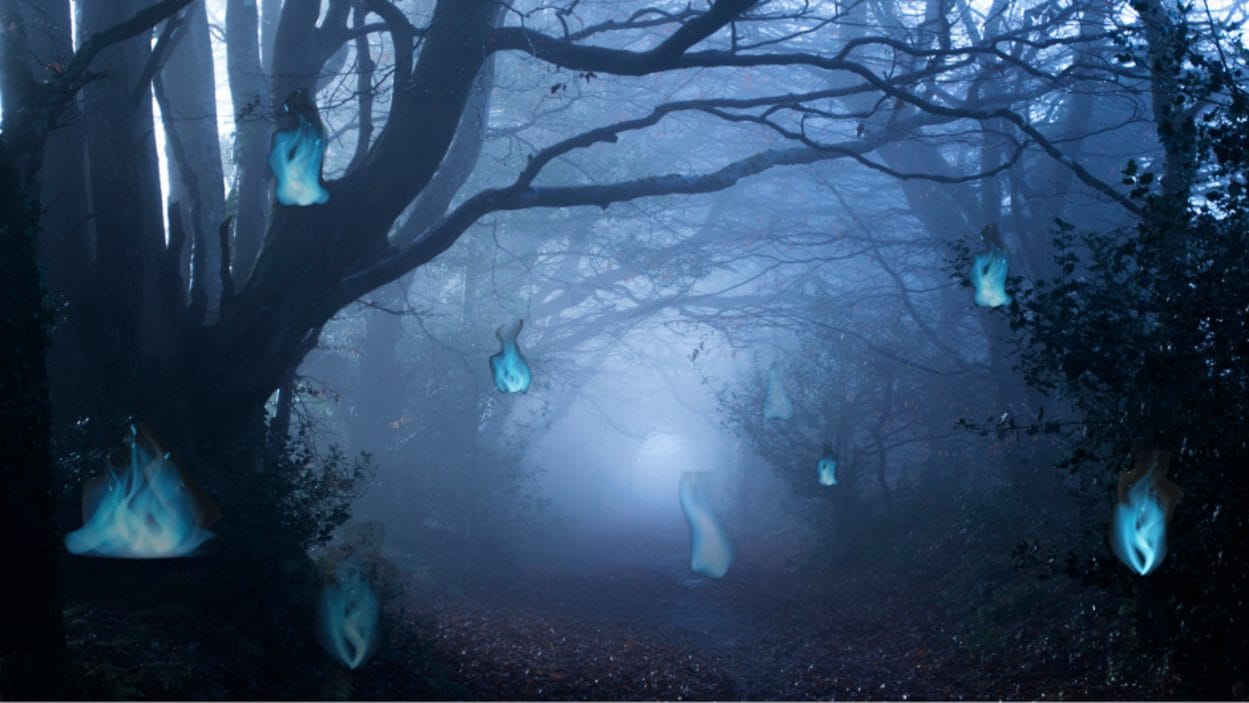
THE will-o’-the-wispsfeeble blue flames that dance in the dark without burning anything, without making noise, without heat, surrounded by the mists of the swamp or in a gloomy cemetery in the countryside, are no longer a mystery. They are not the souls of the dead rising to the surface, nor bad omens from the afterlife. A study published a few months ago in the journal Proceedings of the National Academy of Sciences (PNAS) discovered that it may have been those who lit these flames during the night microlightningarising from clash of tiny bubbles of methane and water with an opposite electrical charge. The spark that is generated just turn on the gas and to give life to those little blue flames that for centuries have tormented the journey of solitary travelers in remote lands and fueled legends since the Middle Ages. Scientists already knew it was the combustion of methane produced by the degradation of organic material accumulated in swamps, but this study by Dr. Zare finally answers the only question that has remained unanswered for centuries: “what turns him on?”.
Will-o’-the-wisps and the problem of ignition
From the Paradise lost of Milton to Newton’s writings on optics, fromHenry IV from Shakespeare to Alessandro Volta, who had understood the importance of electricity in the phenomenon, will-o’-the-wisps have fascinated philosophers and writers as well as scientists. Described as small flames about 15cm high, they appeared a couple of meters from the ground and they could last up to a quarter of an hour.
That the will-o’-the-wisps, oh ignes fatui (from the Latin, foolish fires that do no harm), were not souls of the dead or deceiving spirits, even the first scientists who dealt with the matter knew this. It was immediately hypothesized that these faint blue flames were the result of combustion of methane. All the organic material that accumulates at the bottom of the swamps (leaves, roots, animal remains) is metabolized and decomposed by anaerobic bacteria, i.e. bacteria that do not need oxygen.
The resulting methane rises to the surface and can “ignite” giving rise to the infamous blue flames. The main problem was: What “turns it on”? Methane can also oxidize (and therefore “ignite”) spontaneously, but the activation energy for this spontaneous oxidation is extremely high (over 100 kcal/mol) e impossible to reach under the normal environmental conditions of a swamp and without a sufficient heat source.
The discovery of microlightning
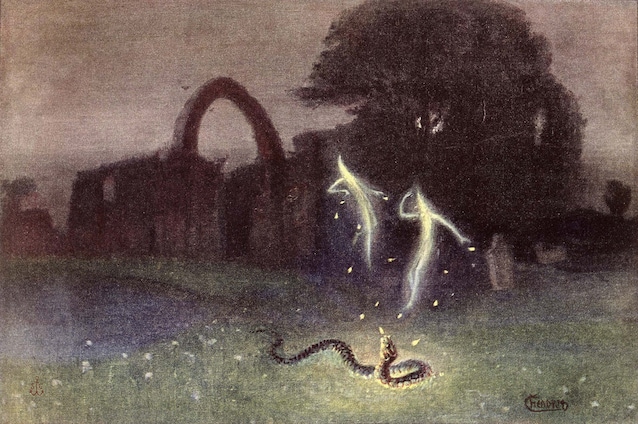
In 1776, Alessandro Volta hypothesized that it was theinteraction between electricity and flammable air to generate the will-o’-the-wisps, going very close to the mechanism proposed in the article published a few months ago on PNAS.
The research by Zare and colleagues tries to explain what happens at a microscopic level in the small gas bubbles that rise from the bottom of the swamps. In practice the researchers fired gaseous microbubbles of methane through the water, simulating the methane bubbles that pass through the water in swamps. This movement leads to the separation of electrical charges on the surface of the bubbles.
The curvature of the bubbles at the gas-liquid interface generates strong localized electric fields and different sized bubbles load with opposite signs: the smaller ones are negatively charged, the larger ones positively. When two bubbles with opposite charges get close enough, the electric field in the small space between them reaches enough energy to “break” the surrounding gas, generating a spontaneous electrical discharge: The microlightningcaptured by researchers on video using high-speed cameras.
Although it is a tiny discharge, the energy is enough to trigger the non-thermal oxidation of methane: a combustion sui generiswhich occurs very slowly and at very low temperatures (in fact it does not produce much heat). Using a photon counter and a spectrometer, the researchers detected ultraviolet light and fluorescence consistent with the presence of formaldehyde, a known product of methane combustion.
An interesting detail is that, in a previous study, researchers had found that microlightning also forms when water is injected just airdemonstrating that the phenomenon is not linked to the flammability of the gas, but is intrinsic to it separation of electrical charges at the interface between gas and liquid. The fact that methane is flammable and “lights up” amplifies and makes the effect more visible, but is not the primary cause of electrical discharges.
What did previous theories say?
One of the most cited theories as an explanation for the trigger concerns the phosphinea toxic gas also produced by organic decomposition, the oxidation of which could have provided the spark for the oxidation of methane. Theory to be discarded, because phosphine, as documented by the experiments of the Italian chemists Luigi Garlaschelli and Paolo Boschetti, produces green flames and not bluish like those of the will-o’-the-wisps.
Another theory suggests that in the past, travelers saw the will-o’-the-wisps because they themselves lanterns they provided the necessary spark. But it was not strong enough to convince the scientific community, even if it would explain why today the phenomenon would have “disappeared”: simply because we no longer walk around with torches and lanterns in the middle of nowhere.
Because today we almost don’t see them anymore
Since the first recorded description, around 1340, historical reports of will-o’-the-wisps have been numerous and widespread throughout Europe and North America. Today they have practically disappeared and the fault seems to lie with progresswhich would have deprived us of night walks in fields haunted by ghosts and illuminated by ghostly blue flames.
In addition to the advent of artificial lighting, with the consequent abandonment of lanterns to light us up during our nocturnal walks in the swamp, the reclamations of marshy areas and theexpansion of urban and agricultural areashave drastically reduced the areas rich in organic material that rots and produces methane gas. No methane bubbles, no microlightning. No microlightning, no mysterious and fascinating blue flames dancing in the dark.
