The European Parliament will meet in plenary in Strasbourg next week, but two trilogues will catalyze attention and provoke the greatest clash between the groups in the Chamber: the one on the trade agreement with the United States and the one on the repatriation directive.
Use and tariffs
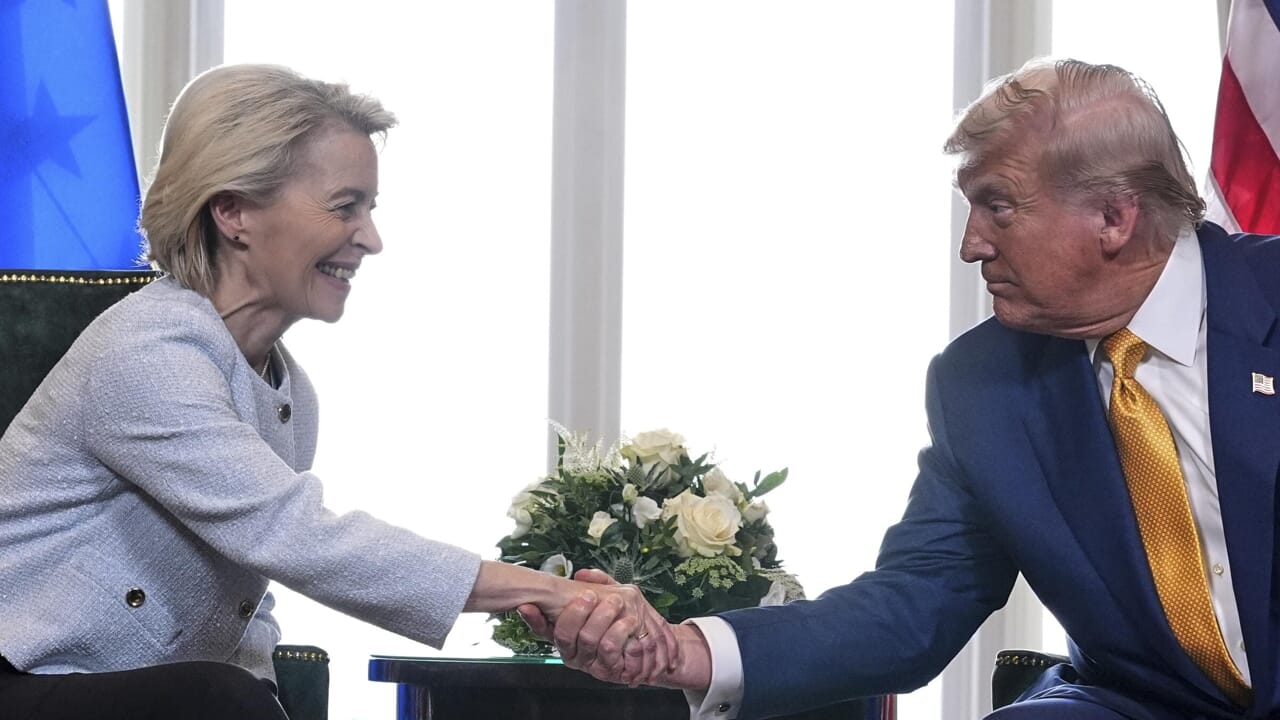
The first will be held on the 19th, with Europe finding itself under an ultimatum from Donald Trump. The US president said that if “by the 250th birthday of the USA”, on July 4, Europe does not respect the agreement, “tariffs will immediately skyrocket to much higher levels” than the 15 percent envisaged by the agreement. At stake is the pact signed last July in Turnberry, Scotland, by Commission President Ursula von der Leyen.
Since then an eternity seems to have passed and tensions with Washington have become increasingly stronger, starting from the threats of annexation of Greenland up to the outbreak of the war in Iran, which also had serious repercussions on the Old Continent.
15% duties, billions in purchases of LNG and US weapons: what is in the agreement between the EU and Trump
Safeguard clauses
For this reason, the deputies are insisting on the inclusion of the so-called “sunrise” clause, which would make the application of the agreement dependent on the reduction by the United States of duties on steel and aluminum products.
In early April, the Trump administration changed tariffs on these products, setting rates of between 10 and 50 percent of their value, depending on the metal content. The European Commission found that almost half of EU exports containing steel and aluminum risk being subject to higher US tariffs under the new regime.
Another point of contention is the request from MEPs to include a “sunset” clause, under which the agreement would expire within two years. However, these are clauses that are not liked not only by the US, but not even by the EPP, which wants rapid approval of the text.
“The protection of European industries remains crucial, particularly in sensitive sectors such as steel and aluminium. At the same time, the suspension mechanism and related measures must be designed in a proportionate way. We need pragmatic solutions that effectively address the concerns of our industries, while avoiding unnecessary protectionism or overly rigid mechanisms that could delay the agreement,” explained Željana Zovko, MEP and EPP spokesperson for trade relations with the United States.
But the other groups, not just those of the centre-left, want the harder line. The head of the Parliament delegation in negotiations with EU governments, the German socialist Bernd Lange, has the difficult task of finding mediation.
Repatriations
However, it will be simpler to find an agreement on the regulation on repatriations, the last pillar of the Pact on Migration and Asylum. The text is supported by the so-called Venezuelan majority, which unites the People’s Party, the Conservatives of the Brothers of Italy, the Patriots for Europe of Matteo Salvini’s League and also the Europe of the sovereign nations of the German AfD and now of Roberto Vannacci.
Why it will be easier to expel migrants in Europe: the ‘Albania model’ passes
The new regulation will make it possible to expel migrant people more easily, also sending them to third countries, even if they do not have a direct link with those nations. This will open the way for EU governments to the possibility of establishing so-called repatriation centres, following the model implemented by Prime Minister Giorgia Meloni with the pact with Albania.
Here are all the topics under discussion in the Plenary
Foreign investments, tightening on strategic sectors
On Tuesday, the House votes definitively on the reform of the EU regulation on the control of foreign direct investments in sectors considered strategic: defense, semiconductors, artificial intelligence, critical raw materials and financial services. The objective is to fill the gaps in the regulation in force since 2020, which left Member States the right to carry out checks, without a uniform obligation. With the new rules, the screening procedure becomes mandatory for all EU countries. The focus is not only on investments coming directly from third countries: those carried out within the EU can also be monitored, when the investor is ultimately attributable to non-European individuals or entities.
The EU’s crackdown on foreign investment in strategic sectors
Steel, new measures against dumping from overproduction
Parliament debates on Monday and votes on Tuesday the update of safeguard measures to protect the European steel industry from global overproduction, particularly from China. The current measures expire on June 30 and the vote serves to replace them.
The new regime provides for annual duty-free import quotas of up to approximately 18.3 million tonnes: above that threshold a 50% duty applies. To close a frequent loophole, the “melting and casting principle” is introduced: the origin of the steel will be determined by the country in which the metal was initially melted and cast, not by the one in which it underwent minor processing. In this way the aim is to prevent non-European producers from circumventing duties by transiting steel through third countries with cosmetic transformations.
Doubled duties and reduced free trade quotas: Europe protects its steel
Victims of crime
Every year around 75 million Europeans, 15% of the population, suffer a crime. On Thursday, Parliament votes definitively on the updated directive on victims’ rights.
The new rules update the framework in force since 2012 on information, support and protection of victims. Among the main innovations, the establishment of a dedicated European telephone number, the improvement of access to legal assistance and compensation, and the possibility of reporting crimes online. Member States will also need to strengthen specialized support for victims of sexual violence and children. The directive aims to make protection more homogeneous across the EU, bridging the differences between national systems which often leave victims without adequate assistance.
Middle East
On Tuesday afternoon, the Chamber questions the EU High Representative for Foreign Policy, Kaja Kallas, on the management of the crises in the Middle East. There are three dossiers on the table: Iran, Israel and Syria.
On the Iranian front, the EU supports de-escalation and is considering expanding the mandate of the Aspides naval operation, so far engaged in the Red Sea, to extend its action to freedom of navigation in the Strait of Hormuz. As for Israel, European ministers have agreed on sanctions against settlers involved in violence against Palestinians in the West Bank, but for MEPs this is not enough. On Syria, however, the EU is working on normalizing relations with Damascus and supporting the transition authorities in the process of reform and reconstruction.
European Order of Merit
On Tuesday, in the hemicycle of the Strasbourg Parliament, thirteen of the first twenty awarded the European Order of Merit will receive the recognition from the hands of President Metsola. It is the first honor established by an EU institution, created last year on the occasion of the 75th anniversary of the Schuman Declaration to celebrate those who have contributed significantly to European integration, democracy and the fundamental values of the Union.
Among those present, the most important names: the former German Chancellor Angela Merkel and the former Polish President Lech Wałęsa, both appointed distinguished members, the highest level of the Order. The ceremony will also be attended by former Austrian Chancellor Wolfgang Schüssel, former President of the European Central Bank Jean-Claude Trichet, Cardinal Pietro Parolin, Vatican Secretary of State, Moldovan President Maia Sandu and former EU High Representative Javier Solana.
Fertilizers
Europe’s dependence on fertilizer imports has long been a weak point in the agricultural supply chain, and the Middle Eastern crisis has made it even more evident. On Tuesday, the Commission presents its action plan on the sector to the Plenary, followed by a debate with MEPs.
The numbers explain the urgency: 30% of nitrogen fertilizers and 70% of phosphate fertilizers used in the EU come from abroad, while European production depends to a large extent on natural gas. The closure of the Strait of Hormuz has pushed up prices of both, putting pressure on agricultural costs. The plan should focus on three axes: reducing dependence on imports, strengthening internal production and encouraging the use of alternative fertilizers, such as those derived from organic waste or circular industrial processes. The Agriculture and Rural Development Commission had already addressed the issue in April, reporting the risks for the sector. Tuesday’s debate does not include the adoption of a resolution.
Care work
Care work is still carried out to a large extent by women: according to the European Institute for Gender Equality, 56% of women with children under 12 dedicate at least five hours a day to caring for their children, compared to 26% of men. On Wednesday, Parliament debates and on Thursday votes on a resolution to address this imbalance.
The text, drawn up by the Employment and Gender Equality commissions, asks Member States to guarantee a balanced participation of women and men in all forms of assistance, formal and informal. MEPs should also demand that informal carers (typically an unpaid family member) be included in pension and social security systems, thus filling a gap that particularly penalizes older women. It also calls for campaigns to encourage men to take on a fair share of caring responsibilities.
Deaths at work
In the EU, in 2023 there were 3,298 unrelated deaths and around 2.8 million non-fatal injuries with at least four days of absence. Numbers that push Parliament to act: the debate on Wednesday, the vote on a resolution from the Employment and Social Affairs Committee on Thursday.
MEPs ask to establish 8 August as the European Day in memory of the victims of accidents at work. But the resolution also looks at emerging risks: the Commission is asked to evaluate the dangers to health and safety linked to artificial intelligence and algorithmic management systems, increasingly widespread in the management of workers, and climate risks, such as thermal stress, extreme weather events and air pollution. The most exposed sectors remain construction, transport, manufacturing and agriculture.
Baltic Sea, vote on the fish stocks recovery plan
On Thursday, Parliament votes on the own-initiative report on the multiannual plan for the Baltic Sea. This sea is in critical condition: fish stocks have collapsed to historically low levels and current fishing practices remain unsustainable. The report calls for giving priority to low-impact fisheries and setting total allowable catches in line with the so-called precautionary approach, which requires remaining well below risk levels for ecosystems before damage becomes irreversible.
It is also called for updating scientific advice methods, adopting a vision that takes into account the entire marine ecosystem rather than individual stocks. In the background, the regulatory fragmentation between EU policies impacting the Baltic, a problem that the report urges to be addressed with greater coherence. According to the proponents, well-calibrated interventions could start a recovery path with positive repercussions on food security, climate resilience and economic stability in the region.
