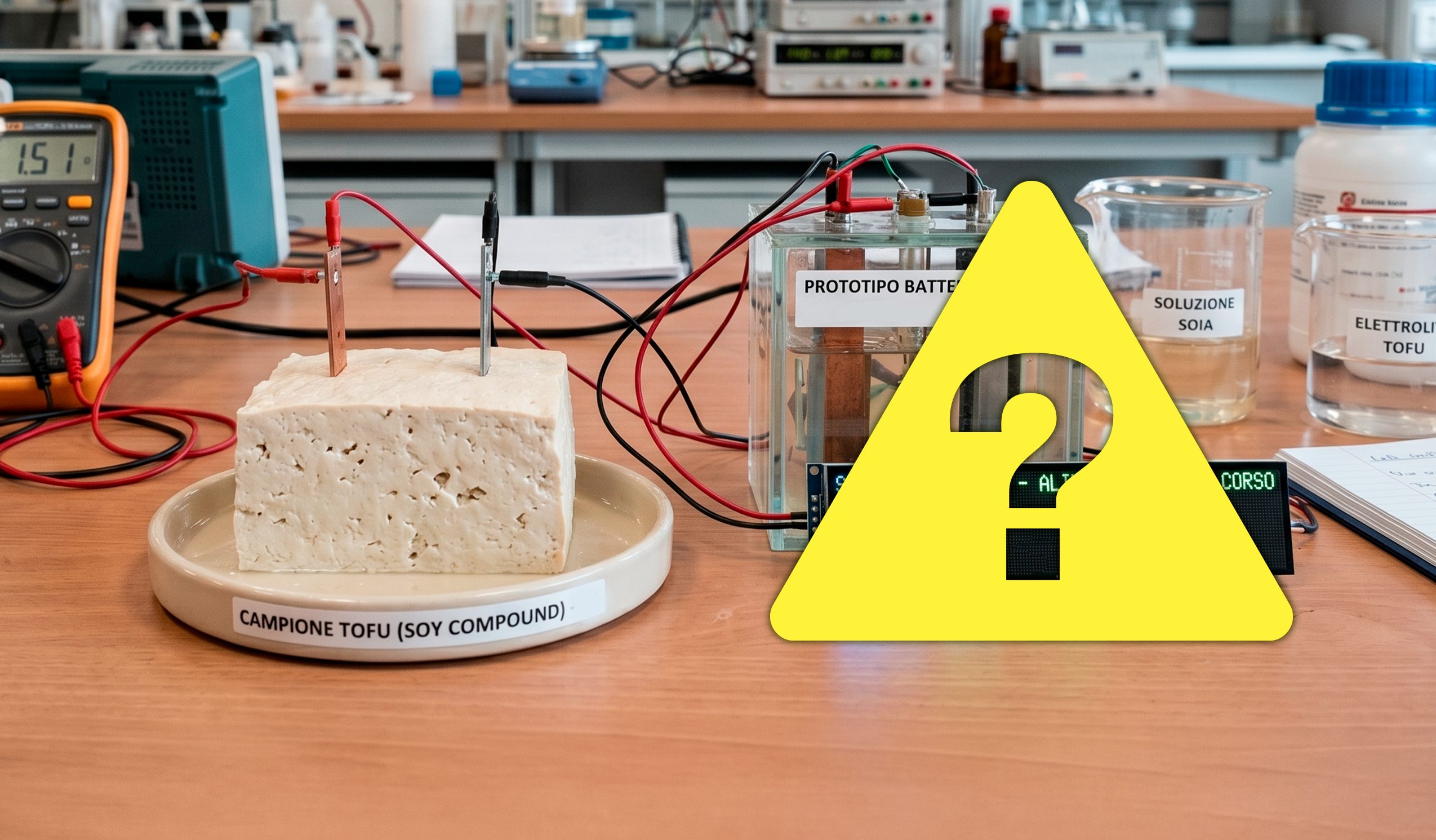
News recently spread of the alleged discovery of one tofu battery which is attributed an autonomy of approximately 300 years. However, it remains legitimate to ask whether this is a real technological innovation or one fake news. In fact, the news finds a concrete feedback – even if you call her tofu battery It’s pretty misleading. A joint research team from the City University of Hong Kong and the Southern University of Science and Technology has in fact developed a battery prototype based on the use of similar compounds to those used in tofu production process. The experimental tests, published on Naturethey highlighted high electrochemical stabilitysuggesting interesting development prospects in the field of sustainable storage systems. The study fits into the context of the energy market’s growing need for identification alternatives technologically valid to traditional ones lithium ion batterieswhich despite being widely spread, present different criticality linked to their limited operational life, their propensity to overheat and the significant environmental impact associated with their life cycle.
How is “tofu battery” made?
The researchers set themselves the goal of do not employ highly polluting substances, commonly present in conventional electrochemical accumulators. With this in mind, they have developed a new typology of electrolytecomponent that allows the transfer of charge between the electrodes, in which traditional acids and bases have been replaced by neutral salts Of magnesium And soccerminerals present in the brine used in the tofu production process. By doing so, it was possible to develop an electrolyte solution a Neutral pH (equal to 7), capable of reducing the corrosive reactions normally induced by heavy metals and minimizing the risk of releasing contaminating substances during the battery operation and disposal phases.
Furthermore, the negative electrode was made of a special alloy based on organic covalent polymers (COP), a composite material that has properties similar to those of plastics with high electrical conductivity, while the positive one (cathode) in Prussian Bluean inorganic compound commonly used as a pigment in paints.
From the tests the results seem promising
Laboratory tests showed that the experimental battery is capable of supporting up to 120 thousand charging cyclesequivalent, in standard operating conditions similar to a daily recharge of a smartphone, to an autonomy of approximately 300 years. This result, in addition to confirming the exceptional stability long-term ensured by operation in neutral electrolytic conditions, is associated with the use of non-toxic liquids and materials that comply with international safety regulations.
Advantages and sustainability: where it can be used
The “tofu battery” has an energy density inferior compared to lithium ion cells. This characteristic, although constituting a possible limit in applications that require high power in small spaces, it is advantageous in stationary contextswhere operational stability and reliability represent priority requirements, as in storage systems for renewable energy or in infrastructures intended to operate continuously for long periods. The project is still in the evolution phase, and the transition from experimental prototype to product intended for large-scale production involves different challengesincluding the optimization of production processes and cost reduction.
