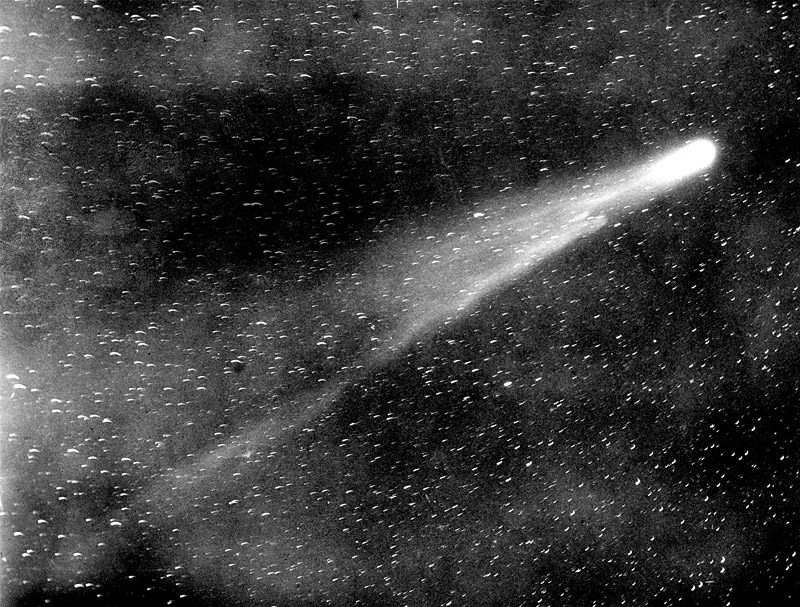
The passage of Halley’s comet of 1910 it was one of the most astronomical events spectacular and discussed of the first part of the twentieth century. The comet in fact passed into the sun 0.15 astronomical units from Earth, that is, approx 22 million kmThe May 20, 1910 thus being extremely bright and visible to the naked eye, including his own queue extended for tens of millions of km. It was also about the first extensively documented return with photographs and studied with instruments spectroscopicthat is, capable of analyzing the chemical composition of the gases in its coma and tail. Precisely these technological advances transformed the spectacular passage of 1910 into a case of collective panic. Astronomers had in fact detected the presence of in the comet’s tail cyanogena toxic gas. Although this gas was present only in negligible tracesthe news, taken from the newspapers of the time with sensationalist tonesraised fears that the Earth might be poisoned by passage through the comet’s tail. The idea of a possible “poisonous tail” triggered the sale of gas masks, “anti-comet pills” and even bottles of pure air, representing one of the first cases of mass hysteria unleashed by the mass media.
Why the passage of 1910 was so important for science
There Halley’s comet had already been known for centuries, but the passage of 1910 occurred in a particular moment in the history of astronomysince new large telescopes, photography and spectroscopy were transforming this discipline from a science of measuring the positions of celestial bodies to a science capable of studying even the physics and chemistry of the latter.
In 1910, in fact, Halley’s comet was observed for the first time with what were the most technologically advanced means of the time. The photographs allowed us to document the shape of the foliage and the tail, while the spectroscopy allowed the identification of some molecules present in cometary gases. It is precisely thanks to these observations that the cyanogena molecule containing carbon and nitrogen. From a scientific point of view, it was valuable information about the chemical composition of the comet that nevertheless came distorted by the media so much so that it became the starting point for one of the most famous “astronomical fears” of history.
Mass hysteria over the comet’s “poisonous tail”.
On February 7, 1910 theYerkes Observatoryin the United States, announced the discovery via spectroscopy cyanogen in the comet’s tail. The problem was not so much the discovery itself, but the way in which it was reported. Although cyanogen is indeed a toxic substance, it was present only in traces in the tail of the comet which by its nature is also extremely rarefiedso much so that the passage of the Earth through it could not have produced any concrete effect on our atmosphere.
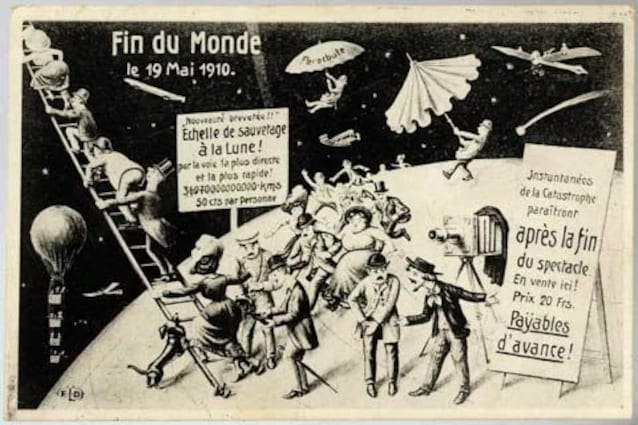
This aspect, however, was overshadowed in favor of one alarmist narrative to which the French astronomer Camille Flammarion also contributed who, albeit with some cautions, contributed to fueling the idea that the gas could enter the Earth’s atmosphere. This “scientific miscommunication”, together with ancient superstitions about comets as bringers of misfortune, resulted in a real wave of collective panic. In fact, they spread to the United States and Europe gas masks, alleged remedies against cometary gases, “anti-comet” pills and other products without any scientific basis.
The passage of the comet and the danger of poisoning pervaded public opinion so much that also eminent intellectuals like Giovanni Pascoli and Leo Tolstoy they dedicated rivers of ink to this celestial event. If Pascoli dedicated the hymn “To Halley’s Comet” to the comet, published in 1910, Leo Tolstoy was decidedly darker in his writings, describing the comet as «an object that was about to capture the Earth, annihilate the world, and destroy all the material consequences of my activity and everyone’s activities».
As expected, the passage was completely harmless: the Earth was not poisoned, there was no catastrophe and the comet offered one instead memorable celestial spectacle. The episode, however, remained in history as one of first great modern examples of bad science journalismshowing how scientific news, if communicated poorly, can turn into collective fear due to a lack of understanding of the science behind it.
What Halley’s Comet is, why it is important and the next meeting in 2061
Halley’s Comet, officially named 1P/Halleyit’s probably the most famous comet in history. The acronym “1P” indicates that it was the first recognized periodic comet as such, i.e. an object that regularly returns to the inner Solar System. Its average orbital period is in fact approximately 76 years oldvarying slightly due to the gravitational influence of the planets. Its orbit is very elongated: at aphelion it reaches beyond the orbit of Neptunewhile at perihelion it enters the internal region of the Solar System. Furthermore, it moves on aretrograde orbitthat is, in the opposite direction to the motion of the planets around the Sun.
The comet’s nucleus is relatively small, with estimates putting the size at approx 15 × 8kmwith a very dark surface and a probably porous structure. When approaching the Sun, intense solar radiation causes sublimate the ice present in the nucleus, releasing gas and dust that form the coma and tail. Part of this debris remains along the comet’s orbit and gives rise to two gods meteor showers most abundant of the year, i.e. the Eta Aquarids in May and Orionids in October.
THE’last step of Halley’s comet dates back to 1986when it was observed by a veritable international fleet of space probes, including the European Giotto mission. The next return is expected in 35 years, in 2061with the comet already on its return trajectory after the transition to aphelion on December 9, 2023.
