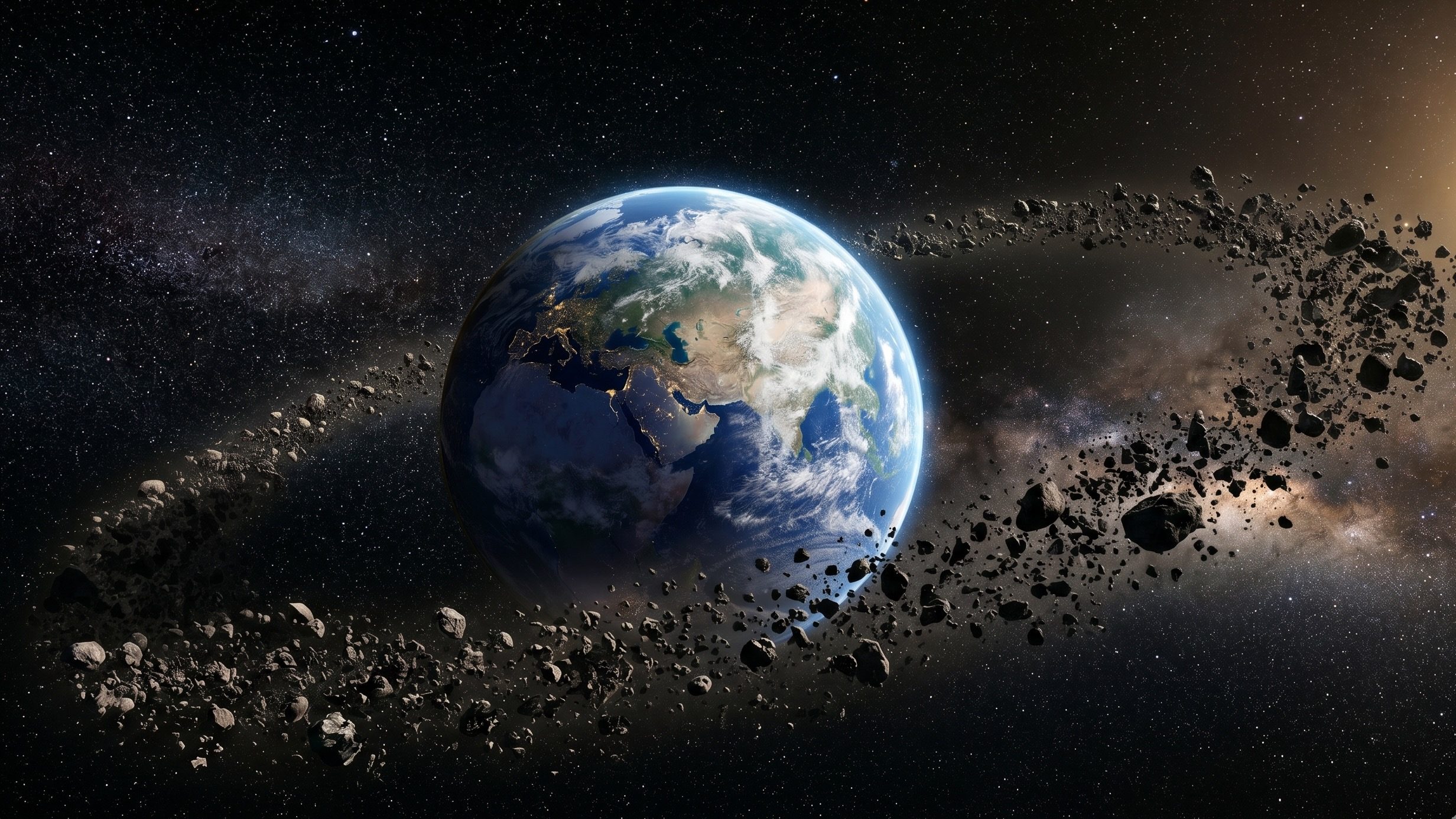
There Moon it is moving away from us at a rate of 3.8 cm per year, but what if instead of moving away fell to Earth? We’ll tell you right now: unless something unimaginable happens, there is no danger that will ever happen. However, investigating these purely hypothetical questions can be very informative, and perhaps even fun. Well, the effect would be catastrophic, although not for the reasons one might think at first glance.
The Moon would begin a journey in an ever-tightening spiral around our planet, headed right towards us. It wouldn’t reach ushowever: having arrived at a certain distance from us, called Roche limitwe would see it disintegrate into one myriad of fragments which would begin to orbit around us forming a ring. A bit like those of Saturn, so to speak, but made of rock instead of ice. But like the rings of the gas giant, our ring would also be an unstable structure: many of those debris would rain down on us, in a very long bombing which would put our survival at serious risk. Here are the main stages of this hypothetical catastrophe.
PHASE 1: The Moon loses orbital energy and spirals down
In order for the Moon to start falling, something needs to be done to it lose orbital energy. There are some physical mechanisms that could do this work: for example, if between the Earth and the Moon large quantities of material flowedthe friction would force our satellite to decrease further and further in altitude. To be clear, it’s the reason why space debris in low orbit tends to return to Earth over time.
Another mechanism could be the passage of a celestial body of great mass near the Earth-Moon system. Depending on the specific geometry of this close encounter, the Moon could lose energy and thus move closer to the Earth. Even a very energetic impact with a large mass body, with the right conditions, it could lead to this result.
Once the approach started, there would be nothing capable of stopping it. At this point you might imagine that the Moon begins to fall vertically towards us, but it’s ascientifically incorrect image. In orbital mechanics, in fact, the transition from one orbit to another always occurs via a curved line. As the Moon moves into lower and lower orbits, it would then draw a spiral. The time of fall depends drastically on the details of the event that caused the fall: it could be a relatively short time, on the order of years, or even very long, for example centuries or millennia.
PHASE 2: The Moon breaks up
The slow spiral that brings the Moon to the Earth, however, is destined to stop at a certain point. To understand why, we need to remember a crucial fact about gravitational attraction, and that is that decreases with distance. The further a point is from the Earth, the less the force that attracts it to our planet. Technically, therefore, the part of the Moon closest to us is a little more attracted to the Earth than the part farthest away.
As long as we are at large distances from Earth, this difference in gravitational force is small. But the closer the Moon gets, the more this difference grows. And the more it grows, the more it tends to deform our satellite, crushing it towards the Earth. And we know what happens when we try to deform a solid body with too much force: at some point it breaks.
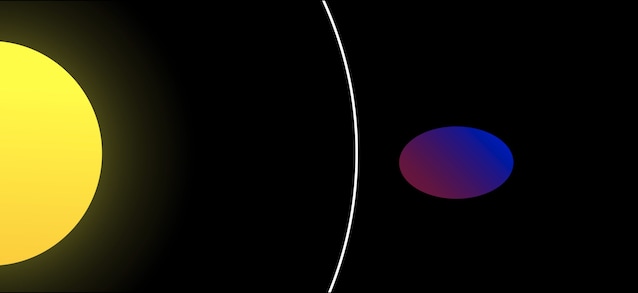
Here, on its journey towards us the Moon is destined to reach a critical distance where it is no longer able to withstand the deformation. This distance is called Roche limitbecause it was calculated by the French mathematician Édouard Roche. This limit depends on how big the Earth is, the density of the Earth and the density of the Moon, and the Moon’s ability to deform. Doing the math, it turns out between 18,000 and 19,000 km from the earth’s surface. Once at this distance, the Moon would appear in the sky 20-21 times larger of how it is today. And it would slowly begin to disintegrate.
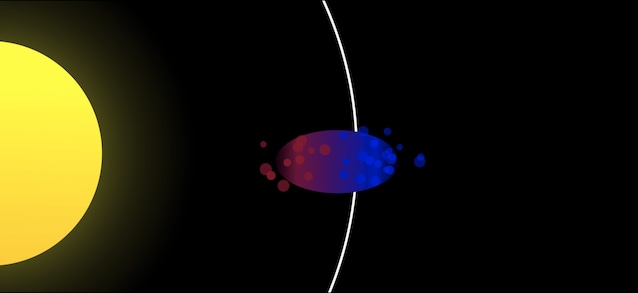
PHASE 3: The Moon turns into a ring around the Earth
Once the Moon has been reduced to fragments, the Kepler’s lawsespecially the third law: closer orbits have shorter orbital periods. In our case, the fragments of the Moon closer to the Earth will orbit more rapidly than those further away. Like a group of marathon runners running at different speeds, the lunar debris eventually ends up forming a ever longer queue.
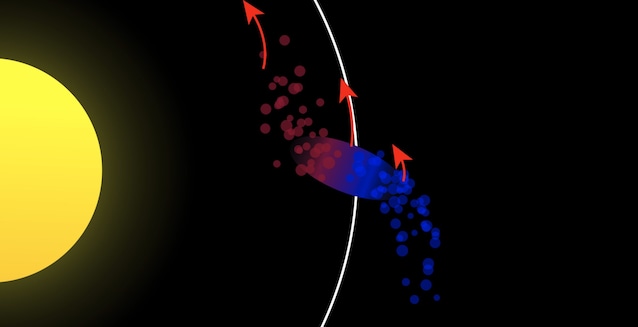
This row follows the Earth’s orbit, and occupies an increasingly larger portion of it until they actually create a ring around the Earth.
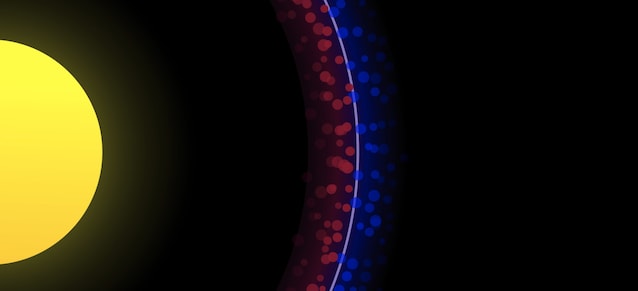
The thickness of this ring will depend on the details of the breakup, but it can be thousands of kilometers thick. It would lie on the Moon’s orbital plane, inclined about 5° to the equator. Consequently, those who live in equatorial areas would see it very “edged”; at the poles, however, it would be very low on the horizon. It follows that the best view of the ring would be at intermediate latitudeslike ours: in short, in Italy we could see it in all its splendor!
PHASE 4: The meteor shower
At this point we might think we have avoided tragedy: the lunar fragments are up there, almost 20,000 km from us, creating an evocative spectacle in the sky. The problem is what a structure of this type would be highly unstable and that debris isn’t meant to stay up there forever.
The inevitable gravitational perturbations would in fact lead some of those fragments to fall on us. Here there would no longer be the Roche limit to save us, because it has already been exceeded. For millions of years our planet would be subjected to a slow but incessant bombardment of rocky objects of varying sizes. Better than getting hit by the Moon, sure, but it wouldn’t be pleasant at all.
Fragments below 20 metres they would disintegrate completely or almost completely in the atmosphere, but this would not prevent them from causing damage with the immense shock waves of their explosions, as happened in Chelyabinskin Russia, in 2013, when a 15-meter meteor exploded in the atmosphere, injuring almost 1,500 people, mostly due to glass broken by the shock wave. Larger objects would cause progressively greater damage. If we were to be hit by a large body 5-10km we could encounter amass extinction not much different from the one that wiped out the non-avian dinosaurs 66 million years ago. And all this without taking into account a probable destruction of our entire orbital infrastructure: goodbye communications satellites, goodbye GPS and so on.
A 2024 study published in Earth and Planetary Science Letters suggests that a similar bombing has already happened in the history of the Earth. Scientists have hypothesized that an increase in meteor craters over a period of about 40 million years in the Ordovician period, about 466 million years ago, could be explained by the disintegration on the Roche boundary of an asteroid. But that was a much smaller body than the Moon; if our satellite were to disintegrate, the consequences for the Earth would be much worse.
PHASE 5: The Earth would become colder
The effects of a ring around the Earth would not stop at impacts. Research published in 2002 on Journal of Geophysical Research (Fawcett & Boslough) studied the effect of an equatorial ring of debris on the Earth’s climate. The results are stark: a dense ring would reflect a significant fraction of solar radiation before it reaches the atmosphere. The shadow cast at mid-latitudes would migrate seasonally (in summer towards one hemisphere, in winter towards the other), reducing radiation and lowering global temperatures substantially. In the simulations conducted by the researchers, the climate disruption was so large that it was impossible to estimate a new steady state in the short term.
