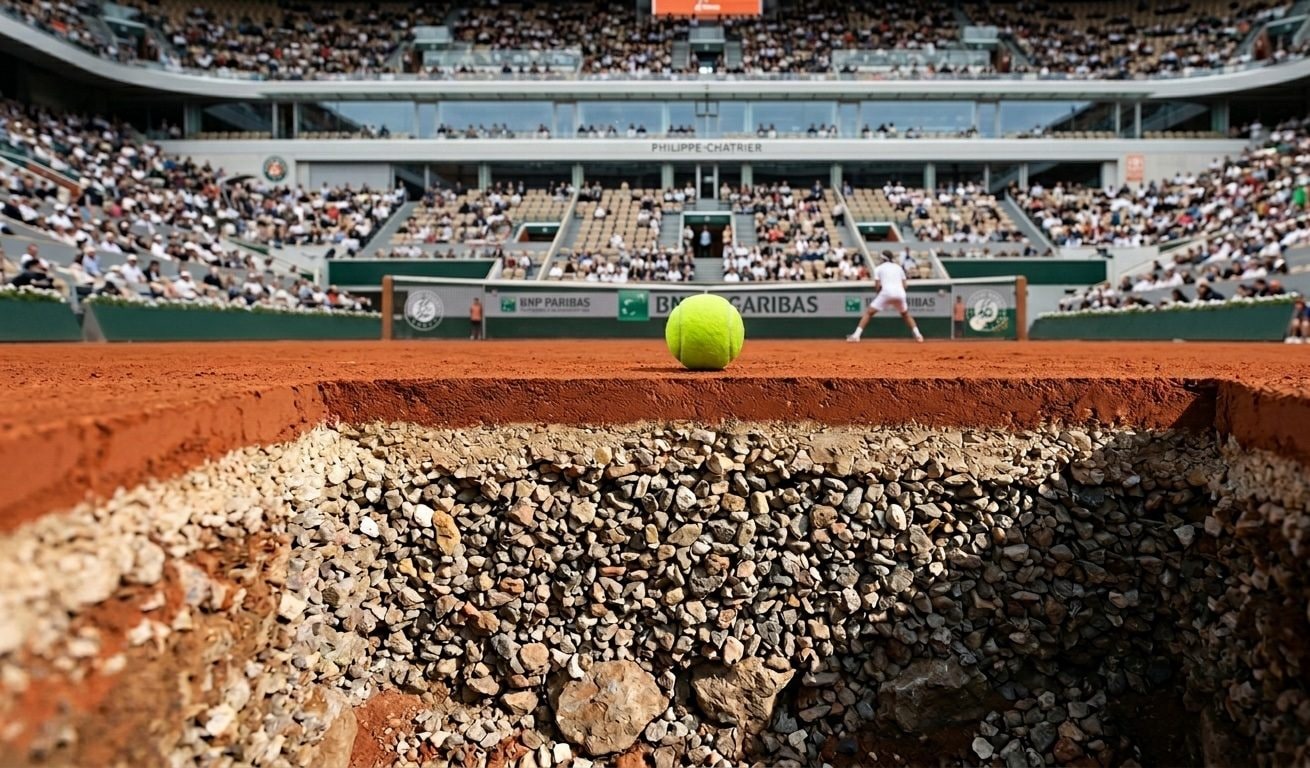
Jannik Sinner he won the Italian Internationals by beating Casper Ruud 6-4, 6-4, exactly fifty years after the last Italian triumph in Rome signed by Adriano Panatta in 1976. Now the tennis caravan is heading towards Roland Garros, the great tournament in Paris which is the last one still missing in the showcase of the world no.1 in the ATP rankings. Both tournaments are played on the same surface: clay. But what is it exactly? And why does the game change so radically compared to, say, the hard courts of New York or the grass of Wimbledon?
The clay of Roland Garros is not clay, but brick dust
The first misunderstanding to clarify is that of the name. Red clay tennis courts are not made up of real clay, but of bricks: fired clay bricks, ground to powder. This material has ideal properties for the game of tennis: it does not retain too much water, is stable under the athletes’ feet and is abrasive enough to guarantee controlled and homogeneous bounces.
The history of this surface is curious. In 1880 the brothers William and Ernest Renshawpioneers of British tennis, were looking for a solution to protect the grass tennis courts of their summer residence in Cannes from the scorching sun. They had a simple yet ingenious idea: cover them with terracotta dust obtained from crushed vases. Thus was born the first form of clay tennis court, destined to become the standard of European spring tournaments.
Today the fields that host tournaments are much more sophisticated structures than a simple sprinkling of shredded bricks: beneath the visible surface, a few millimeters high, lies a complex system that can vary from field to field but which usually includes a fwave of limestone shattered, about 30 cm long gravel and a further drainage layer.
This structure ensures that rainwater is quickly disposed of and that the pitch remains uniform even after a storm, but it can vary from tournament to tournament depending on the temperature, humidity and altitude at which the pitch is located. TO RomeFor example, the surface and treatment of the pitches vary between the different venues where matches are played: some are positioned below ground level, the Center is surrounded by high stands which complicate ventilation, while other pitches are well ventilated and can be drier.
What happens when the ball bounces on the red clay
The red earth absorbs part of thehorizontal energy of the ball, but returns more vertical thrustwith high and often unpredictable rebounds. It’s as if the earth “holds” the ball a little, but then pushes it back higher. The practical result is that the ball arrives slower and higher than on the concrete, giving players more time to reach it.
Thanks to this particularity, the earth accentuates the effects of topspin. When a player applies a lot of topspin (i.e. rotates the ball forward quickly) the ball’s contact time with the ground increases. The result is a higher bounce and a loss of speed, making the shot more difficult for the opponent to attack, who then has two choices: anticipate the response, with a difficult to control shot, or wait for the slow bounce and then step back a lot.
In physical terms, what matters are two quantities: the friction coefficient (how much the surface slows the horizontal movement of the ball) and the coefficient of restitution (how much vertical bounce it returns). On surfaces like clay, ground contact lasts longer, with a greater loss of horizontal velocity than on concrete.
Because clay favors a certain style of play: the scientific aspects
On hard court or grass, those who serve hard and attack the net immediately can gain a decent advantage: the ball is low, fast, and the opponent has little time to respond. On earth this scheme works less, because the ball slows downthe bounce is higher and the receiver has a few more moments to respond even to powerful serves.
It is also important to consider a physical aspect that concerns the athletes’ movements: on red clay courts, tennis players learn to slide while braking, a technique which from a biomechanical point of view reduces the load on the knees by distributing the impact energy. Not surprisingly, injuries are usually less frequent on clay surfaces. An example of this is Rafael Nadal, the undisputed king of clay with his 14 Roland Garros trophies under his belt, who has suffered a long series of injuries in his career but has always managed to give his best on this surface.
The red clay leaves its signature: the mark of the ball
There is an aspect of clay that has no equivalent in any other surface: clay keep the sign of the bounce of the ball. For this reason, referees can check with the naked eye whether the ball is in or out, even if this verification is currently substantially replaced by technology.
This, however, was the main reason why the clay resisted for many years the introduction of hawk’s eye, the electronic technology that reconstructs the trajectory of the ball and which in the last 20 years has gradually replaced line judges in high-level tournaments.
Since 2025, however, this bulwark has also fallen: the ATP has adopted su all tournaments and on all surfaces Live Electronic Line Calling (ELC), the hawk’s eye system that totally replaces the work of line judges, eliminating the difference in the use of technology between tournaments on clay and on hard or grass. The only remaining exception is Roland Garros itself: while all the other Slams adopt the electronic automatic call system, Paris confirms live line judges also in the 2026 edition. An anomaly that is increasingly difficult to justify, but which for now survives, perhaps as a final homage to the most unique characteristic of this surface.
