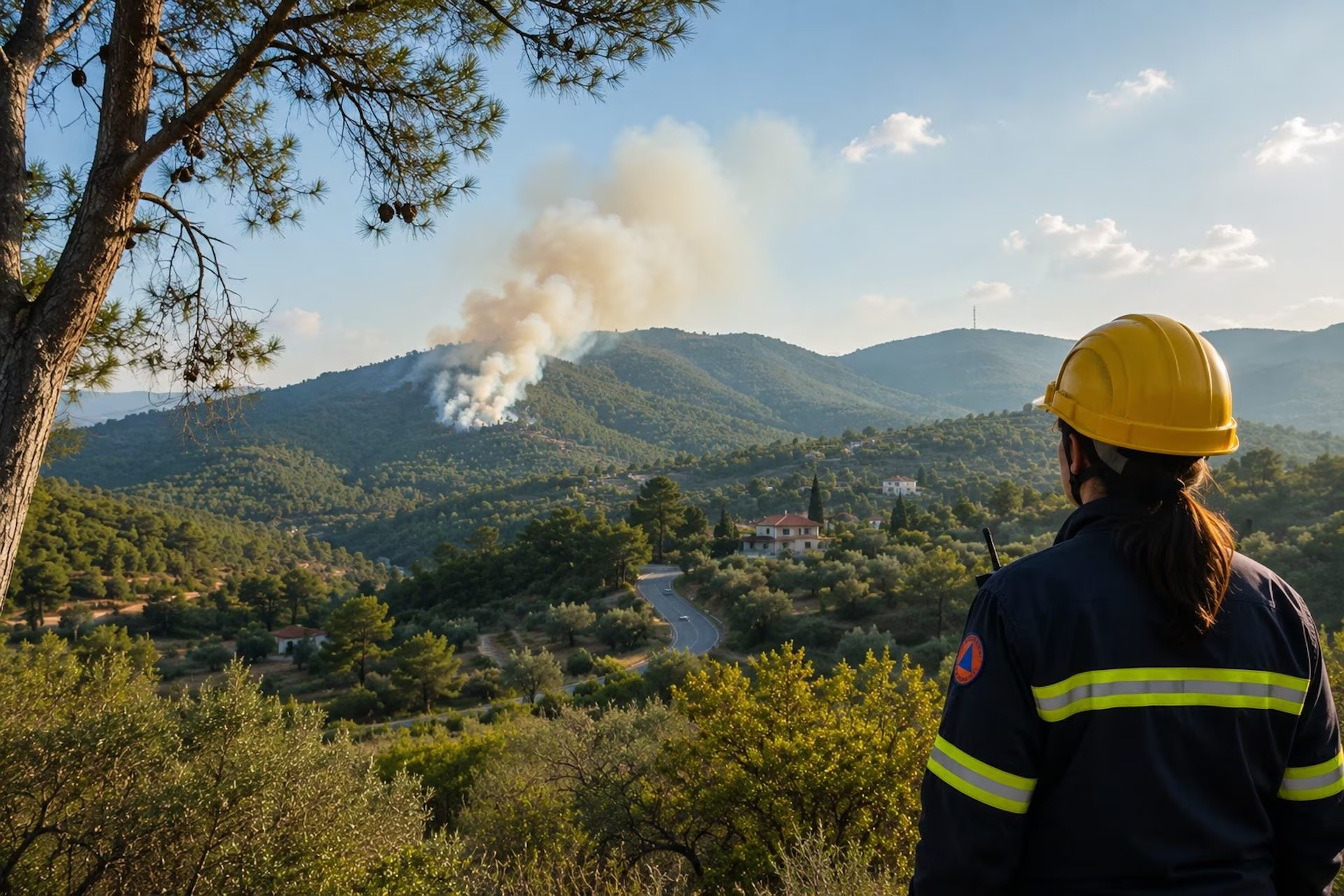
In 2026 in Italy they are already burned 47,942 hectaresThe 135% more compared to the average for the period 2006-2025, when on 22 July the hectares burned were approximately 20,329 hectares: these are the data reported in the EFFIS database of Copernicus (European Forest Fire Information System), the European fire monitoring system.
According to the new report “Italy in smoke 2026” by Legambiente, since the beginning of the year they are well 469 fires were recordedmarking an increase of 36.3% compared to the same period last year (344 fires at the beginning of 2025).
2025 also ended with one of the heaviest tolls in recent years, with almost 100,000 hectares of forests burned, almost double that of 2024. Being a growing threat and a sadly increasing phenomenon, especially in this season, it becomes fundamental knowing what to do, who to call, how to move and how to behaveyes in the presence of a forest fire.
As indicated by the Civil Protection, the most important thing is to look for one safe escape route and immediately call the Single European Emergency Number 112or the 115 of the Fire Brigade. This is because, as you can already imagine, a forest fire does not behave at all like a house fire: it is a front that moves outdoors and can move much faster than a person walks.
Who to call in case of forest fire
If you spot a fire it is essential to alert Fire Brigadeby contacting 115 or 112which is the Single European emergency numberwho will forward the call to the Fire Brigade operations center.
Alternatively, you can call the 1515number of emergency response to which the presence of can be reported forest fires. What should be kept in mind is that the user must indicate with precision the location of the area that is burning, specifying the Province and the Municipality, and that you must never hang up at least not until the operator says so, because the questions he asks serve to dimension the intervention.
How to protect yourself from flames: the indications of the Civil Protection
The operational indications of the Civil Protection and of the I don’t risk campaign specify that we must search a safe escape route, a road, a waterway. We don’t stop never downwindthat is, in the direction towards which the wind is pushing the flames, because you could be trapped.
If there are no alternatives, and the front is not very intense and shallow, an attempt can be made cross it at the weakest point to reach the already burned area. However, when moving is not possible, the right thing is lie down on the ground in a point without vegetation because the smoke tends to rise and in this way you avoid breathing it. There is no stopping along the roads to watch or film, because parked cars are an obstacle to emergency vehicles.
Possible causes of a fire: what not to do
The causes of a forest fire can be either natural or caused by imprudent, unaware or criminal behavior conducted by one or more people. What needs to be kept in mind is that there is a lot that can be done in terms of preventionthen adopt responsible behaviors towards the environment and the territory.
For example, if you have to park your car you have to make sure that the muffler is not in contact with dry grassit could catch fire. Never light a fire if you are not inside designated and equipped areas and when you are in a picnic area (where the lighting of a barbecue is permitted) it is essential to pay maximum attention to the fire and is never left unattended.
It is essential to make sure that the fire is actually put out and that once the on-site activity is concluded, all the waste generated that can constitute a potentially dangerous fuelas well as harmful to the environment. Also it is It is forbidden to throw matches lit or cigarettes which can set fire to dry grass or burn (without the right and necessary safety precautions) straw or agricultural residues. In these cases the fire can flare up in a few minutes without control, also due to the wind, in the presence of which it is always correct not to light any fire in any case.
