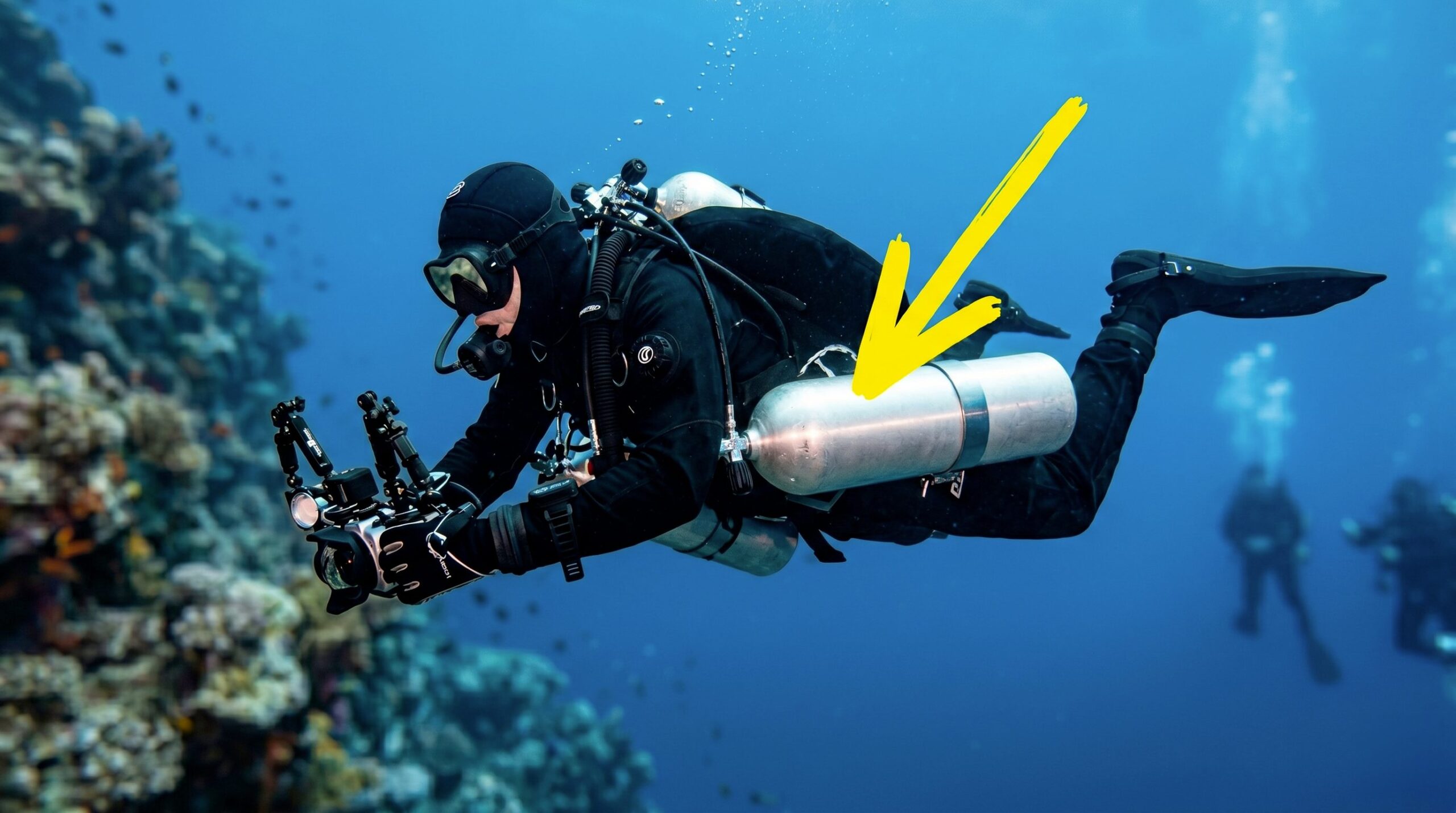
The bodies of five Italian divers died during aimmersion at Maldives they returned to Italy: today, Monday 25 May, the task to carry out the tasks should be formalised autopsies in the morgue of the Gallarate hospital, in the province of Varese. The forensic doctors will thus be able to clarify the causes of death: to reconstruct the complete dynamics of the accident, however, the analyzes of the wrist computers, the Go-Pro cameras used by the team of Finnish rescuers and, above all, the gases contained in the cylinders will also be fundamental, so as to safely exclude the hypothesis of carbon monoxide poisoning.
But, generally, what mixture of gases do divers’ cylinders contain? The composition varies depending on the depth, while the number of cylinders may be greater depending on whether it is recreational or technical diving: in both cases, however, the decompression stages remain a fundamental phase of the dive, to allow the body to eliminate safety inert gases and avoid decompression accidents.
To understand the topic more deeply, we asked for the support of Dr. Pasquale Longobardimedical director of the Hyperbaric Center of Ravenna and vice-president of the Italian Society of Underwater and Hyperbaric Medicine (SIMSI).
What gas do the cylinders contain: it depends on the depth
The first thing to clarify is that our body, underwater, is not able to read the depth. As he explained Dr. Lombards at Geopop, what the human body recognizes is the density of the gas that we are breathing. The human tolerance limit for gas density is 5.2 grams per liter: once this value is exceeded, the body triggers an inflammatory response.
That density depends on the concentration and partial pressure of the individual gases present in the mixture: for this reason, the mixture to be put in the cylinder must be chosen based on the depth you want to reach.
Up to 35/40 metres, a mixture of air enriched in oxygen call Nitrox: Normally air contains 21% oxygen and 79% nitrogen. With Nitrox, however, it is possible to increase oxygen (up to 30% or 40%) and consequently reduce nitrogen, which is responsible for the so-called “decompression accident”. Less nitrogen also means less risk.
The problem, however, is that it is not possible to raise the percentage of oxygen too much, otherwise you risk oxygen toxicity: an excess of this element, in fact, increases the electrical activity in the cells, with the risk of convulsions.
When you go down over 40 metresHowever, things change: at these depths the Nitrix mixture begins to be dangerous, because the density of the gas could easily activate the inflammatory response. The solution in these cases, therefore, is to lighten the mixture adding heliumthus creating a ternary mixture composed of nitrogen, oxygen and helium. This last element is fundamental because it has a very low density (0.18 g/l) and allows the total density of the gas to remain low.
In cases where helium is not available, as is the case in the Maldives (where finding helium is expensive and complicated), it is possible use normal airdespite knowing that a 50 meters an operational limit is reached since at those depths it reaches a density dangerous of approx 7.8 grams per literexposing the body to increased respiratory effort, increased nitrogen partial pressure, and inflammatory stress.
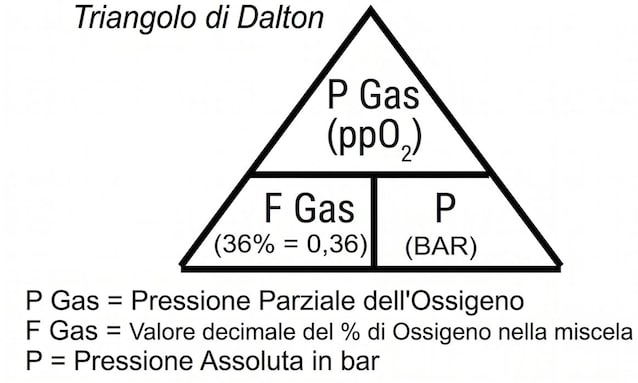
In any case, to quickly calculate which mixture to use at which depth, divers use a tool called «Dalton diamond», a small formula that crosses three variables: the partial pressure of oxygen (1.3/1.4 bar is generally recommended, up to an absolute maximum value of 1.6 bar), the percentage of oxygen in the mixture and the depth expressed in atmospheres. To go to 40 meters (so about 5 atmospheres), for example, the ideal mixture is a Nitrox to 32% oxygen: this is obtained by dividing 1.6 by 5. To go even lower, the count changes and the mixture must be modified accordingly.
The differences in tanks between recreational diving and technical diving
At this point one wonders what changes between recreational diving or technical diving: the latter occur when, during the divea change of respiratory mixture. Translated: when you change tanks and start breathing a different gas than the one you started with, then it’s a technical dive.
If, however, the diver descends and ascends always breathing the same mixture, whatever it is (air, Nitrox or other), it is arecreational diving (often defined as tourist).
In technical diving, among other things, the diver carries one or more accessory tanks on his side (up to three) and during rising changes the mixture based on depth. This allows you to manage at best residence times that the decompression and to tackle greater depths safely.
It must be said, however, that there is also a third type of immersion, that scientificwhich takes place within the framework of authorized research projects at a government level, to study a specific marine environment. In these cases, planning must be even more rigorous, with a mix analysis plan that will be used at specific depths.
The importance of the final decompression phases
If choosing the right mixture is the first pillar for completely safe diving, the second pillar concerns the decompression phases. This is a mandatory practice in underwater activity that is carried out for eliminate inert gases from the body: not carrying out this step correctly can have serious consequences and lead to so-called decompression accidents.
To understand the importance of decompression, we must take a step back to better understand what happens to our body during a dive: trying to simplify, when we descend depththe pressure increases and the gases we breathe (particularly nitrogen) do they dissolve in our fabrics. When we ascend towards the surface, the pressure decreases and those gases that we have accumulated must therefore be disposed of, preferably dissolved in the blood without triggering bubbles. If the ascent occurs too quicklythe gas does not have time to be eliminated through the lungs and forms bubbles in the blood and in the tissues, with the risk of causing the so-called “decompression accident”. In the most modern algorithms, the formula for calculating decompression considers the fraction of dissolved gas in the blood: the greater the dissolved gas, the lower the probability of bubbles triggering.
This is why, every time you go on a dive, you must also consider the timing decompression stages: means stay still for a certain time at intermediate depths to allow the body to eliminate nitrogen in a controlled way, without dangerous bubbles forming.
In the case of decompression accidents, however, there is a very specific therapeutic protocol, which involves therapy in a hyperbaric chamber with administration (even a reasonable amount of time after the accident) of pure oxygen to the pressure of 2.8 bars (high recommendation, it is the protocol to be adopted in any hyperbaric center) or oxygen and helium together (recommended only in Centers that have expertise, mix and protocols).
The 50/50 helium-oxygen mixture allows the injured person to be treated at 4 bars (i.e. 30 meters of equivalent depth in a hyperbaric chamber), with a partial pressure of oxygen of 2 bars, which corresponds to 10 metres. This partial pressure of 2 bar is ideal for facilitating the repair of damaged nervous tissue, while helium protects the mitochondrion (the powerhouse of the cells) and, probably, the same absolute pressure of 4 bar also has a favorable effect in itself.
