
While stroking newborns’ heads, you may have noticed some soft areaswhich sometimes seem to pulsate. They are the fountainsone of the most elegant solutions that evolution has ever devised for dealing with childbirth and allowing the brain to continue to grow once outside the womb. In fact, newborns are born with their skull bones still not completely mergedbut held together by fabric fibrous: In this way, the skull may slightly deform when it passes through the uterine canal at the time of birth. Don’t worry, it will return to normal in a few days. The drinking fountains, as reported by the Meyer University Hospital, are also an excellent point of monitoring the health of the newbornquickly reflecting states of dehydration, excessive pressure in the skull or health problems. By the age of two at most, they “close”, but the bones of the skull fuse completely around the age of twenty.
Disclaimer: This is an informational article only. For any medical indications and information, contact your doctor.
What are fountains and what are they for?
The skull of newborns is a work in progress: the bones that form it, in fact, are not yet fused together as in adults, but are connected by fibrous tissuea sort of flexible joint made of collagen that connects the 6 bones of the skull (two frontal, two parietal and one occipital). These joints (sutures in technical jargon) are essential to allow the newborn’s head, which is larger than the uterine canal, to pass through it, causing the bones to slide slightly over each other and deforming the skull just enough to come out.
Don’t worry, don’t imagine children with oblong heads like Stewie Griffin’s, but slight asymmetries that return to normal in a couple of days. At the point where two or more sutures meet, larger and softer holes are formed: the fountains precisely. This is a feature physiological of the newborn well known and described for decades in manuals of anatomy, pediatrics and neonatology. Because they are called that, according to the French dictionary Allo Dico seems to be linked to slight pulsation visible under the cranial membrane, which resembles that of a small spring: fountains it is in fact a French term in turn derived from Latin fons (source), which first appeared in the 16th century to indicate these areas.
Thanks to these “soft points” (in English they are also called proper soft spots), newborns’ brains can develop adequately in the first two years of life, with the skull “widening” accordingly. In practice, the sutures are seams and the fountains are like small squares on which several streets converge.
There are more than you think and they close at different times
Most people only know the one on the top of the head, but in newborns there are numbers of them six in total: anterior, posterior, two mastoids and two sphenoids. The largest and most “important” are the front and the rear. The anterior fontanel, as reported by both the Cleveland Clinic and the National Library of Medicine, has a rhomboid shape, which resembles a diamondand sizes ranging from 0.6 to 3.6 cm, with an average of 2.1 cm. However, a 2021 meta-analysis published in Public Health Reviews, based on 26 studies and more than 8,600 newborns, calculated a slightly higher global average, 2.58 cmwith differences between populations: African newborns tend to have larger breasts (3.15 cm) than European newborns (2.01 cm). Typically, it closes between 13 and 24 months after birth, so at about 1-2 years.
There posterior fontanelhowever, is smaller and triangularand has a measurement that varies from 0.5 and 0.7 cm. Unlike the front, the closure only requires 6-8 weeksthat is, within the second month of life.
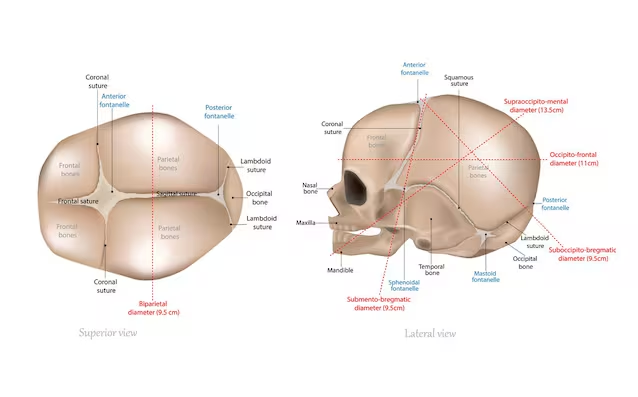
In these weeks or months, the fibrous tissue comes replaced by bone tissue which slowly closes the fountains. The sutures, however, remain “malleable” until much later, some up to 60 years of ageas reported by the Cleveland Clinic! In general, however, the closure of the sutures occurs around the age of 20, to allow the brain and head to reach their final shape! In fact, if you think about it, children’s heads are smaller than adults’ and it is thanks to the sutures that they continue to grow.
I’m a baby health sensor: what does it mean if it’s sunken
During the pediatric visit, the fountains, in particular the anterior one, can provide numerous information and is in fact always inspected, as Dr. Pittari explains for the Meyer University Hospital of Florence. If the fountain is sunkencan indicate a state of dehydration of the child: he has not drunk enough or has lost too much fluids. In addition to the sagging, you notice dry mouth and diapers that are less wet than usual.
If it is enlarged, protruding and tenseis a more serious sign because it can indicate an increase in pressure inside the skull and should be immediately attended to by a doctor.
What if they don’t close or close too soon?
If fontanelles and sutures close too sooncan prevent the brain from growing properly. The technical term is craniosynostosis, or craniosynostosis, and, as reported by the Centers for Disease Control and Prevention (CDC), it can cause deformations of the skull and often requires surgery. On the contrary, if they stay open too long they can be indicative of more complex conditions such as congenital hypothyroidism, rickets or Down syndrome, but obviously in these cases they will also be accompanied by all the other symptoms that characterize them.
