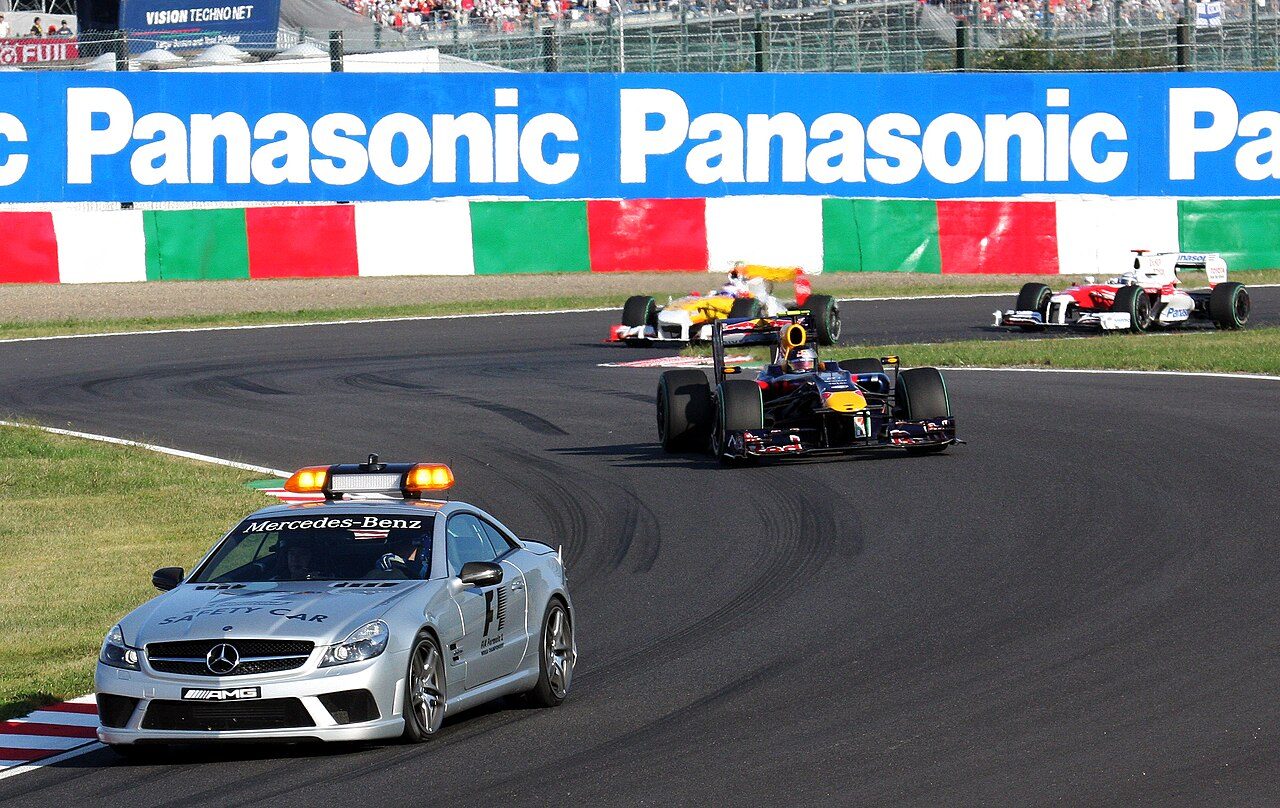
There Safety Car (or peace car) is a high-performance Formula 1 safety car that enters the track whenever dangerous situations occur such as serious accidents, extreme weather conditions or when the Marshalls (track stewards) have to rearrange the barriers perhaps due to an accident. The first appearance of a Safety Car in Formula 1 dates back to September 23, 1973 during the Canadian GP at the Mosport Park circuit. The idea had been proposed by the German pilot Herbert Linger and supported by the then Brabham manager Bernie Ecclestonewith the aim of finding a system that would allow the cars to be slowed down without completely interrupting the race in the event of accidents on the track.
The debut, however, was far from perfect. During the race a violent storm made the track extremely dangerous and, after an accident between François Cevert and Jody Scheckter, the race direction decided to let a Porsche 914/6 yellow driven by Canadian Eppie Wietzes. The car, however, made a crucial mistake: instead of placing itself in front of the race leader, it entered the wrong car, that of the New Zealander. Howden Ganley. In Formula 1 the Safety Car must in fact act as “leader” to the first rider in the ranking, so that the whole group follows in the same order. The error instead threw the layout of the cars and the gaps accumulated up to that point into confusion, so much so that several hours were needed to correctly reconstruct the final classification of the race.
Despite its problematic debut, the idea of the Safety Car continued to be developed and was permanently introduced into the FIA regulations in the early 1990s, becoming a permanent presence from 1993. It was especially from the 2000s that its use began to follow more standardized procedures. In the early years, in fact, each circuit used its own safety car: over time very different models were used, such as Lamborghini Countach, Fiat Tempra (this will be the first official Safety Car at the 1993 Brazilian GP) and Opel Vectra. Starting from the new millennium, the FIA instead decided to standardize the system by entrusting the official supply of the Safety Cars to Mercedes-AMG.
How the Safety Car works when it enters the track: the impact on pit strategies
When the protocol requiring the entry of the Safety Car is activated, the drivers must immediately slow down, maintain their positions and follow the car without the possibility of overtaking, thus allowing the marshals to intervene in complete safety. Its presence is reported via yellow flags and light panels placed along the circuit with the writing “SC”. Once on the track, the Safety Car compacted the group, bringing all the cars to close range and effectively erasing the gaps accumulated up to that point. When the dangerous situation is resolved, the car returns to the pits and the race resumes regularly, with overtaking allowed again after the official restart.
During this neutralization phase, the management of the restart is entrusted to the Safety Car light system: initially the Green LEDswhich then leave room for those orange. When the race director authorizes the restart, the lights are turned off, signaling to the drivers that the Safety Car is about to return and that the race is about to resume.
Beyond safety, the Safety Car is one of the most influential elements of Formula 1 strategy. Its entry can completely reverse the flow of a race as it reduces or eliminates the gaps between drivers, bringing back into the game even those who were far from the top positions.
One of the most important effects concerns i pit stops. During the Safety Car regime, in fact, the single-seaters travel at reduced speed and time is lost when returning to the pits decreases significantly compared to a normal race situation. For this reason, teams often take advantage of the neutralization to change tires or modify their strategy. In free race conditions, a pit stop involves an average loss of approximately 20-25 secondswhile with the Safety Car on the track the actual “cost” can also be reduced by 8-12 secondsdepending on the circuit.
What is the Virtual Safety Car: how the “digital” version of safety works
In addition to the traditional Safety Car that we have talked about so far, in Formula 1 there is also the Virtual Safety Car which comes into play in the event of not particularly serious situations, such as the presence of debris on the track. Unlike the traditional Safety Car, no cars enter the track and the race is not physically “compacted”. The Virtual Safety Car was officially introduced in World Cup 2015after having been tested at the end of the previous season following the serious accident of Jules Bianchi in the Japanese GP, with the aim of increasing safety without completely interrupting the race.
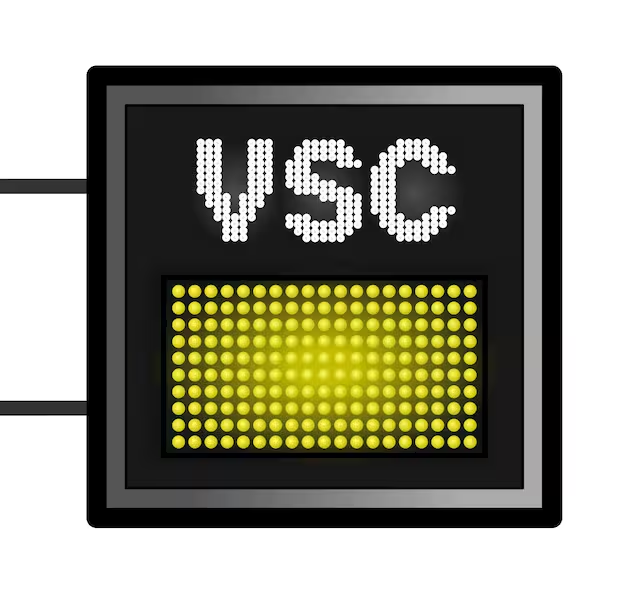
When it is activated, generally after the exposure of the double yellow flagthe race direction communicates the procedure through the official FIA systems and the light panels present along the circuit, on which the acronym ” appearsVSC”. From that moment on, all pilots must respect an imposed minimum time, the so-called delta timereducing speed uniformly in every sector of the track. If a pilot falls below this limit, therefore being too slow or inconsistent in complying with the procedure, he may be subject to investigation and sanctions by the race direction.
During the Virtual Safety Car regime, no groupings are created between the single-seaters: the distances in fact remain unchanged compared to the moment of activation. Overtaking is prohibited and drivers can return to the pits, for example to change tyres, but always respecting the speed limit imposed by race direction. When conditions become safe again, the end of the procedure is communicated with the message “VSC ending” and, after a few seconds, the green signal appears on the light panels indicating the resumption of the race at normal speed.
In F1 there is also the Medical Car: the car that brings help in the event of an accident
In addition to the aforementioned Safety Car and Virtual Safety Car, Formula 1 is also equipped with one Medical Cara sort of high-performance ambulance designed to intervene as quickly as possible in the event of an accident. Its main task is to quickly transport the FIA medical coordinator and specialized medical personnel to the crash site, so as to be able to provide immediate assistance to the pilots involved.
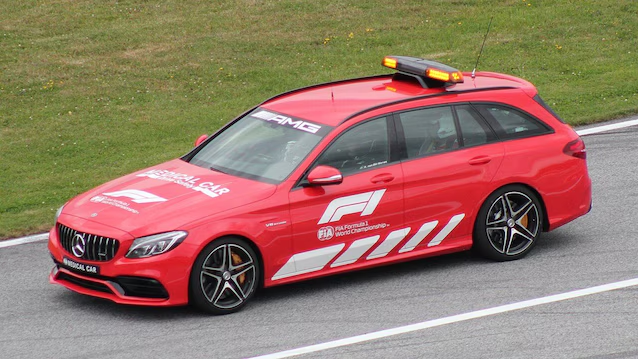
During each race weekend, the Medical Car also carries out a reconnaissance lap before the start of the Grand Prix following the single-seaters, so as to be able to intervene immediately in the event of an accident at the start, considered one of the most “agitated” moments of the race. On board, the crew monitors data and communications from race management in real time, including alerts on impacts recorded by the single-seaterso that we can intervene as quickly as possible.
