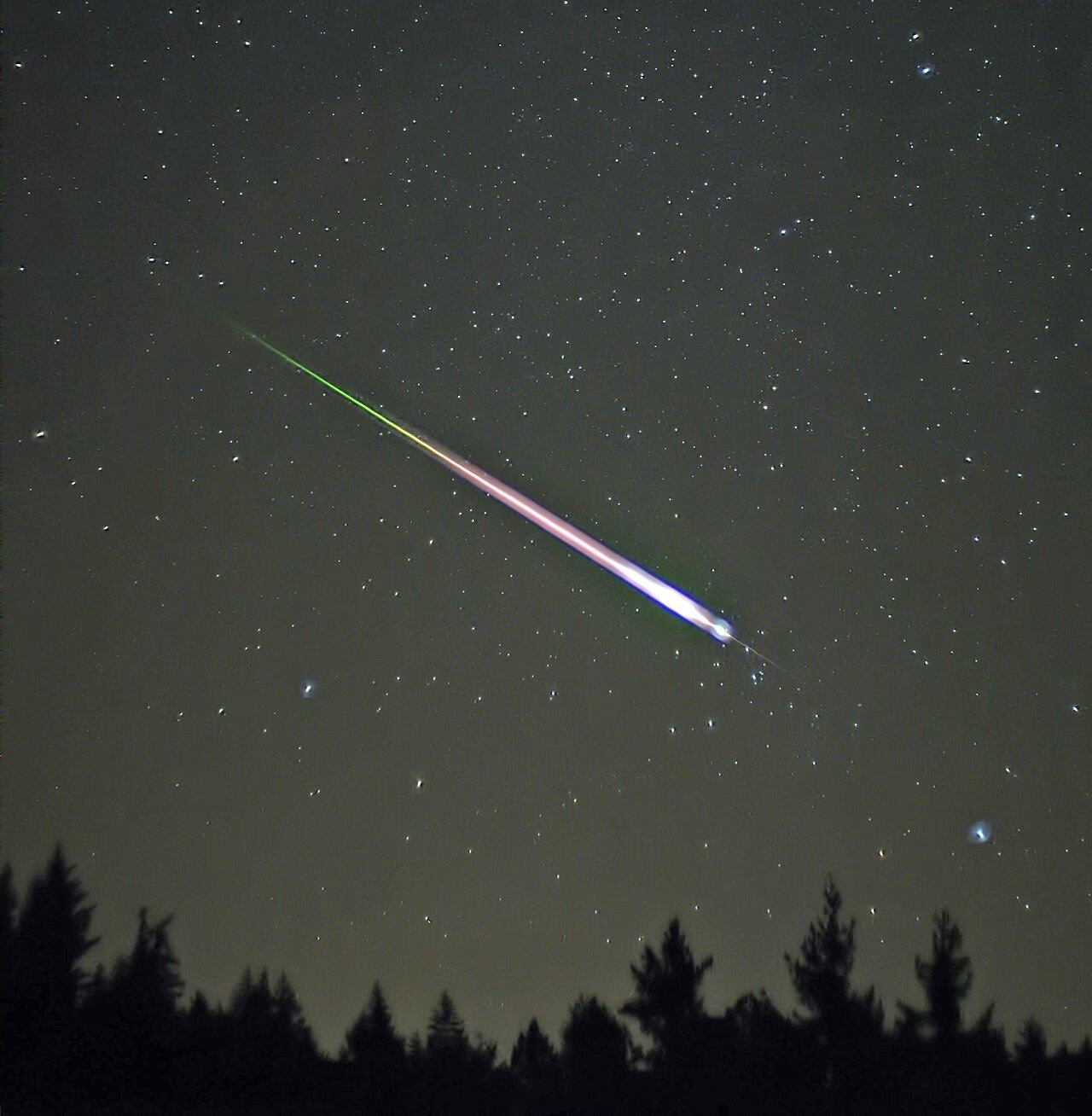
The Leonid meteor shower is active from November 6 to November 30, but will reach peak activity around November 17. This month’s “shooting stars” will be the fastest meteors of 2026, traveling at around 251,000 km/h.
The Leonidsone of the major autumn meteor showers, will reach peak activity around November 17, 2026with approx 15 meteors per hour peak expectations. From the Italian latitudes, the best time to observe the Leonids it will be starting at 02:00when the radiant of the shower, i.e. the apparent direction from which the meteors appear to come, will have exceeded 30 degrees above the eastern horizon in the constellation of Leo.
The observing conditions will be particularly favorable thanks to a crescent Moon that will set around 10.50pm, thus making the observation of the meteor shower completely free from the disturbance of moonlight.
Accompanying the show will also be Mars and Jupiter, visible a few degrees from the Leonid radiant and protagonists of a spectacular approach that has reached its maximum the November 16 at 03:04when the two planets were just separated 1°11′. A particularly interesting configuration for those who want to try to photograph a meteor as it crosses the sky near the two planets.
Although a copious shower of “shooting stars” is not expected, the Leonids have a characteristic that makes them exceptional: they are the faster meteors among those of the main annual meteor showers, with one entry speed in the atmosphere of approximately 69.7 km/sequal to almost 251,000 km/h.
When is the peak and where to observe the “show” of the Leonids from Italy
The Leonids are active since 6 to 30 Novemberbut the greatest concentration of meteors occurs around the mid-month high. Their radiant is located in the constellation of Lion and from Italian latitudes it rises in an east direction around 11.05pm. Initially, the radiant will be too low on the horizon to provide good visibility.
We will have to wait around 02:00when he has reached i 30 degrees in height, to enter the most favorable observation window. From that moment, the radiant will continue to rise progressively in the sky until you reach the maximum height around 06:30coinciding with the first light of dawn.
This implies that the better observation window it will therefore be indicative between 02:00 and the beginning of dusk morning, without having to wait for the radiant to reach its maximum height.
An additional reason to observe the sky will be the presence of Mars and Jupiter in the constellation Leoa few degrees apart. The maximum approach between the two planets occurred in the early hours of November 16thbut the couple will remain particularly close even during the following nights.
Jupiter, with apparent magnitude of approximately -2.1will be easily recognizable due to its high brightness, while Mars, with a magnitude of approximately 0.7will appear decidedly less bright, with its characteristic reddish color. Both will be visible to the naked eye and close enough to enter the same field of view as binoculars.
To observe the Leonids No telescopes or binoculars neededwhich would excessively limit the field of vision. It is preferable to go to a place far from light pollution, give your eyes at least twenty minutes to get used to the darkness and observe as large a portion of the celestial vault as possible, preferably in a southerly direction, maintaining the radiant in Leo in the peripheral area of one’s visual field.
Meteors, in fact, can practically appear everywhere in the skynot just near the radiant. Indeed, those that cross regions farther from the radiant tend to show longer apparent trailsmaking them easier to locate and photograph.
The Expected rate of meteors is 15 per hour. This does not mean that we will necessarily see a meteor every four minutes, but this value represents the theoretical number of meteors observable in ideal conditions, with a perfectly dark sky and the radiant exactly at the zenith.
The truly observable number will generally be lowereven in the absence of light pollution.
What are these meteors and why are they so fast
The Leonids are produced by debris released by the comet 55P/Tempel-Tuttlea celestial body that takes approx 33 years old to complete an orbit around the Sun. Every year, when the Earth crosses the regions of its orbit occupied by the particles scattered by the comet in its previous passages, some of these tiny fragments enter the Earth’s atmosphere at very high speed, producing the bright trails that we commonly call shooting stars.
The peculiarity of the Leonids is precisely that speed of approximately 69.7 km/s with which meteoroids meet the Earth. This is a speed very close to the maximum possible limit for a meteoroid gravitationally bound to the Sun to encounter our planet. This happens because the particles of the swarm follow orbits that lead them to move in a direction almost opposite to that of the Earthcausing their speeds to add during the encounter.
The very high velocity causes rapid heating and ablation of the meteoroid material during entry into the atmosphere, giving rise to particularly rapid and sometimes bright meteorswhich can leave behind persistent trails for a few seconds.
The Leonids are also famous for having produced real ones in the past meteor stormsduring which thousands of meteors per hour were observed. Among the most famous episodes are those of 1833 and 1966followed by intense activity recorded between 1999 and 2002. These phenomena occur when the Earth passes through particularly dense regions of debris left by comet Tempel-Tuttle.
The next passage to perihelion of the comet Tempel-Tuttlei.e. the point of its orbit closest to the Sun, will occur in 2031when new increases in meteor activity could occur, but not necessarily a storm comparable to those in the past.
