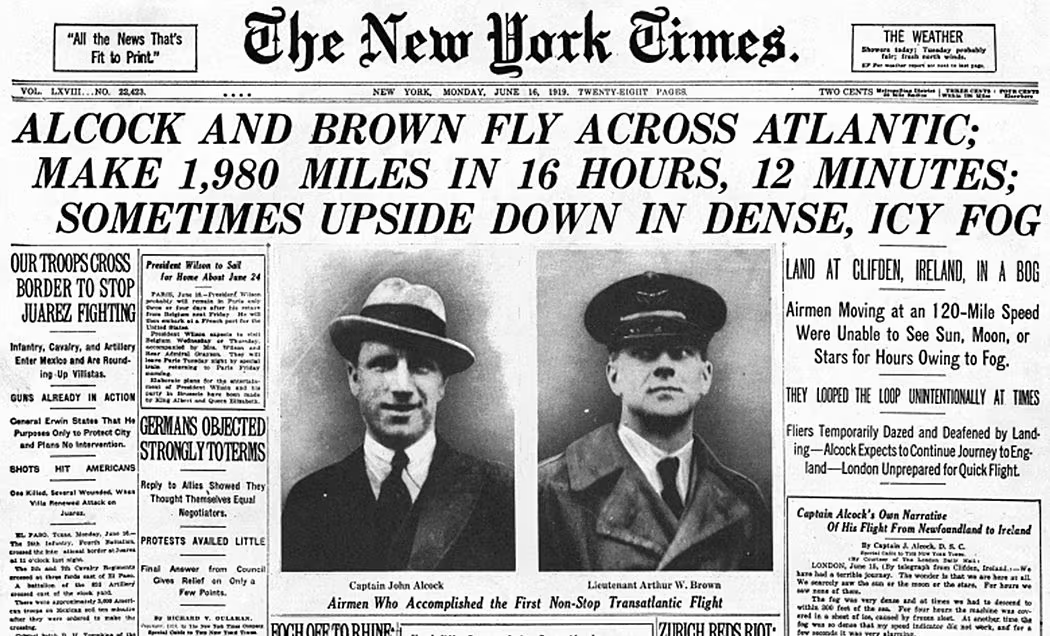
Traveling by plane between Europe and America is absolutely normal for us. It was not, however, in the 1910s. The first flight on the Atlantic Ocean non-stop was created in 1919 by John Alcock and Arthur Brown, British aviators: left from the island of Newfoundland, Canada, aboard an aircraft Vickers Vimythe two arrived in Ireland in about 16 hours.
Many remember the transatlantic undertaking of Charles Lindberghwho flew from New York to Paris in 1927, but the first, 107 years ago, were Alcock and Brown. They decided to attempt the flight to take part in a competition run by the Daily Mail newspaper, which had a rich man up for grabs cash prize for those who were the first to fly over the Atlantic without making any stops. The flight, of course, was made possible by aircraft development who, although born a few years ago, had already made great progress.
Advances in the airplane and long-distance flights
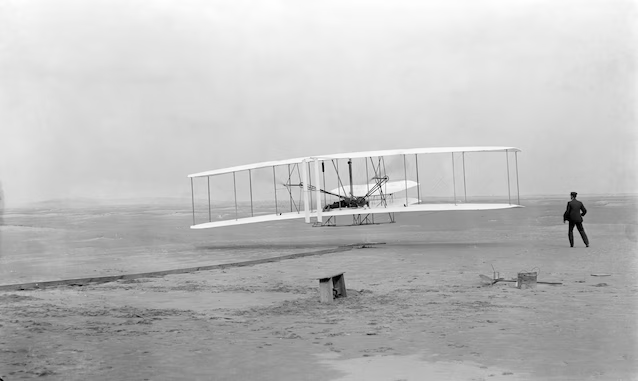
The airplane, as we know, was invented by the brothers Wilbur and Orville Wright in 1903. The first flights managed to leave the ground for only a few seconds, but the Aviation technology progressed rapidlyalso thanks to its possible military uses.
The years in which aeronautical technology made the most rapid progress were those of First World War. Although the planes did not have the importance they had in subsequent wars, during the conflict they proved useful for reconnaissance missions, support for ground troops, bombing of enemy armies and, sometimes, even for propaganda missions. For this reason, during the war the industries of all the belligerent countries strove to produce ever more numerous and ever more efficient airplanes.
Some aircraft were designed for the long-distance bombing. Among them was the English apparatus Vickers Vimya biplane equipped with two Rolls Royce engines, which had a range, very remarkable for the time, of approximately 1,500 kilometres. The aircraft was designed to bomb Germany from bases located in French territory, but entered service when the war had already ended. The Vimy, however, remained the main bomber of the British air force, the Royal Air Force, throughout the 1920s and was also used for commercial flights.
Furthermore, a specially modified example, which mounted additional fuel tanks, served for an unprecedented feat: fly over the Atlantic Ocean without making any stopsreaching Europe from America.
Alcock and Brown’s 1919 Atlantic flight
At the end of the First World War, thanks to advances in technology, flying over the Atlantic did not appear to be an impossible task. The first stopover flight was made in May 1919 by an American aviator, Albert Cushing Readwho flew from Long Island, near New York, to Plymouth, England, making several stops along the way, made possible by the fact that he was flying on a seaplane (he could stop on water). However, he also stopped at the Azores islands.
In the same period, several aviators planned to cross the ocean without stopping, giving rise to a sort of competition. Furthermore, a rich prize was up for grabs: 10,000 pounds (about 470,000 pounds today), offered by the newspaper Daily Mail to the first aviators who crossed the Atlantic without stopping and in less than 72 hours.
The challenge was won by two British officers, the pilot John Alcock and the navigator Arthur Brown. The two aviators organized a flight from Saint John, a Canadian town on the island of Newfoundland, which is the point in North America closest to Europe, to Clifden, a town on the Atlantic coast of Ireland.
Alcock and Brown’s Vimy left at around 1.45pm June 14, 1919beating other aviators who, in Saint John itself, were preparing for the feat. The flight was very troubled. The takeoff already risked turning into a disaster, because the plane was very heavy, due to the overload of fuel, and almost hit the trees located near the runway.
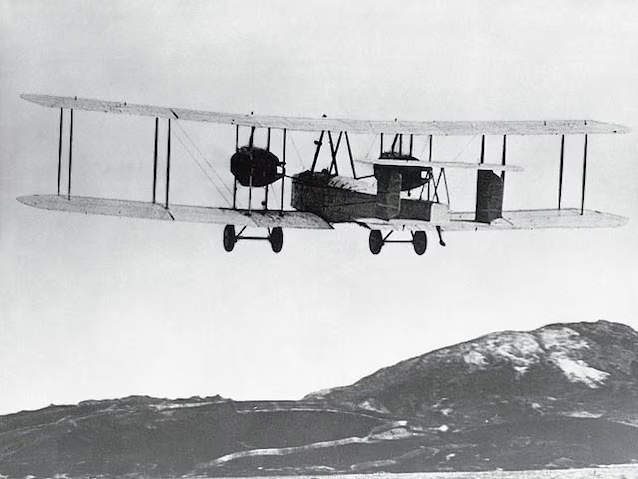
The two airmen also found bad weather conditionswith fog banks and snowstorms, which caused ice to accumulate on the plane. An unverifiable legend has it that Brown had to venture out onto the wings several times to remove the ice with his hands.
From Canada to Ireland
Despite the difficulties, Alcock and Brown managed to complete their undertaking. In fact, they reached the Irish coast at 8.40 in the morning of June 15th and landed in County Galway, not far from Clifden. They had traveled 3,040 kilometers in just under 16 hourstraveling at an average speed of 185 km/h. The maximum altitude reached during the flight was 3,700 meters.
The two airmen were welcomed as heroes and the newspapers competed for interviews. Winston Churchill, who was Secretary of State for Air at the time, presented them with the £10,000 prize offered by Daily Mail. Furthermore, a week after their arrival in Ireland King George V received them at Windsor Castle and knighted them.
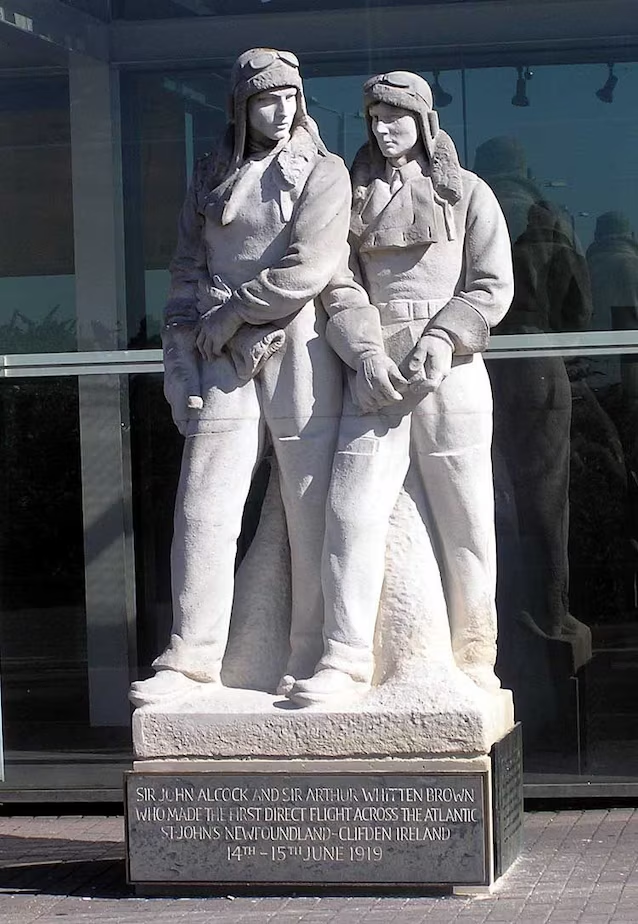
To commemorate the feat, they were erected commemorative monumentson the island of Newfoundland, in County Galway and other locations.
Subsequent transatlantic voyages: the Lindbergh voyage of 21 May 1927
The memory of Alcock and Brown’s undertaking is alive especially in the United Kingdom, while in the rest of the world it was overshadowed by another flight, that of Charles Lindberghwhich in 1927 flew from New York to Paris in 33 hours and 32 minutes. Probably, the fact that the departure and arrival locations were important cities, together with the fact that he flew alone, made the 1927 feat more famous than the 1919 one.
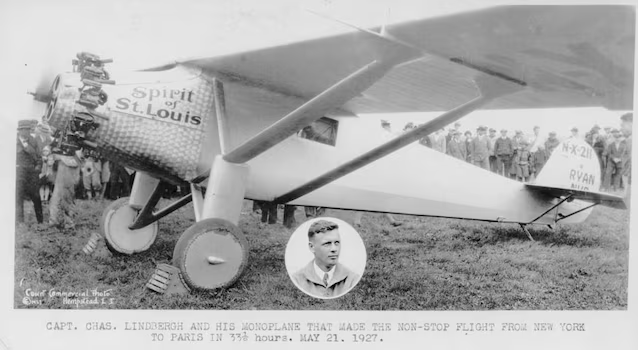
After Lindbergh, aviation continued to make progress. In 1928 a passenger service between Europe and America was introduced by airshipsi.e. air balloons filled with lighter-than-air gases, but the experience ended in 1937, after a tragic accident.
In the early 1930s, groups of formation aircraft flew over the Atlantic thanks to two Italian expeditions: the first, composed of 15 seaplanes, reached Brazil in 1930, the second, with 25 seaplanes, arrived in the United States in 1933. Both expeditions, led by the aviator and politician Italo Balbowere widely used by the fascist regime for propaganda purposes.
Another important innovation took place in 1939, when the US company Pan-Am introduced the first scheduled transatlantic flightwhich connected New York to Marseille at a cost of $375 at the time (about $8,000 today). The Second World War, however, interrupted the flights, which resumed only at the end of hostilities.
