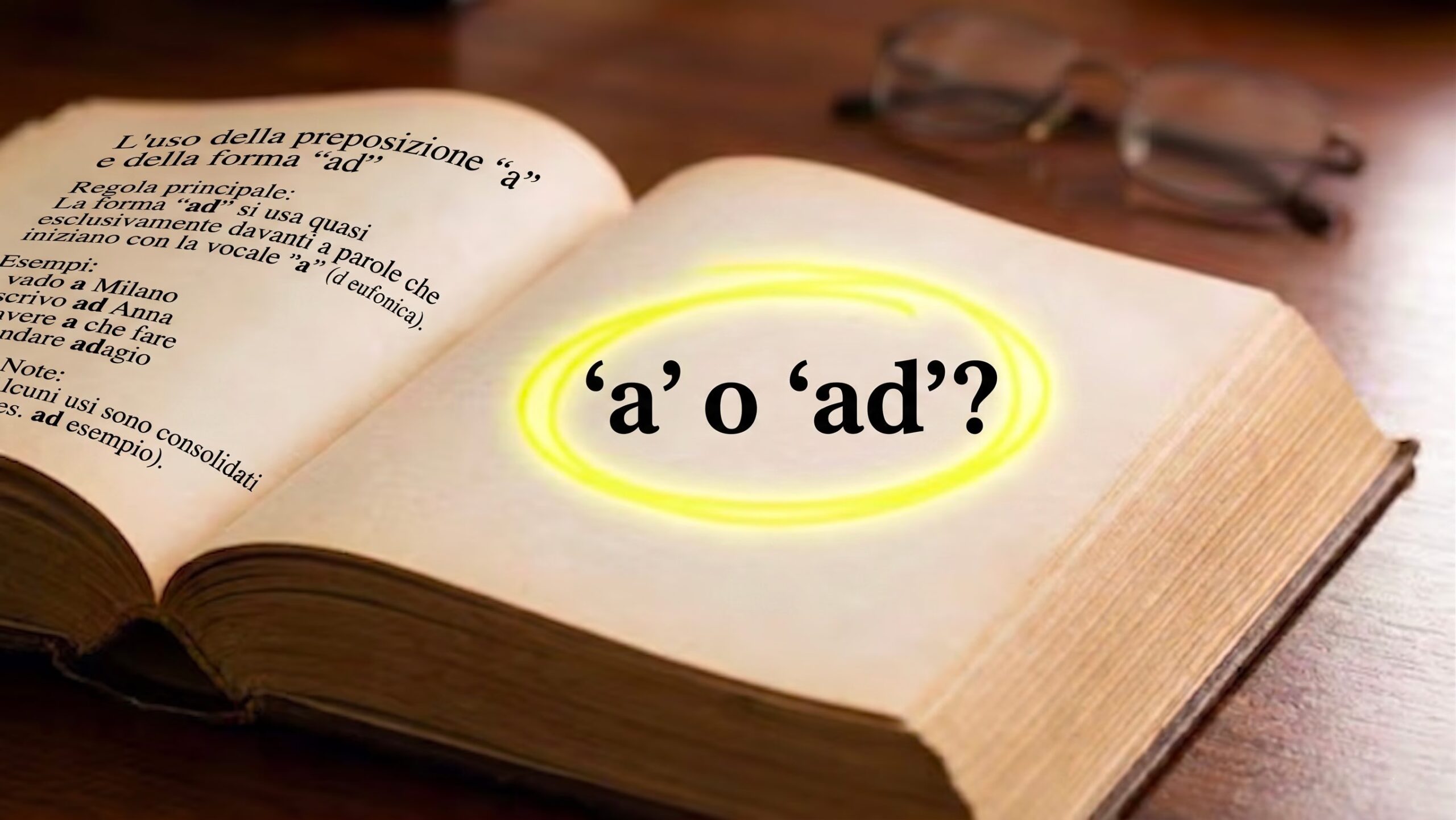
Do you write in Empoli or in Empoli? Hyenas and elephants or hyenas and elephants? Someone will remember a lesson at school in which the Italian teacher explained the correct spelling, someone else will have removed it along with many other grammatical rules and will never have noticed it again, but that “d” has a name, it’s called “d euphonic”a consonant that is added to the simple preposition “a” and to conjunctions formed by a single vowel (“e” and “o”) and whose use from ancient roots hides a precise and very simple rule, which once understood should no longer create difficulties. It is used with the same vowel (for example “in April”, “and behold”), while with different vowels it is better not to insert it because it is too heavy (“with the exception” of some commonly used formulas such as “in any case”).
What is the euphonious “d” and where does it come from
The adjective “euphonious” comes from Greek euphoniawhich literally means “good sound”, or “harmonious sound”. The task of this “d” is in fact to make the pronunciation more pleasant. It is an element that is added to a single vowel – exclusively to the “a” of the preposition, to the “e” and to the “o” of the conjunctions – to avoid clashing with the initial vowel of the following word (technically called hiatus).
This “d” has deep roots, which sink into Latin: according to the most accredited reconstruction, in fact, the euphonious “d” finds its origin in final consonants of the Latin bases et (which corresponds to Italian e), to (a) e aut (or). When Latin evolved to become modern Italian, that final consonant largely fell away, but remained ready to reappear whenever needed to avoid an unpleasant hiatus between identical vowels. In ancient times, in the texts of poets, this “d” was also attached to the negation nor, which became “ned”, but there were also forms such as “sed” for “if” and “ched” for “that”.
The golden rule on use
How is it used today? One of the greatest Italian linguists of the twentieth century took care of putting things in order, Bruno Migliorini (1896-1875), whose indication then became the reference standard, also taken up byCrusca Academy. The rule is simple: the use of the euphonious “d” should be limited to cases of meeting the same voweltherefore when the conjunction “e” and the preposition “a” precede words starting with “e” and “a” respectively. For example “in April”, “and Elisa”.
Try saying “a Amalfi” out loud: do you hear how the two “a”s seem to step on each other’s toes? The “d” serves precisely to avoid that stumble and to make the sequence flow more smoothly. Here “in Amalfi” immediately sounds better.
In short, the “d” is put only when the two vowels that meet are identical. So we will write:
- Live to Amalfi (and not in Amalfi)
- Hyenas and elephants (and not hyenas and elephants)
- And here we are, to go, and Henry
If instead the vowels are differentthe “d” disappears. No “kisses and best wishes”, “at every lap” or “helmets”: these are precisely the examples that the Treccani Encyclopedia indicates as forms to avoid, classic hyper-correctisms that weigh down the sentence for no reason. Fixed sequences such as “you and I”, “for example”, “except”, “until now”, “in any case” consolidated in everyday use are exceptions.
Pitfalls and exceptions
Like any self-respecting rule, this one also has its exceptions, five in particular:
- The case of “od”: while ed we use it continuously, od (instead of o) has now been very rare in writing for a few decades. Inserting it risks making the phrase sound bureaucratic and it is better to limit it to those few cases in which the ear really requires it;
- The “crystallized” expressions: as mentioned above, there are phrases so ingrained in usage that without the “d” they would sound strange, even if the vowels are different. For these the “d” remains mandatory. The most famous case is “for example”: in theory, applying the rule literally, we should write for example (the vowels “a” and “e” are different), but the expression has been fixed like this and is in this case correct with the d – same logic for “to date”, “at any rate”, “with the exception of” and so on;
- The “d” too many: if the vowels are identical, but the next word already contains a “d” in the first syllable, it is better to give up so as not to create an unpleasant repetition of sounds. Sequences such as “and buildings” or “sounds or smells” are to be avoided;
- The aspirated “h”: the use of the euphonious “d” is improper in front of words that begin with an aspirated “h” (it is written “to hamburger”, not “to hamburger”, it is written “the photographers Martin Parr And Helmut Newton”, etc.).
- The comma or the incisions: in the written form the euphonious “d” is never placed before a comma or an aside. A sentence like “he arrives suddenly, and, exactly like the other times…” is wrong, as is “Sara, Matteo and – exceptionally – Elisa showed up”.
In any case, contemporary Italian is much more tolerant of hiatuses than the literary Italian of the past. This means that, even when the vowels are identicalwe can very well do without the “d” without making a real mistake. Saying or writing “I met Luigi and Enzo” is acceptable. The rules of euphony are not set in stone: they depend on the taste and sensitivity of each eraand change over time. This is demonstrated by the fact that those old forms such as “ned” and “ched” have almost completely disappeared from our daily speech, even if they survive within words that we still use today without realizing it, such as “someone” and “each”.
