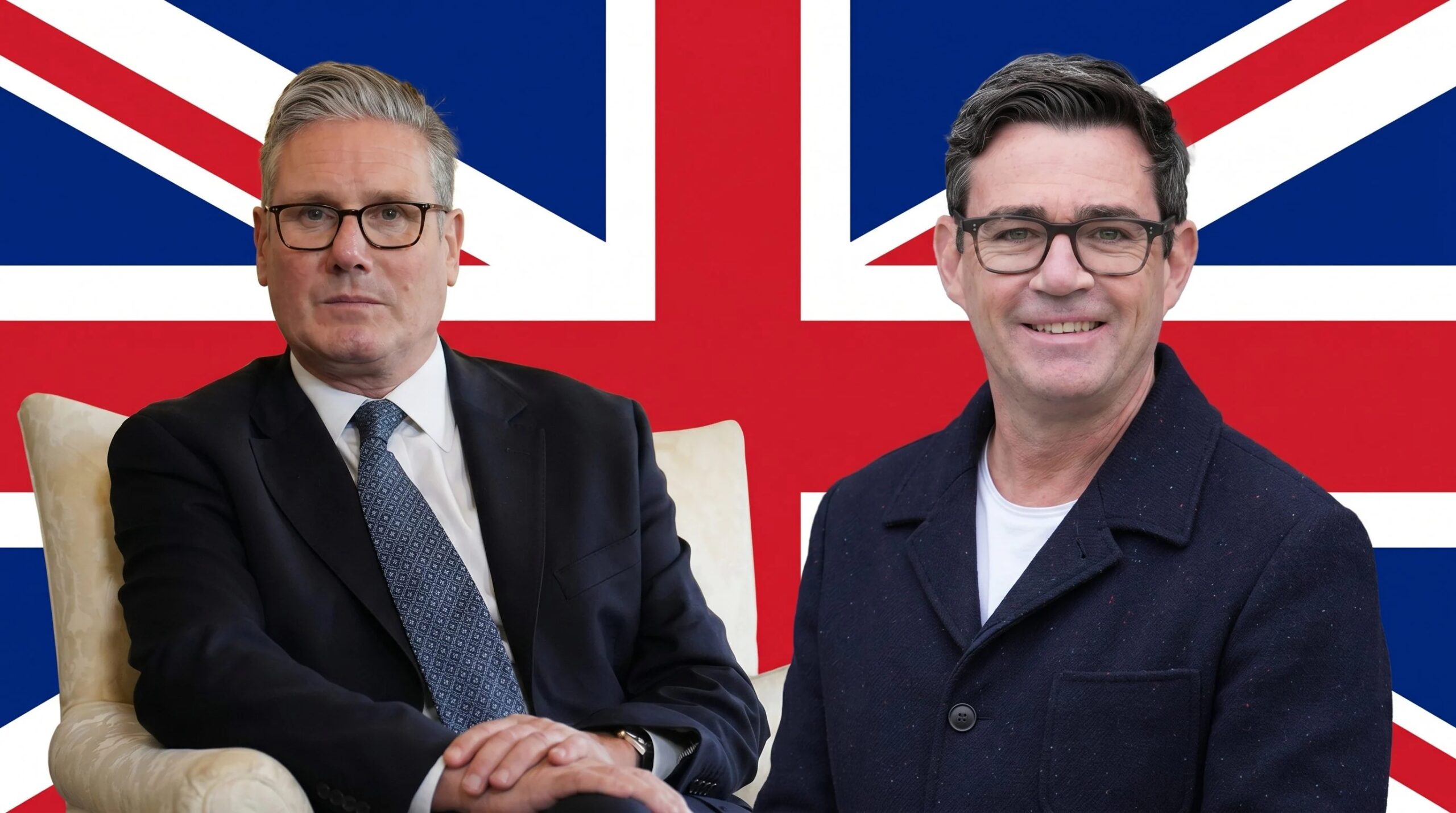
Keir Starmer, The Prime Minister of the United Kingdomannounced his resignation as head of government And leader of the party Labour: In a speech at 10 Downing Street, he said he had already spoken to King Charles III to inform him of his decision.
Although his party had obtained a landslide victory in July of 2024 (after 14 years of conservative governments), Starmer’s resignation does not come as a surprise, to the point that the US President Donald Trump he had already announced the news in a post on his social network Truth, even before it became official.
Over the last few months, in fact, the Starmer’s popularity era dropped drasticallyboth within its own match that among votersmainly due to resignations of executive ministers, political changes of direction and increasingly disappointing electoral results. Meanwhile, Starmer’s main competitor, Andy Burnhamconfirmed his intention to run as the new leader of the Labor Party and new prime minister: Starmer will remain in office until his successor is elected.
For the United Kingdom this is the sixth head of government to resign in just 10 years: unlike countries like Italy, however, the United Kingdom for years it was theexample of political stability thanks to the continuous alternation between two equally strong parties (the so-called two-party system): the Labor party, that of Keir Starmer, closer to the centre-left, and the Conservative party, with more centre-right positions.
Why Keir Starmer resigned: Andy Burnham’s victory in the by-election
But why has Keir Starmer decided to resign now? The British government, in reality, was already in a deep crisis of consensus, both within the Labor Party and among voters. The recent resignation of Health Minister Wes Streeting and of Defense Minister John Healeyfollowing which Starmer was accused of putting the UK’s security at risk at a time of growing international threats, further worsened his popularity.
Despite its large victory in the 2024 elections, over the past few months Labor has progressively lost support due to a series of scandals, political changes and increasingly disappointing election results. In May the party has lost Almost 1,500 councilors in English local elections (on a total of 5,066 seatsof which Labor controlled around 4,900 before the vote), has lost the government of Wales and recorded the worst result of its history in the elections for the Scottish Parliament.
At the same time, as highlighted by ISPI analysts, there are also Starmer’s personal difficulties to consider: the prime minister had come to government presenting himself as a moderate leaderattentive to the population’s requests on issues such as immigration, welfare and economic policy. But precisely this constant search for a balance between the different parts has only fueled the criticisms of a political vision that is not very decisive and recognizable, which is why personal popularity has plummeted.
Andy Burnham’s victory in the by-elections in Makerfield, in the north-west of England, came into play in this context: these are elections held to re-assign a parliamentary seat left vacant, in this case after the Labor MP Josh Simons had resigned.
He was the winner Andy Burnhamthe former Mayor of Great Manchester and one of the most popular figures of the British leftso much so that he earned the nickname “King of the North”. The point is that Burnham was not a candidate simply to return to Parliament (after years of absence from national politics): for weeks he had openly declared that he wanting to challenge Starmer for the leadership of the Labor Party and to do so he needed to gain a seat in the House of Commons (the equivalent of our House of Representatives).
Why the UK has changed 7 prime ministers in 10 years: political instability since Brexit
Starmer’s successor will therefore be the seventh British Prime Minister in just 10 years: none of them reached the end of their mandate, ending up resigning early. The government of the United Kingdom, historically considered one of the most stable within the European Union, is in the midst of a profound crisis of political instability, which began at a precise point: the Brexit referendum of June 2016.
After the vote to leave the EU (in which he won 52% to 48%), the then Conservative Prime Minister David Cameron resigned, with Theresa May who was chosen to replace him. May, who in 2017 had bet on early elections to strengthen her majority (and instead achieved failure), left the leadership of the government in May 2019, after failing to break the parliamentary deadlock on Brexit.
At that point, the government passed into the hands of Boris Johnsonwho won the early elections in December 2019 with the slogan “Get Brexit Done”, completing the exit from the EU and leading the country during the pandemic: a series of scandals that broke out in 2022 (also partly linked to the management of the pandemic) forced him to resign.
It happened to Boris Johnson Liz Trusswhich set a new record by remaining in office for just 44 days. In October 2022, the leadership of the government passed into the hands of Rishi Sunakthe third prime minister in a few months, who in May 2024 called new elections for the following July, which were then won by Starmer.
From there the decline of the Labor Party has been rapid: tax rises of £40 billion a year, overtaking the Reform UK (the opposition party) in the polls since February 2025, the disaster of the May 2026 local elections and the resignations of ministers Streeting and Healey.
The common thread that explains the continuous resignation of British prime ministers, therefore, is a fundamental difficulty: from the Brexit vote onwards, the United Kingdom has tried to chart its own path as a global power outside the European Union, but has struggled to grow a low-growth economyheld back by high debt and rising welfare spending, in a geopolitical context more and more unstable and complex in which it is increasingly difficult for a European country to emerge as a power.
How the Labor Prime Minister’s successor will be voted: the British electoral system
At the moment, what several British media expected has not happened: Starmer, in fact, has not named his direct successor Andy Burnhamwithout going through an internal party election. So how will the new British Prime Minister be chosen? At the moment, it seems that no early political elections will be called (expected for 2029 instead). Since Starmer was the leader of the Labor party (which currently has an absolute majority in the British Parliament), the new prime minister will simply be the new leader of this party.
The British political system, in fact, provides that the head of government is, however customThe head of the party that won the elections. In this case, therefore, an internal Labor Party election will take place. In case the leader resignsevery possible candidate must be supported by at least 20% of Labor MPs (which currently corresponds to 81 parliamentarians): in addition, candidates must also gather the support of at least 5% of local parties (the so-called Constituency Labor Parties) or at least three affiliated organizations (two of which must be trade unions).
The final vote takes place with a preferential systemthrough which each voter can list the candidates in order of preference: whoever gets at least 50% of the votes wins.
Starmerwhich will remain anyway in office until his successor is elected, he announced that the selection process will begin on July 9th and should be concluded in the summer or in any case before the party convention at the end of September.
