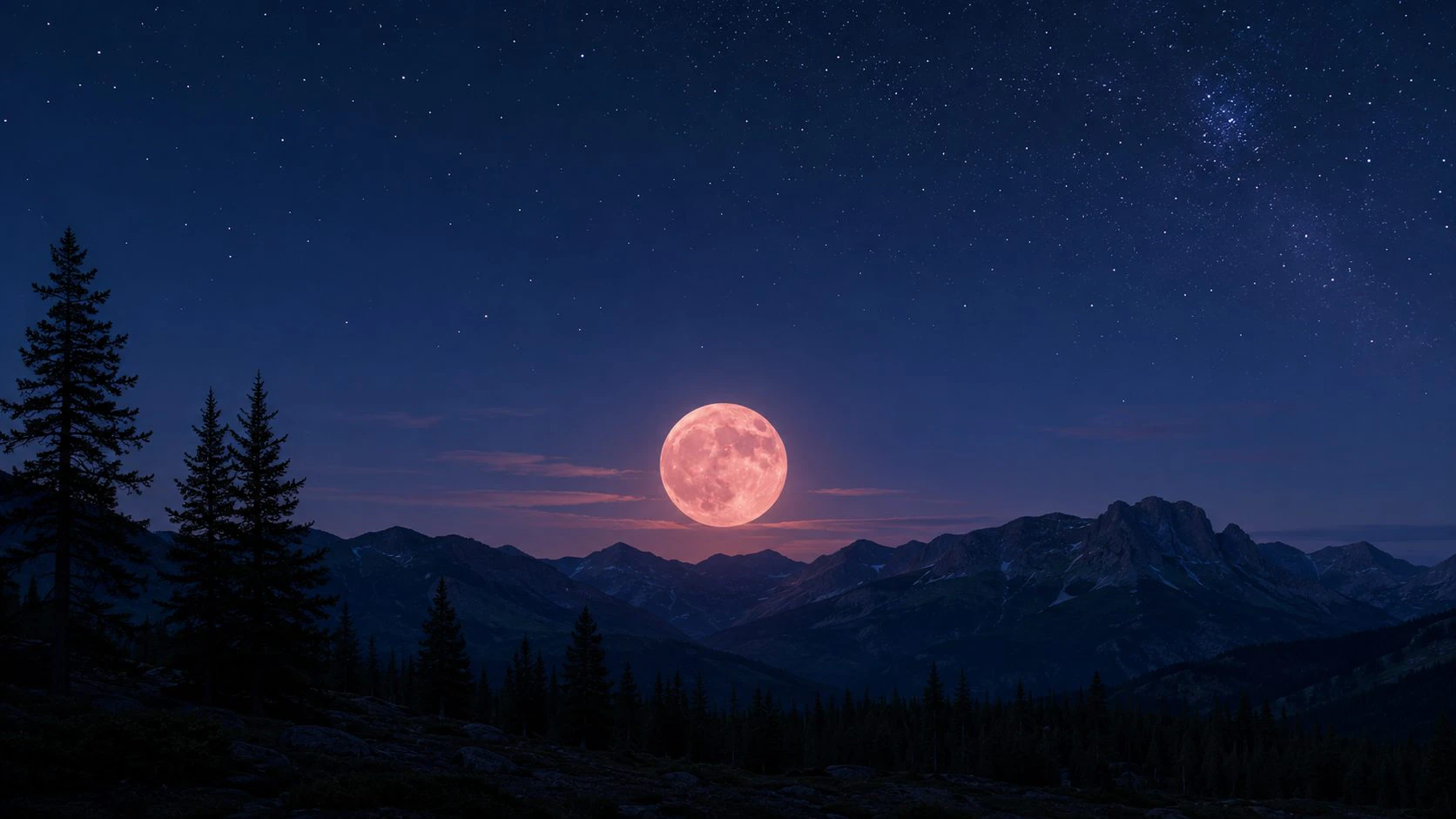
There first full moon of the summer 2026 arrives in the night between Monday 29th and Tuesday 30th June. The Full Moon phase will be reached exactly at 01:56 Italian time June 30thbut our natural satellite will appear substantially full for about three daystherefore it will be observable both the previous and the following evening.
This full moon is traditionally known as “Strawberry Moon”a name which however has nothing to do with the color of the Moon: our satellite it will not turn pink or red for this reason. What makes the event special is the fact that it will also be a “micromoon”that is, a full Moon that occurs when our satellite is located close to the apogeethe farthest point of its elliptical orbit around the Earth. The event will be visible to the naked eye from all over Italy, weather permitting, even if the size difference compared to a normal full Moon it will be a lot difficult to notice without a photographic comparison.
How and when to observe the full moon on June 30th
There Full moon will occur at 01:56 of June 30, 2026therefore in the middle of the night between June 29th and 30th. To observe it, however, it will not be necessary to set the alarm clock exactly at that time: the Moon will appear full already since the evening of June 29th and will continue to appear almost completely illuminated even on nearby nights. The best time to observe it it will be around the moon risingshortly after the sunset of the Sun. In this phase our satellite will be low on the horizon and will be able to assume a redder shade due to the greater amount of atmosphere crossed by its light. It’s the same reason why the Sun appears redder to us at sunrise and sunset.
This Full Moon will also be particularly low in the northern hemisphere skybecause it falls a few days after the summer solstice. At this time of year the Sun travels in a very high arc in the sky during the day, while the full Moon, being roughly on the opposite side of the sky from the Sun, follows a lower trajectory during the night, reaching a maximum height above the horizon of about 25 degrees during transit to the meridian.
The observation of the Strawberry Micromoon does not require special tools: just look towards the eastern horizon after sunset, looking for a point with a view free from buildings, mountains or trees. Binoculars and telescopes are not necessary, although they can be useful to better observe the lunar seas, the most obvious craters and the differences in brightness on the surface.
Because it will be a micromoon: slightly smaller than normal
The Moon orbits the Earth following aelliptical orbit which determines a constant change in its distance from us. When a Full Moon occurs near the perigee we commonly speak of “Supermoon”; when it actually happens close to the apogee we talk about “micromoon”both names of journalistic rather than astronomical origin. In the case of the Full Moon on June 30, 2026, our satellite will be close to the apogee on June 28, when it will reach a distance of approximately 406,265 km from Earth at 09:10. The result is that the full Moon will appear slightly smaller and dimmer than normal. The difference, however, is not so evident to the naked eye: to really notice it you would need to compare two photographs of the full Moon taken with the same instrumentation and in the same conditions, one near the apogee and one near the perigee.
The meaning of the name Strawberry Moon
The name “Strawberry Moon” comes from English Strawberry Moon and became popular thanks to the American agricultural almanacsespecially starting from the 1930s. The reference is to the Algonquian populations of the north-eastern United States, for whom the full moon in June coincided with the short wild strawberry harvesting season. This means that the name is linked to the agricultural calendar and not to the physical appearance of the Moon. Although the name might make you think of a pink or red Moon, our satellite will appear in its usual color: white, yellowish or reddish depending on the height above the horizon and atmospheric conditions.
