Despite the transition to energy sources green and renewables, the coal continues to play a central role in the global energy system. There Chinain particular, produces over 52% of the world’s coalapproximately 4,600 million tonnes, more than any other producing country, and uses over 4,900 Mt to support national needs.
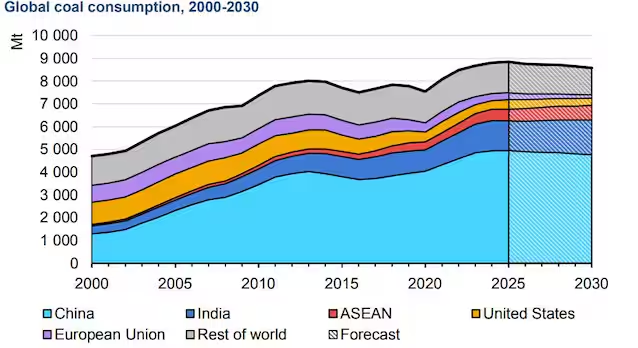
According to the report Coal 2025 – Analysis and Forecast to 2030, published by the IEA (International Energy Agency), in 2024 global coal production stood at approx 9,100 million tons (Mt), of which 4,666 Mtequal to over 50% of global production, were produced in China. In the ranking of the main producing countries they follow India (1,082 m), Indonesia (836 Mt), United States (461 Mt), Australia (474 Mt) e Russia (426 Mt). Collectively, these six countries represent over‘80% of global coal production. In Europein 2024 they were produced approximately 378 Mt of coal, with Germany And Poland which confirm themselves as the main producers on the continent. According to the IEA’s first estimates, these values should remain substantially stable also in 2025, while the Chinese production could increase by just over 1%, reaching approx 4,730 Mt.
Coal production and consumption are influenced by numerous factors, including the price of oil and natural gas, climate conditions, geopolitical context and the availability of other energy resources in the area. In India, for example, one season of monsoons particularly intense has reduced the demand for electricity and increased the hydroelectric productionleading to a decrease in the use of coal. In Europe, however, the lower production of hydroelectric and wind energy recorded in the first months of 2024 has favored greater use of coal to compensate for the energy deficit.
In China the situation is very different, as coal represents the main energy sourcecovering over the 60% of national energy needs. In 2024 consumption exceeded 4,952 Mtgiving China the primacy of the world’s largest consumer. Beyond 4,210 Mt were employed for the electricity productionfor heating and for the production of heat intended for industrial processes, while approx 734 Mt were used in sector metallurgical. By way of comparison, theIndiasecond in the world consumer ranking, records consumption of just over 960 Mtabout a fifth of those in China. It is also important to point out that domestic production is not enough to meet domestic demand, which is why China imported from foreign countries approximately 548Mt of coal.
IEA forecasts indicate that a gradual decrease in production and consumption, in the order of 1% per year, could be recorded by 2030. However, the growing demand for electricity and the geopolitical context of 2026, also characterized by tensions in the Strait of Hormuz and the resulting uncertainties in the supply of other fossil fuels, could slow down or even reverse this trend.
At the same time, the Chinese government has reiterated its goal of reaching peak carbon emissions before 2030 and accelerating the diffusion of non-fossil energy sources. Already today, China is the first country in the world for the production of geothermal heat for heating and aims to install further 4,700 GW of capacity from renewable sources by 2030. In 2024, energy production from renewable sources was strongly affected by high weather variability in the Central Asian region. Frequent fluctuations in hydroelectric, photovoltaic and wind generation have made it necessary to rely more on coal to ensure the stability of the energy system.
