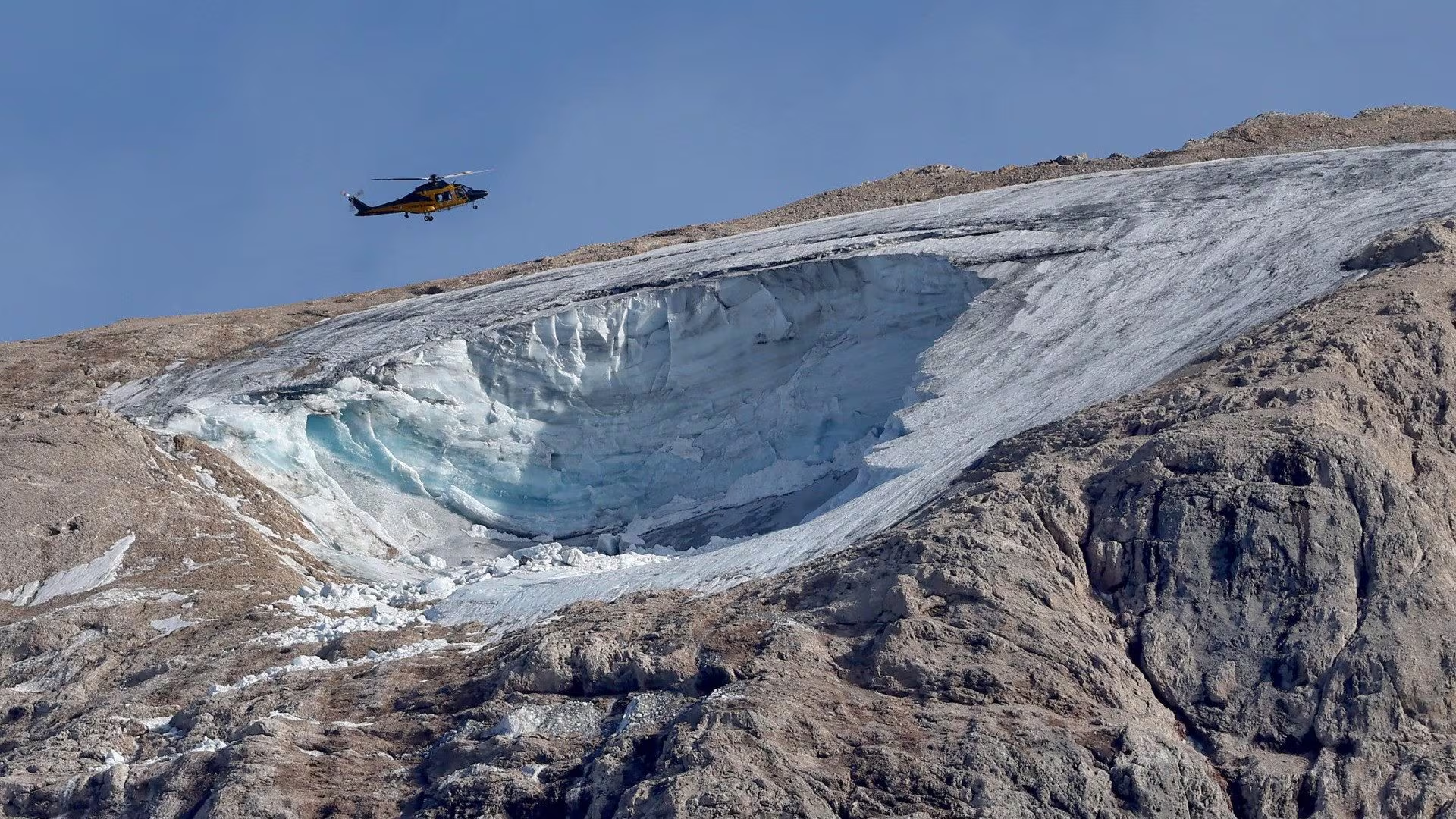
Four years have passed since, the July 3, 2022suddenly broke away from the Marmolada glacier 3200 m of altitude a mass of over 70,000 cubic meters of ice and debris causing 11 victims and 8 injured. There cause of the collapse was traced back to high temperatures due to ongoing climate change. However, a recent international study has identified with greater precision the concomitant factors that led to this disastrous event, reconstructing it the origin of collapse. To do this, the researchers used advanced technologies which are now also used for monitoring Alpine glaciers with the aim of prevent the risk linked to these events. The study, which also involved several Italian universities, was published in the journal in 2025 Natural Hazards and Earth System Sciences.
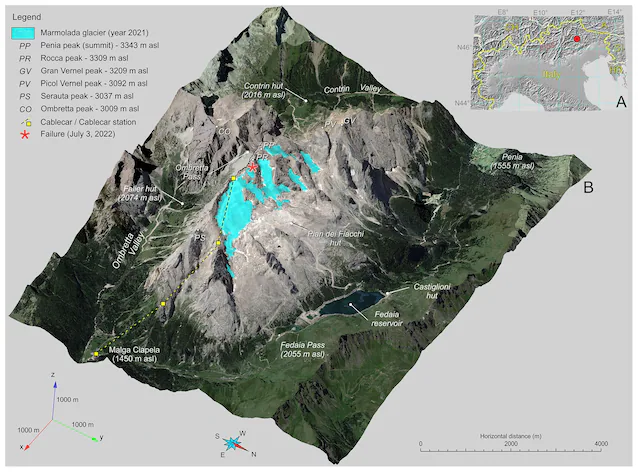
The reconstruction of the factors at the origin of the collapse of the glacier
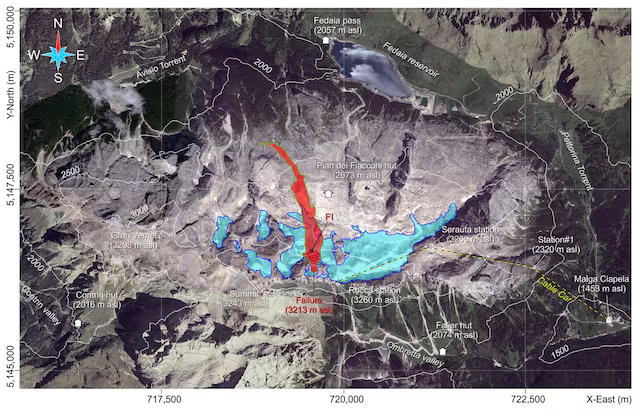
The researchers verified that the collapse of the ice mass took place in correspondence with a small glacial cirque located under Punta Roccaat 3309 m above sea level, in an area of the glacier that is already fractured and fragile. The detachment occurred on a slope inclined up to 40° and the mass traveled approximately 2.3 km at an included speed between 80 and 90 km/h. There was no earthquake at the origin of the event, but il was immediately identified as being responsible climate change. The high temperatures of summer 2022 resulted in the melting of the ice with the formation of a layer of liquid water between the glacier and the mountain, which acted as a lubricant, favoring the sliding and detachment of the ice mass.
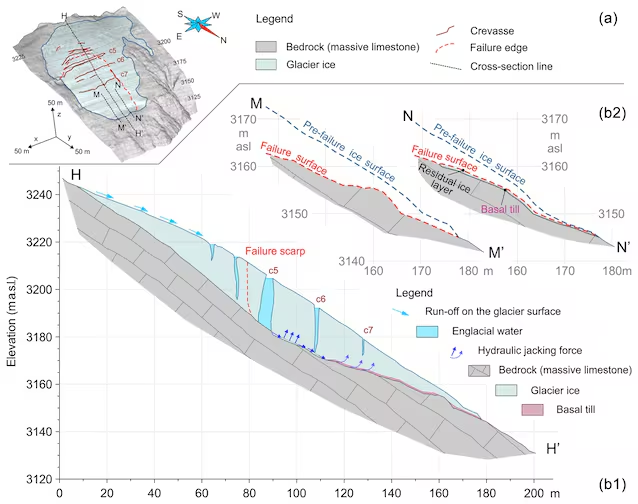
In the recent study, the researchers’ analysis highlights that the collapse was caused not by a single factor, but by a combination of concomitant conditions:
- a accelerated fusion of snow and ice due to the record temperatures of spring-summer 2022;
- the presence of a large amount of melt water which has infiltrated from the surface in the crevasses exerting high pressure;
- there permafrost melting in the rock beneath the glacier, which was therefore no longer able to exert its bonding action between ice and rock;
- there high slope of the slope, covered by layers of poorly cohesive glacial debris.
Aldino Bondesan, geographer at the University of Padua and author of the study, said:
The glacier suddenly found itself in a condition of precarious equilibrium: the internal temperature was high, the base was unstable and the water under pressure, in the crevasses and at the base, exerted a push.
The event was therefore sudden, with a collapse occurring within a few seconds, but the conditions that predisposed it to occur persisted for months and even years. During this period, due to global warming, the glacier had already retreated and thinned, fragmenting into several portions.
The techniques used by researchers to study the origin of the collapse
For the study the researchers carried out geophysical investigations including reliefs with ground penetrating radar (Ground Penetrating Radar – GPR), which made it possible to obtain images of the glacial mass in depth by sending pulses of electromagnetic waves. They were used drones equipped with LiDAR technology (Light Detection and Ranging), who carried out high-precision topographic surveys of the ice and surrounding areas, providing 3D maps and making it possible to identify crevasses and evaluate the stability of the glacier.
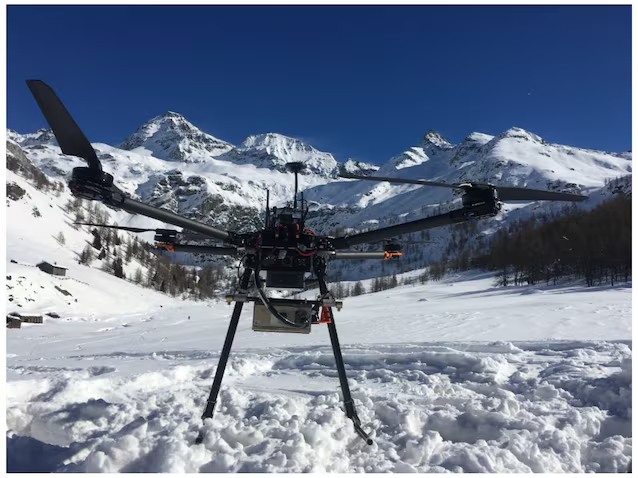
They were then processed high resolution satellite images to analyze the presence of water on the surface and inside the ice. A was also carried out glacier core drilling residue and were inserted temperature sensors at different depths in the glacial mass. These indicated temperatures included between -2.4 and -3.1 °C in the core of the glacier, values dangerously close to the melting point. The researchers then numerically simulated the stability of the glacier using the Limit Equilibrium Method (LEM)a technique commonly used to evaluate the stability of slopes. Investigations and simulations have shown that the loss of equilibrium of the ice mass occurred for theinteraction of concomitant factors e not for a single condition.
After the collapse of the Marmolada glacier, these techniques were also used for ice mass monitoring residual, with the aim of identifying anomalies and signs of instability. Knowing the variations in ice thickness, the presence and distribution of pockets of water or layers of melted ice at the base is essential for the risk prevention linked to events such as that of 2022. With the same aim, these investigations will be extended to other Italian glaciers.
