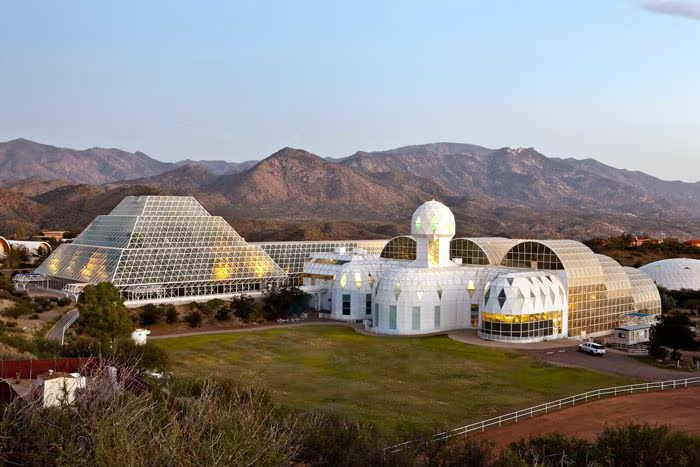
The largest terrarium in the world is Biosphere 2: a huge artificial ecosystem completely closed and isolated from the outside which is located in Arizona and extends over 1.27 hectares, enclosing an internal volume of approximately 200,000 cubic metres.
But do you know what it means to put together air, water, soil, plants and people inside this gigantic closed space and try to make everything work without exchanges with the outside? It means, in fact, taking away one of its fundamental characteristics from the biosphere: the possibility of diluting, compensating and rebalancing.
In this large-scale artificial ecosystem tropical forest, agriculture and other environments coexist under the same envelope. The result was not just a “giant terrarium”, but a concrete experiment on what happens to ecosystems when they are isolated. More than imitating the Earth in miniature, this enormous closed system showed how much life depends on delicate balances, on invisible feedbacks and on chemical and biological processes that, once isolated, suddenly become evident.
After being under the management of Columbia University for eight years (1995-2003), the facility is now led by the University of Arizona, which has transformed it into a world-class research center.
A terrarium on an architectural scale
Defining Biosphere 2 a “terrarium” helps to give us an idea, but it is scientifically reductive. Do you know the domestic ones that we keep in the living room? Water and matter rotate in a super simple way in there. Biosphere 2, on the other hand, is a giant terrarium with an extreme experimental setup designed to study what happens when a set of ecosystems and humans share the same confined atmosphere. This can be understood even just by looking at the level of insulation: air leaks were designed to remain below 10% per year, a value approximately a thousand times more stringent than in a normal building.
In practice, it is as if it were a sealed steel and glass box: no clean air from outside, no water supply and no dispersion of the gases produced inside. Everything that came in or out had to be authorized and documented by scientists. The only thing that wasn’t “closed” was the energy: the structure received sunlight, imported electricity and used an immense thermal system to keep everyone from dying of heat under the Arizona sun.
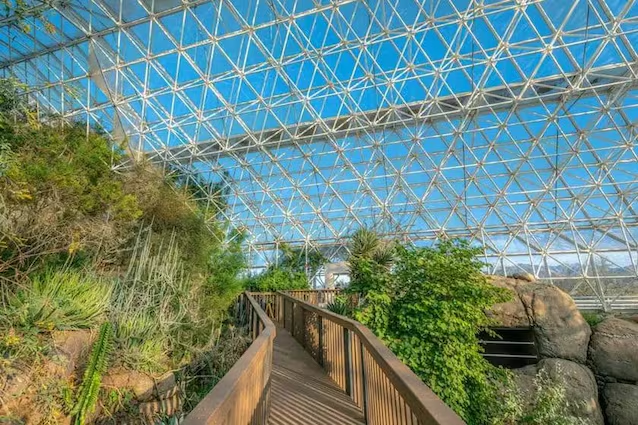
But the real engineering genius of this scientific experiment lay in pressure management. Think about it: when indoor air warms up it expands, when it cools it contracts. In such a rigid and sealed structure, such changes would risk causing the glass to explode. To avoid disaster, engineers invented “lungs” (lungs): enormous variable-volume chambers capable of expanding and deflating to absorb changes in pressure.
Because to create a closed ecosystem it’s not enough to put four plants under glass, eh? We need an architecture that knows literally breathe without breaking.
One shell, many internal worlds
Inside Biosphere 2 there was not a single climate, but five model ecosystems large enough to show real ecological processes (the mesocosms) that coexisted under the same glass: tropical forest, savannah, swamp, desert and even a small one oceanin addition to agricultural area and human habitat. All these worlds were connected by a single common atmosphere.
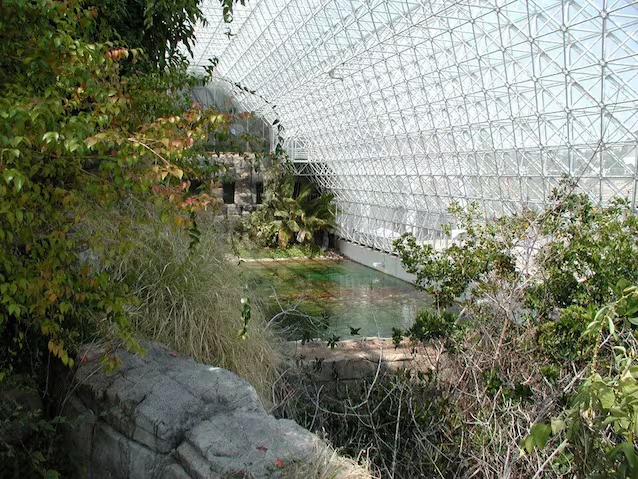
A scientifically powerful choice, but also very risky. If on Earth ecosystems breathe thanks to immense reservoirs of air, water and soil that cushion any changes, in Biosphere 2 these reservoirs were very small compared to the quantity of plants and organisms present. In such a system, natural cycles no longer behave as they do on Earth. The result of all this? In the terrarium the transformations occurred over shorter times and with more evident variations.
What on Earth is diluted, absorbed or compensated on an enormous scale, here accumulated and was immediately visible.
The tropical forest, but not the one we all have in mind
One of the most fascinating biomes of this project was the tropical forest. It had several functions within the system (contributing to the gaseous exchanges of the internal atmosphere, increasing biological diversity, and also offering useful resources to the inhabitants, such as some food plants). The area designated for forest covered approx 1900 square meterswith a total volume of approximately 35,000 cubic meters. Inside they had been introduced further 282 plant species coming from tropical forest areas.
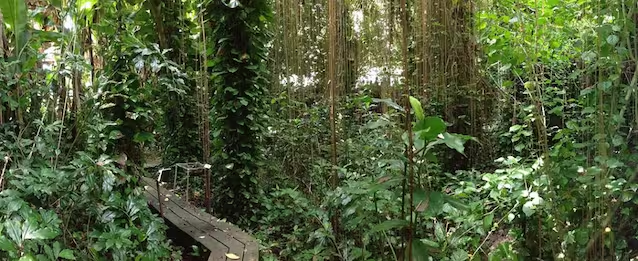
But why so many? This choice to “overload” the environment with species was not accidental: the researchers wanted to leave room for ecological self-organization and observe which communities would spontaneously form from the interaction between internal climate, soil, introduced species and human presence. After two years of closure, 39% of the species had vanished, but the remaining 61% had created a new, adapted community. It was proof that the system was not static: it was selecting, transforming, reorganizing.
An important point must be clarified here: this tropical forest did not grow in the same conditions as a natural tropical forest. The internal conditionsin fact, they totally were anomalous compared to a real equatorial forest: the soil was artificial, the temperatures were different and the CO₂ reached peaks of 4500 ppmv. This “super-greenhouse effect” has caused plant growth to skyrocket: in three years biomass has increased by 400%and some trees grew four times faster than normal, but developed thinner trunks.
And human management played a decisive role in this: human intervention in fact accelerated the succession towards more advanced stages, favoring species considered important in the long term, especially large trees. Therefore the forest was not only the product of biological self-organization, but also of the choices of residents and managers. Biosphere 2 therefore demonstrates that in a closed system the “natural ecosystem” and the “human factor” are not easily separable.
Agriculture: the biome that fed people and the problem of classical agriculture
If the tropical forest was the symbolic heart of the project, theIntensive Agricultural Biome it was his kitchen. This agricultural mesocosm of approximately 0.22 hectares had to produce enough food to sustain the inhabitants during periods of closure.
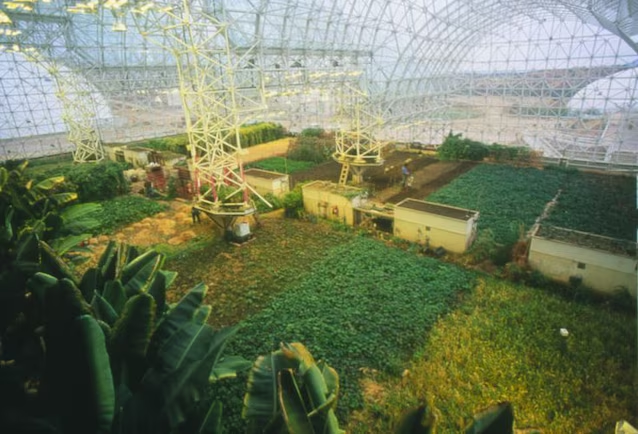
During the two missions from the nineties (the first from 1991 to 1993 and the second from March to September 1994) and despite the little light and parasites, productivity was higher than that of the most efficient traditional lands, guaranteeing a low-calorie but super nutritious diet (about 1800–2200 kcal per day per person in the first mission and 2200–2400 kcal in the second). It was an integrated ecological supply chain: crops, wastewater recycling, rice paddies and even ducts to pass air through the land to purify it.
But there was a problem: the scientists chose classical (soil-based) agriculture rather than hydroponics, and the soil, very rich in organic matter, literally began to “burn” its reserves. And so, the microbes in the soil were breathing too much, and in doing so they consumed oxygen and released mountains of CO₂, which was then trapped by the concrete of the structure. As, in winterwhen the light was less and therefore photosynthesis slowed down, the air inside was almost unbreathable.
In a closed atmosphere every gas counts
Thanks to the incredible seal of Biosphere 2, scientists were able to monitor gases like never before. The result? Plants, soil and microbes were so “powerful” compared to the small volume of air available that they literally drove carbon dioxide (CO₂) levels crazy. Put in practical terms: the amount of gas went on a roller coaster in the space of a few hours, impressively altering the composition of the air between day and night.
But the twist was nitrous oxide (N₂O), a potent greenhouse gas. In the soils of the Intensive Agricultural Biome, and even more so in the rainforest during some periods sampled, it was produced in high quantities, and its levels shot up to 300 times more than normal. This is because on Earth these gases are dampened by immense compartments or destroyed in the stratosphere, but inside the dome there were no escape valves.
It is the phenomenon of accelerated cycles: if on our planet the cycles of carbon, nitrogen and oxygen are vast and slow, in Biosphere 2 they were tiny and very fast. And it is precisely this that has allowed us to study them almost in real time, leaving us a fundamental legacy for designing future human bases in space or on Mars.
From the “giant terrarium” to a successful laboratory for studying the Earth
Over time, Biosphere 2 has changed radically: from the initial goal of keeping humans alive in a sealed ecosystem, the structure has been transformed into a super laboratory to study the Earth. The most notable case is the Landscape Evolution Observatory (LEO): three enormous inclined artificial landscapes (330 m² each), made of crushed rock and placed in a totally controlled environment where scientists can decide how much rain to fall, the humidity, the temperature and even the wind speed.
This is a huge conceptual leap. In LEO, researchers closely follow how water and carbon move and, above all, how soil is born and evolves from scratch. The measurements are mind-boggling: thanks to hundreds of probes that collect data every 15 minutes, every millimeter of land and air is monitored, recording the impact of millimeter-level artificial rainfall on soil CO2. It is no longer simple observational ecology, but real-time process ecology: researchers turn a knob, change a variable and immediately see what happens.
From the “giant terrarium” to a successful laboratory for carrying out experiments and studying the Earth
The truth success of Biosphere 2 lies in having demonstrated that an ecosystem is not just a sum of plants and air under glass, but a live and unpredictable system where microbes consume oxygen, gases accumulate, species do not stay where they are put, and human presence changes the ecological trajectory as much as the internal climate.
But it must also be said that this great laboratory gave us the most important lesson of all: the stability of life on Earth does not arise from simplicitybut with an immense and very delicate complexity. If in a small living room terrarium all this is barely noticeable, in Biosphere 2 it is impossible to ignore.
