“When will he start walking?” It’s the classic question of every parent. Usually, i first steps they happen around one year of life, but the window considered “physiological” is much wider, up to 18 months. But why does nature choose this moment? Unlike other animals, our bipedal posture requires a lot of coordination work and of specific brain structures that mature over time. Some external factors, such as the time of birth, the use of walkers or play practices, can decrease or increase the time needed to walk independently. A moment when even the language and communication of little humans explodes, precisely thanks to the achievement of the upright position and a broader and more panoramic vision.
From crawling to walking: when the first steps begin and age variability
One of the biggest sources of anxiety for new parents is comparison with other children: “My friend’s child is already walking, why can’t mine?”. In reality, the time window in which children take their first steps in total autonomy is extremely broad and ranges from 8 to 18 months of age! The general average found in different risearches indicate that age average for the start of independent walking it is around 12-13 months, but it is just an average: there is no need to worry if the child starts later, given that the range is much wider. In clinical settings, this milestone is often defined very precisely, for example as the child’s ability to take at least five consecutive steps without any external support or without falling. But how do we achieve this achievement?
Developmental scientists Schneider and Iverson talk about a fascinating phenomenon called “equifinality“: there are many different paths that lead to the exact same result. Some newborns crawl on their hands and knees, others crawl on their bottoms, and still others get up early and walk sideways while holding on to living room furniture (a practice known as “cruising”). Before they even leave their parents’ hands, babies accumulate an enormous amount of motor experience. During free play, a child learning to move can spend up to 75% of his time moving, accumulating thousands of steps and countless attempts every day. This enormous volume of supported practice serves to build the muscle strength and coordination necessary for walking.
Because animals do it right away while children take about a year
While many animalslike foals or calves, stand up and walk a few hours after birth, human cubs require, as we have seen, a much longer period to master independent locomotion.
Unlike the vast majority of mammals, which rest on four legs and therefore have a wider and more stable support base, the human walking And erect and bipedala unique characteristic of our species. Moving on two legs is a feat of physical engineering: it requires learning to balance on a tiny base of support, gradually developing a muscle strength and postural control of the trunk enormous to be able to constantly counteract the force of gravity.
The long period before being able to unhook and walk is therefore part of a precise evolutionary strategy. Having a very long sensitive period to learn to walk allows humans to adapt plastically to their local environment, experimenting with different motor solutions and accumulating months of practice and attempts before finally standing up.
As revealed by an analysis of Nature Human Behavior out of 70,000 children across Europe, the age at which one begins to walk also seems to be linked to one’s genetic plan which determines the maturation of the brain structures necessary for balance and movement. The “physical history” of the newborn also has its relevance: children born prematurely or underweight tend to show a slight delay in gait acquisition compared to those born at term. A 2021 systematic review reports that in those born preterm, in fact, the vertical development trajectory and the control of movements against the force of gravity require more time to fully consolidate.
Scientific studies on the golden ratio
When children begin to walk without support, their first steps are often hesitant, characterized by a very wide base, short steps, and frequent falls. How do they go from this clumsiness to a smooth, confident walk? The research published on Developmental Psychobiology indicates that the best predictor of walking ability it is not so much the age of the child nor his body size, but rather the “months of walking”, i.e the pure and simple experience accumulated from the moment he began to take his first independent steps. As the weeks go by, the steps become longer, narrower and much faster.
But perhaps the most surprising and poetic aspect of human locomotion is its mathematical harmony. In healthy adults walking at a comfortable speed, the ratio between the duration of the entire gait cycle and the phase of stance on the ground, and at the same time between the phase of stance and the phase of swinging the leg in the air, converges towards a specific number: 1,618. This number is famous in mathematics and art as “golden section“.
A study carried out between Rome and Amsterdam monitored children before, during and after their very first steps and discovered that the golden ratio is not present in neonatal motor reflexes and does not even appear at the exact moment of the first steps. independent steps. It’s only after you’ve accumulated some experience of walking without support that the rhythm of their steps begins to naturally converge towards this proportion. Think of someone learning to play the piano: the first few times they press the right keys, but the rhythm is mechanical, rigid and fragmented. Only with daily practice does the movement of the fingers become fluid and the melody takes on a natural musical cadence.
The surrounding environment: what stops and what favors the first steps?
Many parents wonder whether certain choices can influence or slow down motor development. THE’environment in which the child grows plays a crucial role: a study by Haspodar and colleagues noted that children who have more free space inside the house to explore and to toys designed to encourage locomotion (such as gymnastics or push carts) tend to exercise more and develop better motor skills compared to those who spend a lot of time in confined spaces or stationary with static toys.
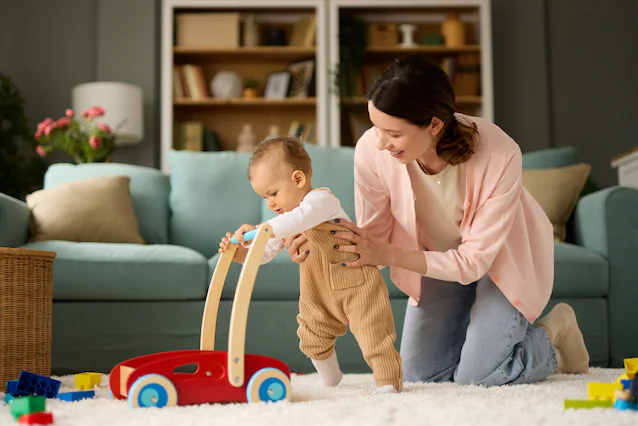
Even seemingly trivial everyday elements influence the mechanics of first steps. For example, a Dutch study showed that size or thickness of the diaper they alter walking, forcing children to widen their base of support and causing more missteps than when children walk naked.
A further environmental factor is the use of the walker: the same Dutch study states that prolonged use of the walker it can actually slightly delay the age at which children can stand and walk, altering their natural ability to balance. In short, the environment acts as a playground that can pose small obstacles or offer advantages, but the child’s natural biological drive to explore the world is usually strong enough to allow him to overcome most daily constraints without problems.
Walking changes children’s minds and communication
Learning to walk literally opens it up new visual, cognitive and social horizons for the child. By acquiring the upright position, the little one stops focusing mainly on the floor in front of him and obtains a panoramic view of the room; he can travel much faster and explore the environment, finally having his hands free to transport objects from one place to another.
This new independence triggers a powerful “cascade effect” on the development of communication and language. Observational studies by West and Iverson have shown that, as soon as children begin to walk, the frequency with which they use preverbal communication (such as gesturing, pointing or showing a toy) undergoes a sensational surge. This happens because the interaction strategy changes: While a crawling baby tends to sit and stop to try to communicate over a distance, a walking baby learns to fluidly coordinate movement with social interaction. He can walk directly towards the parent, hold up an object and seek eye contact from a whole new height. Consequentially, even the behavior of parents changes: Faced with these more direct interactions, parents tend to provide richer, more contingent, and more frequent verbal responses to a walking child than to one who is still crawling.
But there’s more: the age at which you start walking can also be a sign of future lifestyle habits. Long-term monitoring studies suggest that an older age at the onset of independent walking is often associated with a greater tendency to be sedentary in later childhood years, and to less time spent in physical activities. In contrast, “early walkers” show, on average, higher levels of physical activity as they grow older.
Sources
Schneider & Iverson, 2023, Equifinality in infancy: The many paths to walking Hospodar et al., 2021, Practice and proficiency: Factors that facilitate infant walking skill Størvold et al., 2013, Age for onset of walking and prewalking strategies Gui et al., 2025, Genome-wide association meta-analysis of age at onset of walking in over 70,000 infants of European ancestry West & Iverson, 2021, Communication changes when infants begin to walk Aoyama et al., 2018, Association between age at onset of independent walking and objectively measured sedentary behavior is mediated by moderate-to-vigorous physical activity in primary school children Boonzaaijer et al., 2020, Factors associated with gross motor development from birth to independent walking: A systematic review of longitudinal research De Bartolo et al., 2022, The Role of Walking Experience in the Emergence of Gait Harmony in Typically Developing Toddlers
