You’re watching Behind social media Don’t miss out on more content from Geopop
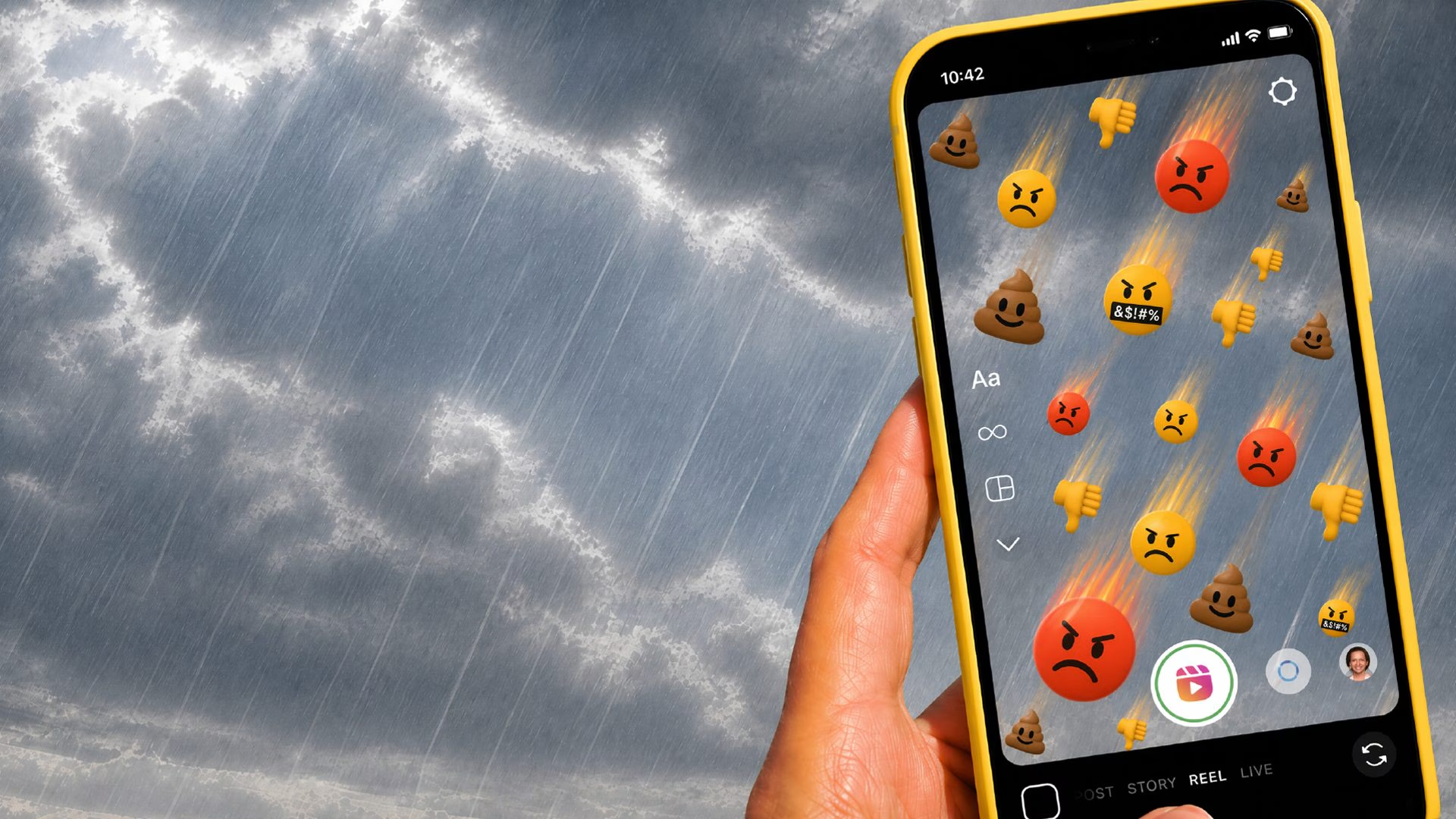
The shitstorm – in Italian “media pillory” – they are one of the most widespread phenomena on the web nowadays. These are those situations in which a person – often famous – becomes the public target of verbal violence and offenses following an event in which she was the protagonist. In short, the victim is insulted en masse after having done something that society did not like.
It is something that today – in the age of social – happens constantly. There is at least one shitstorm a month. And it’s something that affects all of us. Any of us may have written a negative comment at least once, or received one if we end up in the center of the eye of the storm.
But why does this happen? Because shitstorms are so widespread on social mediaand what are the mechanisms behind this phenomenon? And how can we defend ourselves if we become victims? Let’s see it in this article.
What is a shitstorm: the most famous examples
As we said, shitstorms are there version 2.0 of the pillory of the Middle Ages. What happens is that an individual, following a video, an article or a statement that is incorrect or that society deems wrong or unethical, becomes prey to insults. It is a phenomenon that usually affects famous people, but it can also happen to ordinary people, with often disastrous consequences.
The Ferragni case
An exemplary episode is that of the most famous influencer in Italy, Chiara Ferragni, who in December 2023 was accused of defrauding consumers for passing off a commercial practice as charity. Ferragni was submerged by a mud storm. Insults towards her, towards her family, her children… and there was also a serious consequence economic: in addition to having paid a fine of one million euros to the Antitrust (and this has nothing to do with the shitstorm), the influencer has lost more than a million followers, and for an influencer this means an enormous loss of economic value on the market, and in fact her personal brand has been greatly devalued.
This is an example of those cases in which shitstoms have a very long aftermath over time, even if there are many cases in which the media storm ends quickly time.
The case of the restaurateur from Lodi
Sometimes, however, shitstorms overwhelm even the lives of common people.
An unfortunately very famous example dates back to 2024, when a restorative lodigiana – Giovanna Pedretti – saw his life crumble in just a few hours precisely because of a media pillory. What happened: the restaurateur became famous on the web for having responded in an exemplary way to a homophobic and ableist comment in reviews at his restaurant. So in the beginning, he gained positive fame on social media. However, it happened that a famous commentator – Selvaggia Lucarelli – and her partner noticed that the homophobic comment had in all likelihood done herself and then respond in an estimable way. In short, he had used a trick – certainly unethical – to advertise on the web.
In a few hours his media fame went from being positive to extremely negative, and the restaurateur was inundated with insults from the people of the web. He ended up in the eye of the storm. And he couldn’t take the blow. He took his own life. Warning: we cannot say with certainty that it was the shistorm that killed her. When it comes to suicide, the variables at play are very complex and many. What we can say is that the shitstorm certainly did not help and greatly aggravated the psychological situation of the victim in question. It was the straw that broke the camel’s back. And all this happened for one fake review.
The impact of the media pillory on the famous and on ordinary people
There are differences between shitstorms towards public figures and shitstorms towards ordinary people.
On the one hand, we can say that the shitstorms towards common people they risk being more serious, especially from a psychological point of view. In a certain sense, famous people have a sort of habit of exposure, or at least they know better the risk of fame, the risk we run when so many people talk about us.
On the other hand, however, the famous people undergo what we might call “de-personification“, that is, that psychological and social phenomenon whereby public figures are considered by society not as real people, but as products, symbols, or in the case of shitstorms, targets. In short, the famous cannot make mistakes because they must be perfect as public examples, and one misstep is enough to bring them to the pillory. It is a consequence of the so-called halo effect.
Let’s see, at this point, what drives us to become executioners.
The mechanisms behind the shitstorm
The first concept to mention is that of social justice: if someone made a mistake, they must pay. A kind of “homemade justice”, where the users, the company, decide who will end up in the eye of the storm and what the punishment will be, i.e. the harassment that the victim of the shitstorm will have to suffer.
And why do we feel the need to do social justice? The psychological reasons are different, let’s look at the most important ones.
The first is the so-called altruistic punishmentthat is, the act of punishing someone who has violated an ethical, moral or social norm, even if punishing costs us time and energy and does not bring us any benefit – which is why it is called “altruistic”. In truth, clearly, there is a benefit and it is psychological: protecting society’s values makes us feel good, it gives us a rush of dopamine, the so-called “pleasure hormone”.
Another reason is the so-called virtue signaling, in Italian virtue signaling: by lashing out against those who have made mistakes, we are affirming our ethics and morality. It’s as if we were saying: “I would never do that, I’m the right person”. And the more indignant we show ourselves, the more we consider ourselves to be people of value.
Then there is the so-called crowd effect. Simply put, we could describe it like this: “if others do it, I can do it too”. According to this mechanism, we evaluate our insults as less serious, because they get lost in a sea of other comments.
It is also true that on social media we allow ourselves to say things that we would never say in person. This is because there is a difference between us and the interlocutor physical barrierwe are not faced with our “adversary”. We do not perceive danger, we are unable to think about the consequences of our actions.
And if we were the victim instead, what should we do?
What to do if you fall victim to the media pillory
The first fundamental rule is: do not respond immediately. I know, it seems banal, but often when we feel attacked the first instinct is to defend ourselves, to respond in kind, perhaps even trying to justify ourselves, most of the time clumsily or aggressively.
Even if we feel like we need to take action right away, the most important thing to do is: wait. Collect all possible information, understand what the web or commentators are saying about us, so as to prepare a cold response, a single official press release – a video, a post, a comment or an interview – to be published later, more calmly, trying to touch on all the critical points.
Clearly, then, if the situation has some legal implications, it is essential to contact a lawyer to understand how to proceed in the right way, also and above all from a more formal and bureaucratic point of view.
