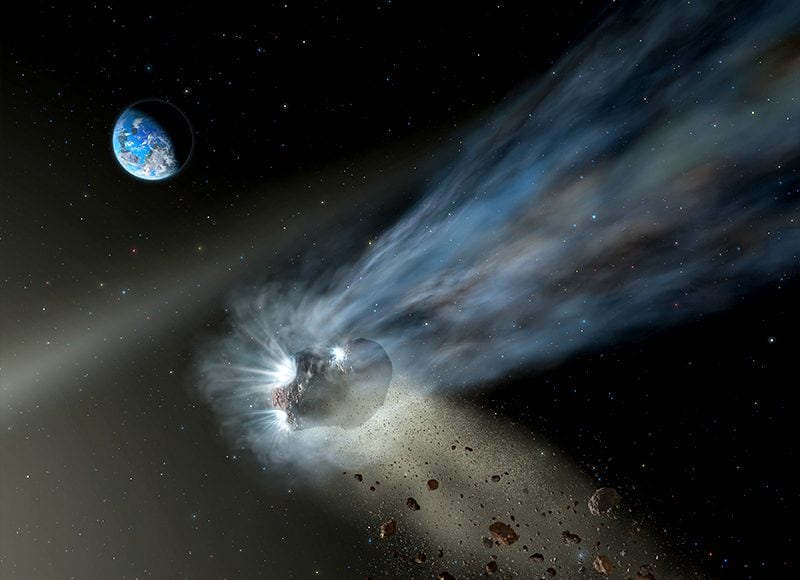
According to a study published in Nature Astronomy, the interstellar comet 3I/ATLAS it may have formed around one older star and poorer in metals than the Sunperhaps in the early ages of the history of the Milky Way. In fact, the analyzes show isotopic ratios of carbon and nitrogen that are very different from those measured in comets in the Solar System.
3I/ATLAS is the third interstellar object identified with certainty after the passage of 1I/’Oumuamua in 2017 and of comet 2I/Borisov in 2019 (the letter “I” denotes the interstellar origin of the object). Its trajectory is in fact hyperbolic (i.e. not closed on itself) and the body it is therefore not gravitationally bound to the Sunallowing it to continue its journey to other solar systems.
But a very interesting feature of 3I/ATLAS emerges from its chemical composition. When a comet approaches the Sun, the heat from our star causes the sublimation of the ice present in the nucleusreleasing gas and dust that form the characteristic comet coma. This cloud of material can be analyzed with spectroscopic instruments, capable of identifying the molecules present and even distinguishing the isotopes of the elements that compose them.
The cometary tail of 3I/Atlas tells us that it is older than the Sun: where and how it was born
The molecules present in the coma absorb and emit light a very precise wavelengthsproducing a characteristic spectrum (a real chemical signature). By analyzing this spectrum, astronomers can identify which molecules are present and in what quantities. There Coma cloud it is composed of molecules such as water and other organic molecules including a very particular molecule, the cyanogen (chemical formula CN). Cyanogen is in fact an important tracer because its spectral bands are very intense in the visible and for decades it has been used by astronomers to measure isotopes in comets.
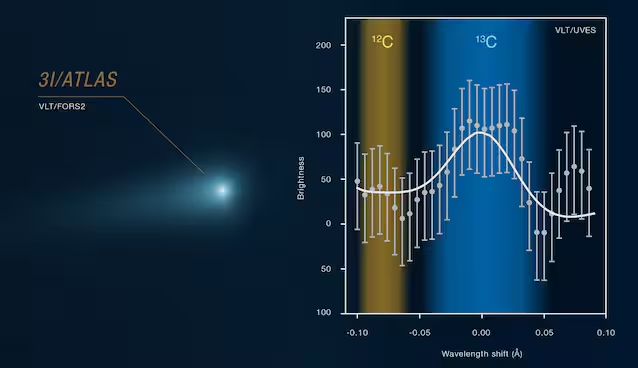
In the study, the authors to measure these spectral bands they used the high-resolution spectrograph installed on ESO’s Very Large Telescope (VLT) (European Southern Observatory) located in the desert highlands in northern Chile. Basically the astronomers can measure the atomic weight of molecules, allowing the presence of isotopes to also be distinguished. Although two isotopes of the same element have almost identical chemical properties, they differ slightly in their mass. This small difference changes significantly the energy with which molecules vibrate and rotate, causing the light emitted to appear at slightly different wavelengths.
Isotopes are slightly different versions of the same chemical element: they have the same number of protons, but a different number of neutrons. A molecule containing carbon 12 (made up of 6 protons and 6 neutrons) produces a slightly different spectral signature compared to the same molecule containing carbon 13 (composed of 6 protons and 7 neutrons). This small variation is extremely important in astronomy, because the ratios between different isotopes can preserve information about the physical and chemical conditions of the environment in which a material was formed.
In the case of 3I/ATLAS, astronomers measured carbon and nitrogen isotope ratios that deviate significantly from typical values observed in solar system comets. This would confirm the hypothesis that 3I/ATLAS may have formed in a environment with a different chemical history compared to the region of the galaxy from which the Sun originated.
Stars produce different isotopes through different nuclear processes. Nitrogen 14 and nitrogen 15, for example, are not produced in the same proportions by all stars: it depends on the mass of the starfrom its initial composition and the phase of its evolution.
The authors then observed the cyanogen molecule in the coma of 3I/ATLAS via the VLT spectrograph and by observing the spectral lines formed by this molecule, they concluded that the 3I/ATLAS material is relatively poor in heavy isotopes (i.e. carbon 13 and nitrogen 15) compared to the cometary material that formed near the Sun.
They were therefore able to establish that the material of which 3I/Atlas is composed has been enriched with carbon 12 by a star older than the Sun. Carbon 12 is in fact produced very efficiently in massive stars and in the first stellar generations. While carbon 13 is produced in important quantities especially by less massive stars, such as the Sun.
However, the isotopic ratio between the quantity of carbon 12 and carbon 13 does not allow for directly date a comet as is done with a radioactive sample on Earth. What can therefore be done is an indirect estimate of the galactic environment and the probable time of formation, comparing its isotopic composition with models of chemical evolution of the Milky Way. 3I/ATLAS then formed in a region of the Milky Way where they were present many young, massive starstypical of one remote phase of evolution of our galaxy.
How interstellar objects are discovered
Planetary formation models predict that during the birth of a star system billions of small cometary bodies are ejected into interstellar space from gravitational perturbations with giant planets or other nearby stars. Most of these fragments travel forever in interstellar space, but a small fraction may randomly pass through other planetary systems, including our own. The interstellar comets type 3I/Atlas and 1I/’Oumuamua are real interstellar travelers generated within the extrasolar protoplanetary cloud.
The problem is that these objects are very small and faint, and pass through the Solar System at very high speeds, making them extremely difficult to detect with telescopes. The acronym ATLAS, in fact, stands for Asteroid Terrestrial-impact Last Alert System and it’s a sky surveillance system designed primarily to detect asteroids potentially dangerous to Earth. The project is led by the Institute for Astronomy, University of Hawaii, and is funded by NASA through the Planetary Defense Program.
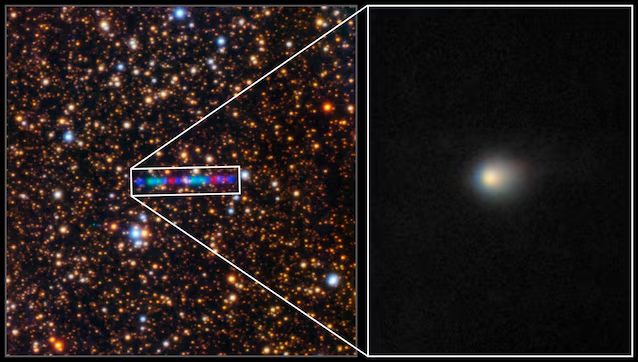
Unlike large telescopes dedicated to studying very faint objects, ATLAS was designed for a different goal: to rapidly observe the entire sky visible several times every night. To do this, it uses small telescopes with a mirror of just 50 centimeters but equipped with a wide field of view and very sensitive cameras. This combination allows you to continuously monitor millions of stars and to locate any bright spot that changes position between one image and the next. It was precisely during its normal surveillance activity that 3I/ATLAS was identified.
In fact, in the coming years through the new astronomical observatory called Vera C. Rubin Observatory, located in Chilethe chance of finding other interstellar objects passing through our solar system will become even greater. In fact, the new telescope will observe the entire southern sky every few days with very high sensitivity and continuously. Astronomers predict it will be able to spot dozens of interstellar objects every yeartransforming what today is still a study based on a few exceptional cases into a true statistic of the population of extrasolar bodies.
