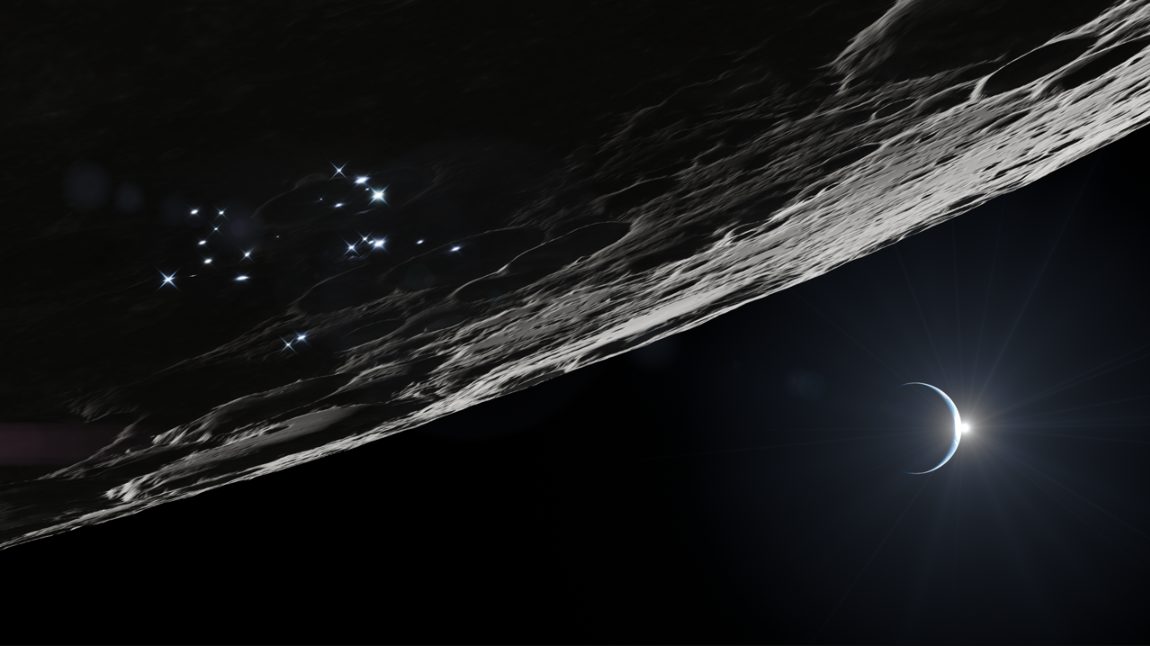
International Moon Day (IMD) is the international day dedicated to our satellite, celebrated every year on the date that coincides with the anniversary of the Apollo 11 landingwhich occurred on July 20, 1969.
However, the history of lunar exploration begins long before 1969: the first man-made object to reach the Moon was the Soviet probe Luna 2ten years earlier. Since then the United States, Russia, Europe, Japan, China and India have sent dozens of missions, but the human moon landing of Apollo 11 remains the symbolically most important moment, the one chosen to identify the day of July 20th.
But the establishment of theInternational Moon Day takes on a meaning that goes beyond the historical commemoration of Apollo 11. Fifty-seven years after the first step of a human being, Neil Armstrongon the surface of another planetary body, the Moon has once again become a realistic but at the same time contested objectivewith multiple geopolitical and economic meanings. But it could also become a test bed for humanity’s ability to explore space cooperatively and with shared space programs.
Who established International Moon Day and why
The idea comes from the Moon Village Association (MVA), an international non-governmental organization that promotes public-private cooperation for the exploration and sustainable use of the Moon. It was the MVA itself that presented the proposal during the 64th session of United Nations Committee on the Peaceful Uses of Outer SpaceUN-COPUOS (Committee on the Peaceful Uses of Outer Space), the body that deals with regulating space activities at an international level. The proposal was accepted and on December 9, 2021, the UN General Assembly officially proclaimed July 20 as International Moon Day.
The objective arises from the idea of trying to inform the public about the state and prospects of thelunar explorationand, raise awareness of the importance of sustainable exploitation of our satellite’s resources and promote cooperation between space agencies, governments and private companies that are projecting their interests towards the Moon.
This year’s edition extends over a long period, from 1 July to 31 October 2026during which local events are organized in dozens of cities around the world: from Sri Lanka to South Africa, from India to the United Kingdom, from the United Arab Emirates to Spain, up to Japan and Brazil. The main event of 2026, the IMD Main Event, will be held in Bogotá, Colombia.
From NASA’s Artemis program to a commercial lunar base
After the unmanned flight of Artemis I in 2022 and the lunar circumnavigation of Artemis II, accomplished on 1 April 2026 by the crew composed of Reid Wiseman, Victor Glover, Christina Koch and from Canadian Jeremy HansenNASA’s Artemis program initiated an entirely new, strategic twist on the Moon’s role in future space missions.
On March 24, 2026, NASA Administrator Jared Isaacman presented Ignition, a plan that radically redesigns the agency’s priorities: no longer isolated multi-year missions, but the launch of a real commercial program for the creation of infrastructures and assets for a permanent human presence on the lunar surface. The goal is to build a Moon Base, an outpost at the lunar south poleconceived from the beginning as a semi-commercial infrastructure rather than an entirely government project.
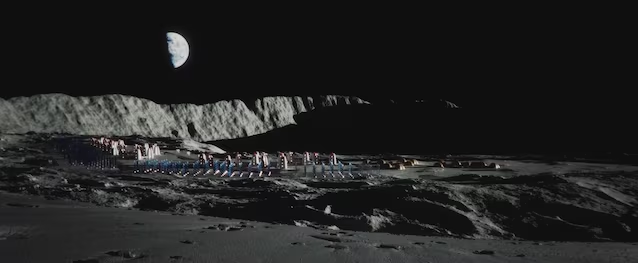
The area identified as a possible operational site is lo Shackleton Connecting Ridgea ridge near the south pole, on the slopes of the lunar crater of the same name. The site was chosen for its almost constant illumination from the Sun and its proximity to craters rich in water icetwo resources that are essential for human settlements.
A consortium of private companies will concretely build this base. For example Blue Origin will supply the Blue Moon Mark 1 heavy landers for the transport of main loads. On the mobility front, NASA has awarded Astrolab and Lunar Outpost contracts worth over $200 million each to develop manned and unmanned lunar vehicles that must be operational by 2028. Some missions already include international payloads, such as those from ESA and the Korea Astronomy and Space Science Institute, a sign that the model remains open to cooperation with other agencies.
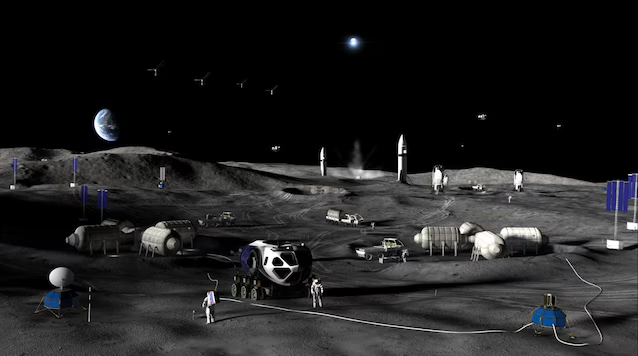
The finish line of first manned moon landing, initially planned with the Artemis IV missionis now placed no earlier than 2028, with the Artemis III mission expected in mid-2027: from that moment astronauts will move from the Orion capsule to a commercial lander to descend to the surface. NASA’s stated ambition is to reach a rate of one moon landing every six months in the initial phase, and then stabilize at one mission per year, then leaving private companies to directly operate their missions independently.
China and the race to the lunar south pole
In parallel, China is accelerating its lunar exploration program. After the successes of the Chang’e 5 (2020) and Chang’e 6 (2024) missions, which brought back samples from the visible and hidden sides of the Moon respectively, the CNSA (China National Space Administrationsor the Chinese counterpart of NASA) is preparing for the launch of Chang’e 7headed to the lunar south pole to search for traces of water ice with a lander, a rover and even a small vehicle configured as a hopper, capable of flying between the craters in permanent shadow using the low lunar gravity.
The objective declared by the CNSA is a manned moon landing by 2030for which some candidate sites have already been identified in the lunar region called Rimae Bode. But the Chang’e robotic missions, together with the future human landing, converge towards a larger project: the International Lunar Research Station (ILRS)that is, a scientific base that will always be built near the lunar south pole and that China and Russia intend to build together with other international partners by the mid-2030s. The planned site will be that of the Shackleton crater, for the same reasons why it was selected by NASA’s Ignition program.
A shared cooperation project for the Moon is still missing
On the one hand, the Artemis Accords, promoted by the United States in 2020 and signed today by 68 countries. On the other hand, the Chinese and Russian-led ILRS project, also open to international partners, conceived as an explicit alternative to the American program, so much so that Beijing and Moscow have never joined the Artemis Agreements (nor were they ever invited to do so).
There are therefore more and more consolidating two opposing axesin fact, two geopolitical blocs. But everything that is being built around the lunar south pole together with the development of the future lunar space economy moves on the same international legal framework: theOuter Space Treaty, i.e. the Outer Space Treaty of 1967ratified by over 110 countries, which prohibits any state from claiming sovereignty over the Moon or other celestial bodies.
It’s a principle born in the midst of the Cold War precisely to prevent the space race from turning into a race for the annexation of territories, and to this day it remains the only reference of international space law for future human expansion towards Moon And Mars. The problem is that the treaty says almost nothing about how to manage resource extraction, the possible interference between different missions or the shared use of the most favorable sites which at the south pole, for reasons of solar illumination and proximity to water ice, are a very limited number. In short, a truly shared project between the two blocks is missing for human exploration of the Moon and it is not yet clear if and when the main space powers will be able to cooperate in the future.
