There truce between the United States and Iran it’s officially skippedwith mutual attacks now increasingly intense in recent days and the reintroduction of US naval blockade. Now the conflict, however, risks spreading beyond Persian Gulf: Yemen’s Iran-backed Houthi rebels just announced a maritime embargo against Saudi Arabia.
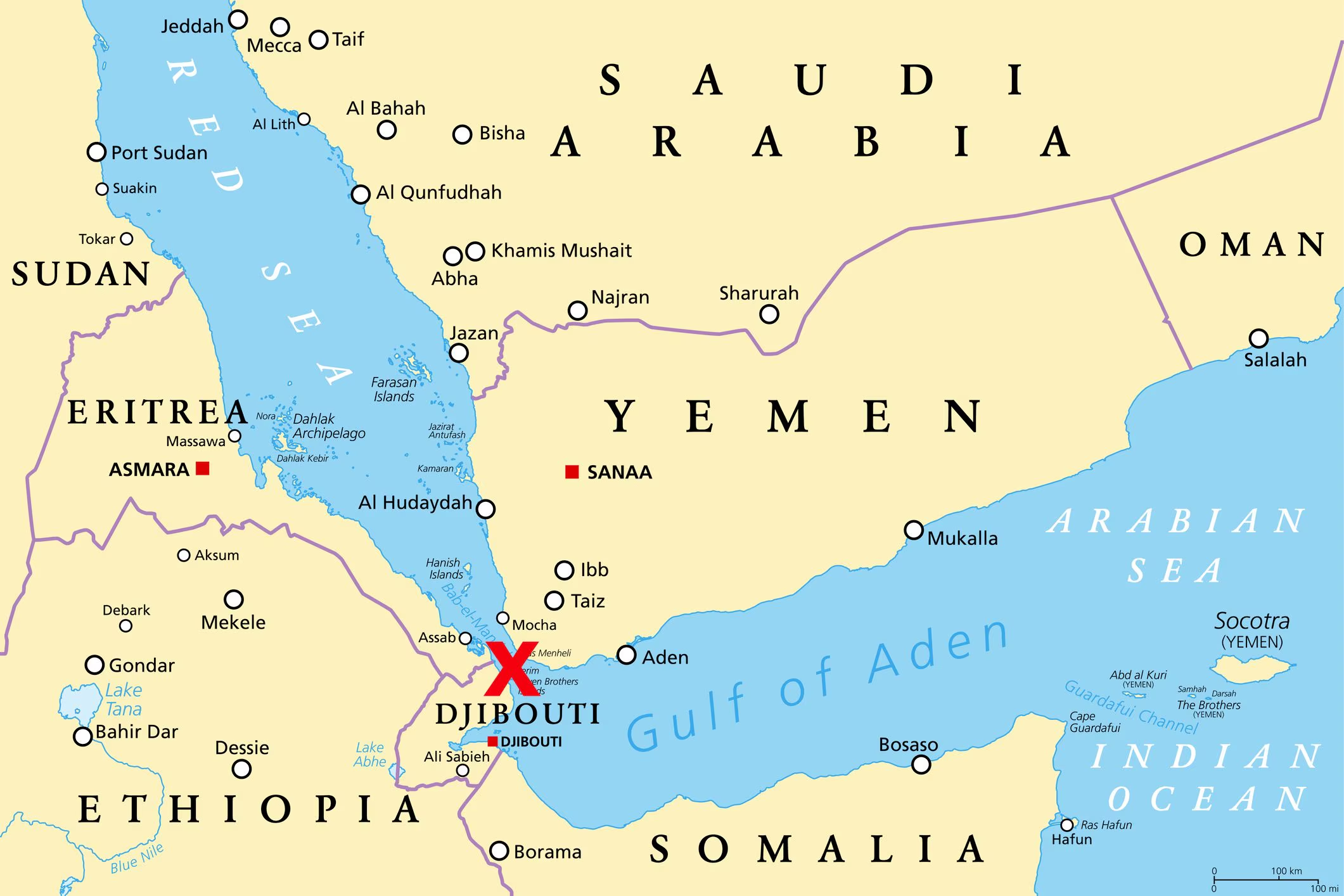
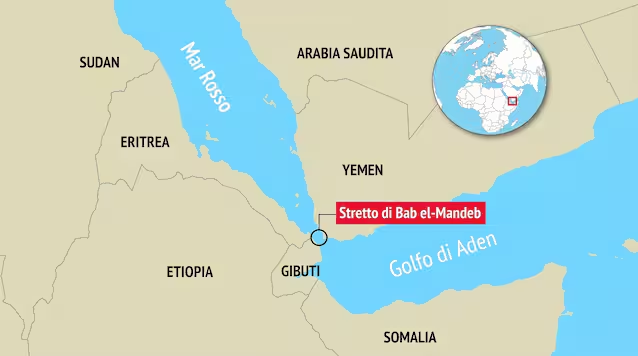
To understand why a Yemeni militia could frighten global energy markets, we need to look at geography and, in particular, that of the so-called chokepoints (thebottlenecks”), through which a huge portion of global oil trade passes. With the closure of the Strait of Hormuz, in fact, Bab el-Mandeb (which connects the Red Sea toIndian Ocean through the Gulf of Adenlocated between Yemen, Djibouti and Eritrea) has now become an essential maritime hub for Saudi exports.
Considering that the Strait of Hormuz (when open) passes approximately 20% of global crude oilif the two straits were closed at the same time, they would block approximately 30% of global oil transported by sea. The problems, however, do not only concern oil: the Strait of Bab el-Mandeb also passes through Approximately 10% of global tradewith numerous containers arriving from China, India and other Asian countries and headed towards Europe.
The consequences of a Bab el-Mandeb blockade on oil exports
Let’s start from the most practical point: what effect would the closure of this strait have? The answer lies in the fact that, with Hormuz already blocked, Bab el-Mandeb it has become the main hub for getting oil out of the region.
After the outbreak of war between the US and Iran last February, Saudi Arabia gradually hijacked millions of barrels of oil per day to an export terminal on the Red Seagiven that the conflict had seriously affected oil tanker traffic through the Strait of Hormuz. More specifically, Riyadh pushed its East-West oil pipeline (the so-called Petrolines) at the full capacity of 7 million barrels per day, redirecting by land crude oil from the eastern fields to the port of Yanbu on the Red Sea, to completely bypass the strait.
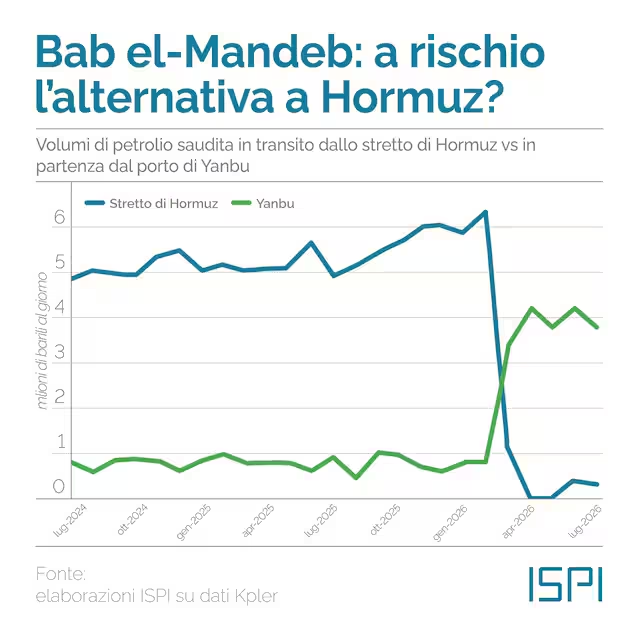
But that oil, to reach Asia, it still has to come out of the Red Sea. And the only exit door to the south is right there Bab el-Mandeb. The closure of this chokepoint, therefore, would block crude oil exports again, making it worse the interruption of oil supplies already triggered by Hormuz’s paralysis.
In short, any threat to the Red Sea and its Bab el-Mandeb passage risks further worsen the energy crisis global, with the danger that the conflict will spread beyond the Persian Gulf.
It must be said, however, that at least for the moment the nature of today’s announcement by the Houthis is not yet clear: as reported by Reuters, the group’s military spokesperson declared the start of a «maritime embargo against the criminal Saudi enemy, based on the ‘eye for an eye’ principle, with immediate effect upon the publication of this statement.”
So it remains to be understood the intensity of this maritime embargo: It is unclear whether the Houthis will maintain the same level of attacks against Saudi Arabia as seen in the past, or whether this is a measure to pressure the country into giving in on local issues. The group, however, it does not have military capacity to impose a naval blockadebut in recent years he has shown he can hit commercial ships with missiles and dronesespecially in the waters of the Red Sea near the coasts of Yemen.
The reaction of the markets, at least immediately, was however cautious: crude oil prices remained almost unchanged after the announcement, as reported by CNBC.
The fragile truce between Houthis and Saudi Arabia in force from 2022
The Houthis confirmed they had imposed the maritime embargo against Saudi Arabia following an attack last year July 13th against the airport of the Yemeni capital Sanaawhich is controlled by the military group. According to the Houthi Political Bureau, Saudi Arabia attacked the airport for prevent landing of a passenger plane Mahan Aira company linked to Pasdaran Iranians, who, according to reconstructions, was carrying a returning Houthi delegation from the funeral of the former Supreme Leader Iranian Ali Khamenei in Tehran. The attack was not claimed directly by Saudi Arabia, but by the Yemeni government supported by Riyadh: the Houthis therefore responded attacking Saudi Abha Airportin the south of the country.
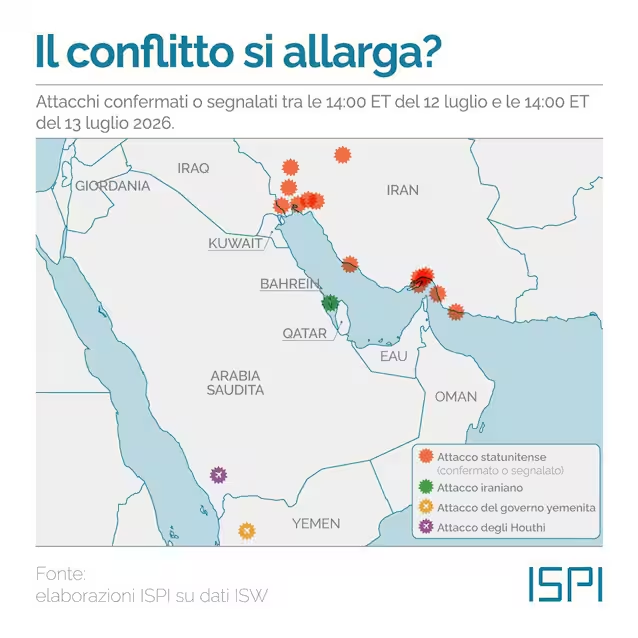
For the first time after 4 years, therefore, the Yemeni armed group and Saudi Arabia they violated the (fragile) truce reached in 2022: to understand the root of this conflict, however, we need to take a step back to 2014, when the civil war in Yemen began. The conflict, in fact, saw the Houthi rebels (supported by Iran) aligned against a Saudi-led coalition, which supported the country’s government.
In the 2022 that war it was essentially “frozen“: an uneasy truce between the Presidential Command Council and the Houthis froze the lines of conflict and put an end to coalition attacks against the Houthis. Since then the balance has effectively held, albeit with some cracks: since 2022, intermittent clashes have continued between the Houthis and various anti-Houthi forces along the lines of contact.
The moment chosen, clearly, is not random: the Houthis and Iran in fact have a common interest in putting Saudi Arabia under further pressure, to further increase the regional and global cost of the war and indirectly push the United States to stop military activities. At this stage, as ISPI notes, not only have Houthi and Iranian objectives converged, but so has the challenging approach adopted by both.
Be careful, though: these new tensions do not mean with certainty that open war will break out across the region. The ISPI analyzes also call for caution regarding the timing, while recognizing the importance of this change: with the resumption of the war in Iran, the Houthis and Saudi Arabia will probably not immediately increase mutual conflict. But the risk of escalationstrengthened by internal and regional dynamics, has already changed the picture of Yemeni truceeroding a delicate balance that had lasted four years.
