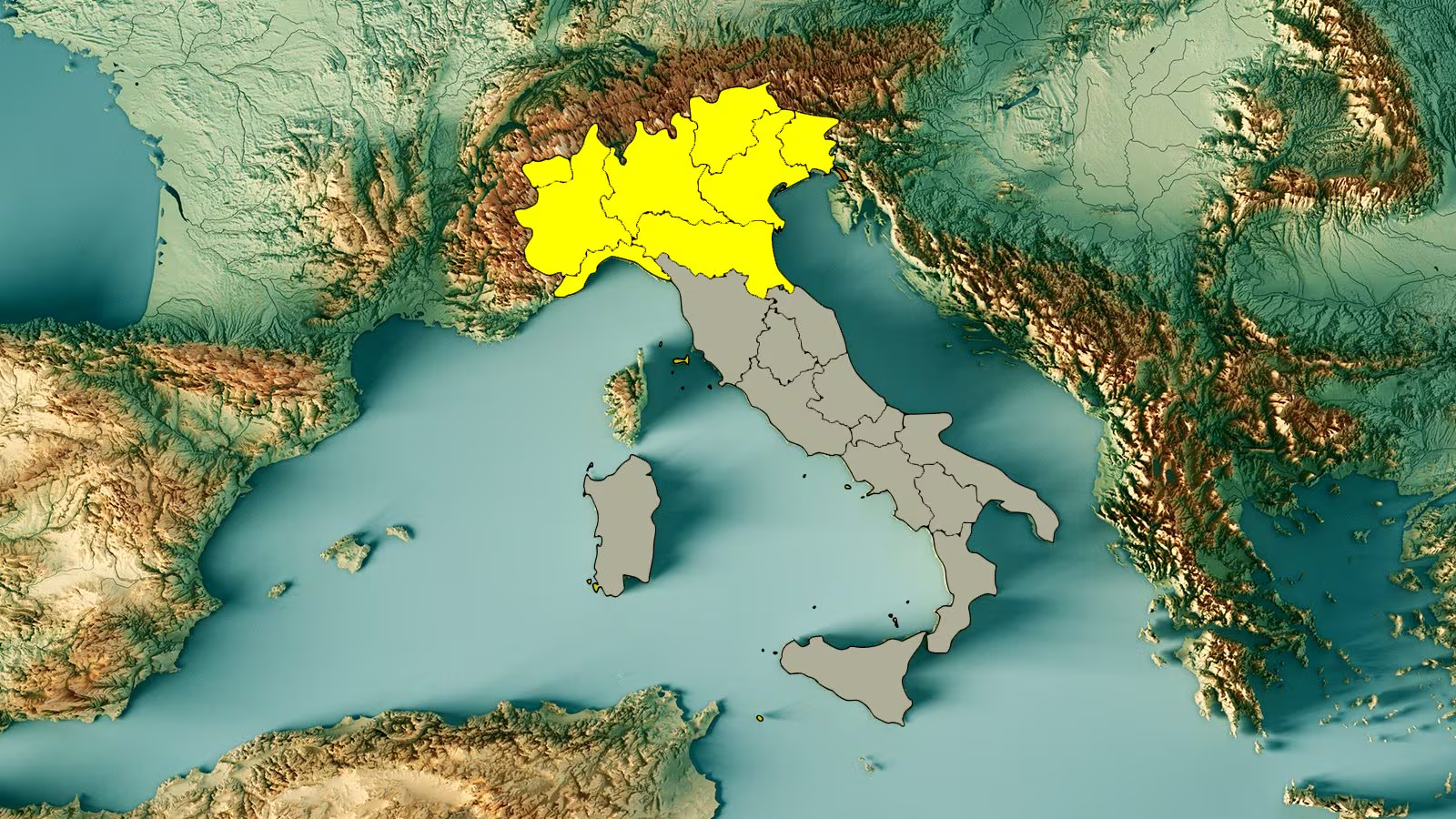
In everyday language, when we talk about North we simply mean the North. Yet, the word North comes from Latin septem trioneswhich means literally “seven oxen”. A completely different image from the modern geographical one: in fact it does not indicate a cardinal point, but a group of stars very precisely, the seven brightest stars in the constellation Ursa Major. In fact, the ancient Romans imagined them as seven yoked work animals, intent on making a circular movement around the celestial pole, just like oxen dragging a plow in a field.
For the ancient Romans the constellation ofUrsa Major she was not represented as a bear, as in modern tradition, but rather as a wagon or as a set of draft animals. Hence the idea of “seven oxen” (septem triones), where triones is linked precisely to working animals, in particular those used for ploughing. The image is of creatures moving in circles in the sky, as if tethered to an invisible axis.
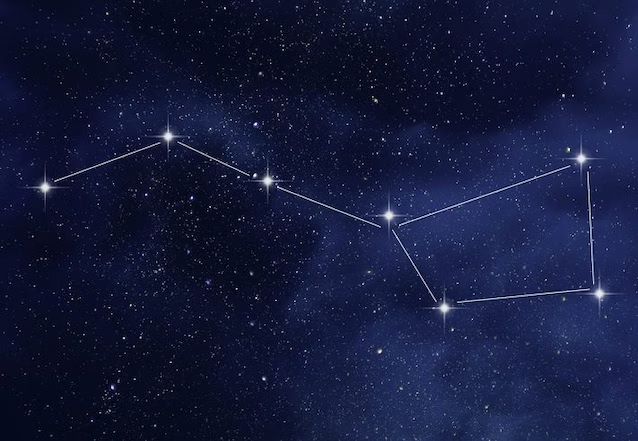
This representation is not accidental. In ancient agricultural societies, the ox was one of the most important animals for the work in the fieldssymbol of strength and daily effort. To use it as a metaphor for the stars was to make the sky understandable through familiar elements of earthly life.
But why have these stars become synonymous with the North? The reason is astronomical and practical at the same time. The stars ofUrsa Major I’m a reference point essential to find the Polar Starwhich is located almost at the north celestial pole. By tracing an ideal line between two rear stars of the “chariot” of the Big Dipper (Dubhe and Merak), we arrive precisely at the Polar Star. This makes the constellation a real one natural compass to orient yourself in the night sky. Hence the change in meaning of the word North: from constellation to cardinal direction.
With time, septem triones it was in fact transformed into “North” in the Romance languages, progressively losing the original image of the “seven oxes”, but maintaining the meaning of Geographic north. The same linguistic phenomenon also occurred for other cardinal points: “Noon” indicates the moment in which the Sun is located south in the sky, while “West” And “East” they bind to sunset and sunrise.
An interesting aspect is that this transformation shows how much the tongue is closely linked toobservation of the natural world. Before being abstract concepts, the cardinal points were observable phenomena: the Sun moving across the sky and the stars rotating around the celestial pole.
In the case of the North, therefore, we have a perfect example of how astronomy, agriculture And language have intertwined. An expression born to describe a group of stars has become one of the fundamental words of modern geography.
In this sense, every time we say “North”, we are actually citing a piece of ancient sky: that of the “seven oxes” which rotate around the Polar Star and which, for the ancients, indicated the road to the North.
The term “north” instead it has a different origin: it is from Germanic root and it spread to Romance languages (such as Italian) probably through medieval French. The French had in fact learned a lot about nautical art from the peoples of Northern Europe and therefore their maritime vocabulary was imbued with a large quantity of Germanic terms including the names of the four cardinal points which, for brevity’s sake, were found more convenient than their Latin correlatives.
