Since i AI-powered chatbots they started answering users’ questions directly, the future of search engines has become one of the most talked about topics in the tech industry. In fact, these tools allow you to obtain explanations, comparisons and summaries without having to go through the traditional results page, made up of links, images and ads. It is then easy to imagine that this new way of accessing information could take away the public from Google Search.
The data relating to June 2026 However, they tell a less immediate scenario. As explained in the analysis of BofA Securities reported by Barron’s, the expansion of AI assistants has not yet reduced access to Google Search: the platform continues to expand its audience both on the web and on mobile devices. However, the comparison must be read taking into account the dimensions of the different services.
Google’s numbers: visits grow by 4% and mobile users by 12%
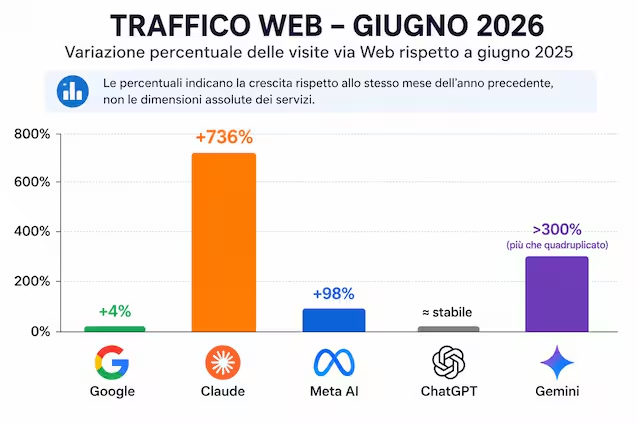
According to an analysis by BofA Securitiessigned by the analyst Justin Post and based on the findings of Similarweb And Sensor Towerlast month global visits to Google are increased by 4% compared to the same period of the previous year, reaching an average of approx 2.8 billion per day.
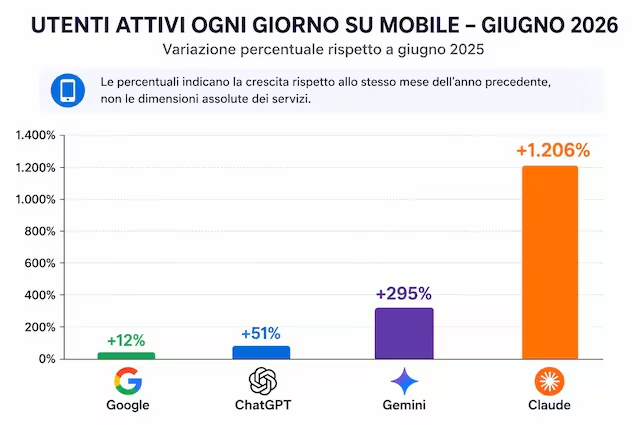
The trend is also positive on mobile devices. The average number of people who use Google every day from smartphones and tablets is rose 12% year-on-year. The two indicators show that the search engine continues to maintain a strong presence among users, at least in terms of overall accesses.
A 4% change may seem modest when compared to the triple-digit increases seen by some competing tools. However, applied to a platform used daily by billions of people, it corresponds to a very significant additional volume. To interpret these values it is therefore necessary to also consider the initial dimensions of the different realities examined.
It should also be noted that visits to Google and active users on mobile devices do not necessarily correspond to the exact number of searches performed. The findings indicate how much the service is used, but do not allow us to know how many searches have been performed nor how many links to external sites have been opened.
Claude and the other AI chatbots advance much faster
The picture becomes more interesting when comparing Google’s results with those of the main AI-based assistants. Also last June, visits via Web to Claude have increased by 736% compared to the previous year, while Meta AI recorded an increase of 98%. The traffic of ChatGPT it is instead remained substantially stable in the annual comparison.
The situation changes on mobile devices. Daily active users on ChatGPT have grown by 51%while Claude recorded an increase of 1.206%. These are very high percentages, which show how quickly conversational assistants are becoming part of everyday habits.
These values, however, do not mean that Claude or Meta AI have reached the size of Google. A relatively young service can multiply its audience in a short time precisely because it starts with a smaller number of users. On the contrary, for an already dominant platform it is more difficult to obtain equally striking percentage changes.
The gap between expansion rates therefore does not automatically equate to an imminent overtaking: Chatbots are gaining space, but they still operate on lower volumes than the most used search engine in the world.
Gemini grows without taking away audiences from Google Search
Another significant fact concerns Geminithe assistant developed by Google itself. Over the course of a year, its web traffic is more than quadrupledwhile daily active mobile users increased by 295%. Over the same period, however, access to traditional research has also continued to rise.
At least for now, therefore, the growth of Gemini It does not appear to have reduced Google Search usage. A possible explanation lies in the fact that the company does not consider artificial intelligence only as a separate product, but is progressively integrating it within its engine.
An example is represented by AI Overviewsthe system that processes the information and offers a summary response at the top of the results page. It adds to this AI Modea more conversational mode that allows you to formulate detailed requests, obtain comparisons and ask follow-up questions.
The distinction between search engine and chatbot is therefore becoming less clear. A person can open Google, receive a Gemini-generated response, and continue with a conversation without going through a separate application.
It is also plausible that the two methods are chosen for different needs. The classic search remains practical for quickly finding a site, an address, a product or a piece of news, while an assistant can be more convenient for summarizing a topic, developing a text or comparing different possibilities. Traffic data, however, does not allow us to establish with certainty which activities are carried out within individual platforms.
More hits on Google don’t necessarily mean more site visits
Google’s holding does not exclude that artificial intelligence is profoundly transforming the functioning of the Web. The number of people using the search engine may in fact increase as Clicks directed to external sites decreaseincluding online newspapers, blogs and specialized portals.
With AI Overviews and conversational modes, some of the information is shown directly in the Google interface. The user can thus read a summary, find what they were looking for and close the page without opening the sources used to generate the answer, a change already evident in the way artificial intelligence is modifying web search.
As a result, the increase in access to the platform it is not enough to measure the impact of AI on the entire online ecosystem. Google can maintain or grow its audience while changing the path people take to information and reducing the amount of traffic distributed to content producers.
Google Search is not in crisis, but online search is changing
The June 2026 results do not prove that Google is safe from any future threat. They represent a snapshot of a single period and not a prediction on the future evolution of the sector. However, they show that, at the moment, the success of chatbots is not causing the collapse of the search engine.
Before drawing definitive conclusions, it should be remembered that the data analyzed concern traffic and active users, but do not in themselves allow us to establish which tools are used for each individual search or what the overall impact on the Web ecosystem is.
However, Google maintains a positive trajectory, while Gemini and other assistants record much faster increases. The two trends can coexist because artificial intelligence is not just creating competing services: it is also transforming from the inside the tools already used to search for information.
The challenge, therefore, is not simply which platform will be able to win over the most users. The real change affects the way questions are formulated, answers presented and original sources reached. For now the search engine is resisting the chatbot boom, but the traditional list of links is progressively giving way to an increasingly synthetic, personalized and conversational experience.
