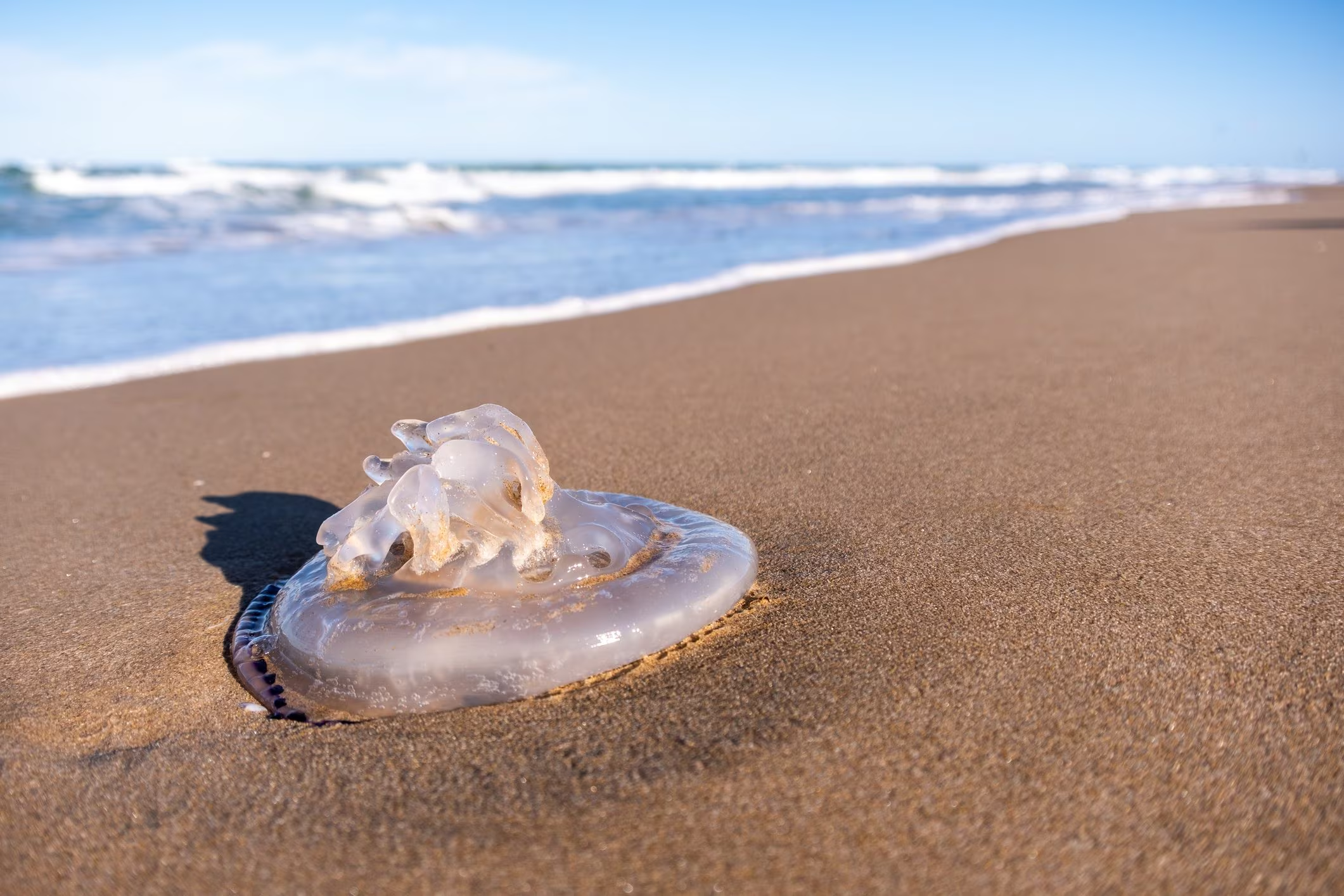
Capturing and beaching jellyfish is not a simple stunt nor a way to “clean up” the sea, it does not just represent a cruel gesture, but a real crime punished by ours Criminal Codein particular from article 544 on animal cruelty. Penalties can range from heavy economic sanctions (from 5,000 to 30,000 euro fine) up to imprisonment up to 2 years. These floating creatures that seem to arrive from another planet have populated the oceans for hundreds of millions of years, practically without ever changing shape. Yet, despite their incredible evolutionary history, for us they are a sort of enemy to defeat. In fact, many of the species that swim in the Mediterranean Sea are completely harmless for us or, at most, they can cause a slight and temporary irritation. In short, they have nothing to do with the “sea monsters” that we often imagine, but they actually have an important aspect ecological role both as “food” for larger predators, and as predators themselves, helping to maintain the balance of the system
What the Italian law says: fines from 5,000 to 30,000 euros
From a strictly regulatory point of view, ours legal system speaks clearly: the law makes no distinction between “A” pets and “B” wildlife. Even if jellyfish (like starfish), not having a brain, do not experience emotional suffering or pain as we understand it, the legal definition of “animal” includes them in all respects among the organisms deserving of protection.
For this reason beaching a jellyfish first and foremost violates thearticle 544-ter of the Criminal Codewhich punishes the mistreatment of animals. This regulatory system was profoundly tightened just last year with Law 6 June 2025, n. 82, which eliminated the old alternative between a prison sentence alone or a fine alone, providing that the sanctions are now applied jointly. The current text of the rule establishes that:
«Whoever, cruelly or unnecessarily, causes injury to an animal or subjects him to torture or behaviors or toil or work that is unbearable due to his ethological characteristics and is punished with imprisonment from six months to two years e with a fine of 5,000 to 30,000 euros. The same penalty applies to anyone who feeds to animals narcotic or prohibited substances or subjects them to treatments that cause damage to their health. The penalty has increased by half if the death of the animal results from the facts referred to in the first and second paragraphs.».
If, however, the conduct causes the death of the animal, article 544-bis of the Penal Code may also apply, which regulates the killing of animals and establishes that:
«Whoever, cruelly or unnecessarily, causes the death of an animal is punished with imprisonment from six months to three years and with a fine from 5,000 to 30,000 euros. If the act is committed by using torture or deliberately prolonging the animal’s suffering, the penalty is imprisonment from one to four years and a fine of between 10,000 and 60,000 euros.”
The penalties are even more serious when the crime is committed presence of minorsagainst multiple animals or when the perpetrator creates or disseminates images or videos of the crime through IT or telematic tools.
At this point it is good to focus on the concept of “without necessity” just mentioned. The simple annoyance of bathers or the desire to “clean up” the body of water in front of one’s towel does not constitute a state of necessity at all. In short, there is no legal justification to remove a jellyfish from the sea. Even if the application of the penalty is assessed on a case-by-case basis by the authorities, the line of jurisprudence is crystal clear: attacking an animal due to an unjustified phobia is, in all respects, a crime.
What happens to jellyfish in the sun: certain death
You may have heard, seen in a documentary or read from government sites like the one National Oceanic and Atmospheric Administration (NOAA) such as that jellyfish are organisms composed of up to 95-98% water, completely devoid of a skeleton, a brain or a central nervous system. In their place, there is a dense widespread nervous network and a series of peripheral receptors: a decentralized structure that allows them to orient themselves, perceive light and react to external stimuli without the need for a real “control unit”.
This particular anatomy has a dramatic consequence: when a jellyfish is pulled out of the water and abandoned on the shore, his sentence to death it’s certain. The summer sun triggers a process of evaporation and dehydration lightning fast. Having no skin or protective barriers against the sun’s rays, its gelatinous body literally begins to melt and collapse within a few minutes. Let’s be clear: not having a brain, the jellyfish does not have the biological circuits to experience agony or emotional suffering as we understand it. However, the fact remains that it is one total and almost immediate cellular destruction. A brutal ending dictated, in the vast majority of cases, by a completely unjustified fear.
The ecological role: why jellyfish are useful to the sea
Beyond the legal aspect and the cruelty of the act, there is a fundamental ecological reason why these creatures must remain exactly where they are. The jellyfish they are not at all “monsters” that haunt our beaches, but they represent gods crucial pieces for the health of the marine ecosystem. On the one hand, in fact, it is documented by many studies that constitute the main scope in diet of many animals: they are the primary nourishment for sea turtles and various species of bony fish. On the other hand, they act like true guardians of biological balance: as reported by Purcell, White and Roman in a 1994 article, being exceptional predators of plankton, small crustaceans and larvae, they avoid the overpopulation of some species and keep the oceanic food chain stable.
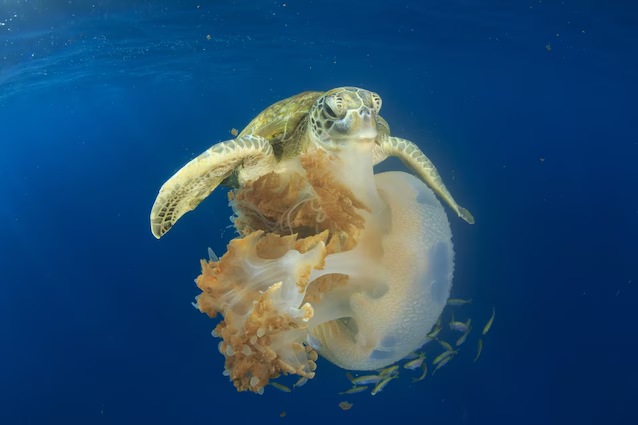
For this reason, if you find one nearby during a refreshing bath, the golden rule is: peaceful coexistence. There is no need to panic. Jellyfish do not hunt humans, but simply let themselves be carried by sea currents. To avoid a painful urtication, that’s enough walk away calmlyalways remembering that respecting the sea also means protecting those inhabitants who, perhaps, we like a little less.
