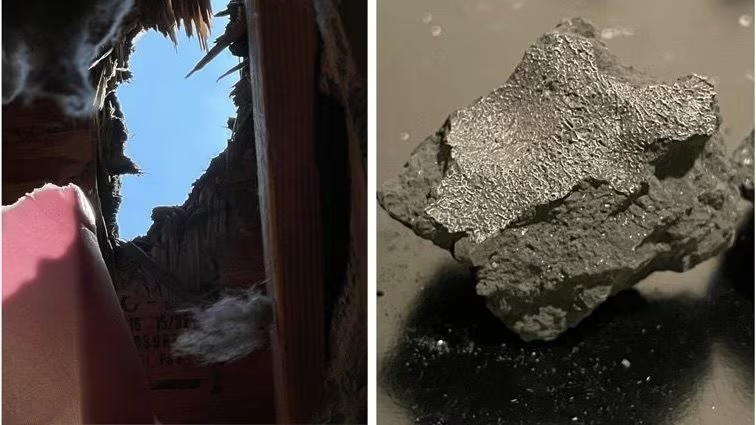
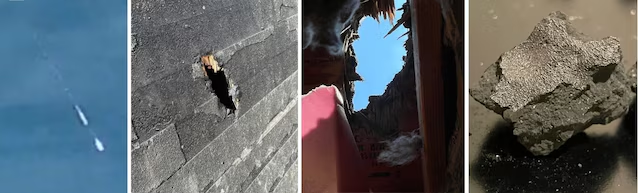
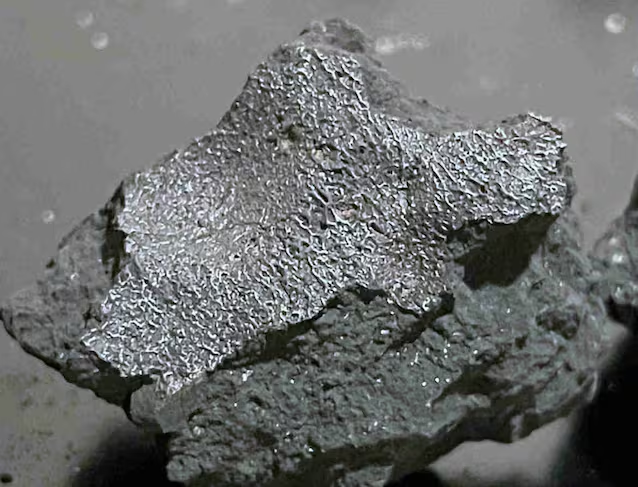
In July 2024 one meteor trail it streaked across the sky over the New York metropolitan area. The fireball traveled on an east-west trajectory over Staten Island towards New Jersey before disintegrating into multiple fragments. One of these fragments fell onto the roof of a house in Hillsborough, New Jersey, breaking through the ceiling of an empty bedroom. The meteorite sample was entrusted and distributed to several international laboratories for analysis. A team led by Peter Jenniskens, researcher at SETI Institute and NASArecently published in Science Advances the complete results of the study begun two years earlier: the Hillsborough meteorite, as it was officially named by Meteoritical Societyproved to be a unique sample of chondrite CM.
The carbonaceous chondrites CM are considered by scientists to be planetary among the most important materials for studying the origin of lifebecause they contain abundant water bound to minerals and complex organic compounds, including amino acids, sugars and nitrogenous bases, the chemical compounds at the basis of terrestrial biology. What makes the Hillsborough meteorite so valuable remains the speed of recovery. Since it was a fall observed and documented in real time and not a chance discovery after years of exposure to atmospheric agents, the meteorite did not have time to be contaminated by the terrestrial environment, remaining one of the best preserved primitive samples ever analyzed.
A very rare chondrite that tells the story of the formation of the solar system
The acronym CM identifies a group specific whose name derives from Mighei meteoritewhich fell in Ukraine in 1889 and was used as a reference sample (CM is in fact the acronym for Carbonacea Mighei). CM chondrites are distinguished by the degree of aqueous alteration. This alteration is rated on a decreasing numerical scale from 3 to 1: the CM3s have undergone minimal alteration, the CM1s the most intense, almost complete one. It is precisely in this context that the Hillsborough meteorite fits, classified as CM1/2, i.e. a particularly rare middle ground between the two extremes of the scale.
Carbonaceous chondrites are a class of rocky meteorites considered among the most primitive materials in the solar system: they were formed by the growth of dust and granules about 4.6 billion years ago, in protoplanetary nebula which gave rise to the Sun and the planets, and since then they have not undergone the processes of fusion and differentiation that have instead transformed larger bodies such as the Earth or Mars. For this reason they are often compared to real chemical time capsulesbecause they still retain the original composition of the matter from which the planets were formed, including organic substances.
Traces of ancient brines containing organic molecules
It is precisely thanks to this speed of recovery that scientists were able to identify, within the rock matrix, the evidence of ancient salt brines which once flowed beneath the surface of the parent asteroid.
Once a meteorite lands on Earth, it immediately begins to interact with the atmosphere, oxygen and microorganisms in the soil. These processes can alter its chemical composition, introduce organic contaminants of terrestrial origin and mask or destroy traces of salt brines, amino acids and other organic molecules. A recovery within hours or a few days of the fall instead allows scientists to analyze a sample that reflects the intact chemical conditions present at the time of its formation billions of years ago.
Saline brines present in meteorites are considered environments particularly favorable to prebiotic chemistry. Their high concentration can favor and accelerate chemical reactions between the organic substances present, in which simple molecules can combine into increasingly more complex compounds, such as amino acids and other protein precursors.
In the primitive asteroidssaline brines are formed when the frozen water originally incorporated into the materials that compose them melts, often due to the heat generated by the decay of radioactive elements present in the rock. This liquid water then circulates through the fractures and pores of the rock, progressively dissolving the salts and minerals that it encounters along its path and becoming increasingly concentrated as, over time, the water evaporates or is consumed by chemical reactions with the surrounding minerals.
A particular characteristic of these fluids is the ability to remain in a liquid state even at very cold temperaturesseveral degrees below zero. The high salt concentration in fact significantly lowers the freezing point of the solution, a bit like what happens when salt is spread on icy roads. This property allows brines to remain chemically active even in freezing environments such as those typical of the subsurface of asteroids, much longer than pure water would.
Saline deposits of this type, generated by the evaporation of aqueous fluids, had already been observed on the dwarf planet Ceres and for example in the samples brought to Earth by Japanese missions Hayabusa2 from the asteroid Ryugu and by the US probe OSIRIS-REx from the asteroid Bennu. They weren’t though never been documented in a CM-type chondrite that fell on our planet. The almost immediate recovery of Hillsborough made it possible to exclude this hypothesis, demonstrating that the saline water activity actually originated within the asteroid.
Until now it was believed that underground environments capable of hosting brines were a typical characteristic only of relatively large bodies such as Ceres, equipped with sufficient internal heat to keep the water liquid for a long time. Traces found in Hillsborough suggest that similar conditions may have also occurred into much smaller and more primitive asteroidsthe same ones that could have formed in the early stages of evolution of the Solar System billions of years ago.
Extraterrestrial amino acids and clues to the origin of life
The biochemical analyses conducted on the Hillsborough fragments revealed the presence of amino acidsi fundamental building blocks for the construction of proteins. Their extraterrestrial origin is confirmed by the presence of molecules that are extremely rare or completely absent on Earthsuch as α-aminoisobutyric acid and isovaline, both considered true signatures of biological chemistry that occurred in space.
There mass spectrometry at very high resolution also allowed us to identify thousands of others organic compounds belonging to different molecular familiessuch as carboxylic acids, oxygenated molecules and polycyclic aromatic hydrocarbons.
According to the researchers, these prebiotic molecules would have formed inside the progenitor body during an initial phase of aqueous alteration, and then become further enriched thanks to the subsequent appearance of salt brines.
CM-type carbonaceous chondrites have long been considered among the main ones vectors of organic matter towards the primordial Earth. Scientists speculate that meteorites like this may have contributed to enrich the range of prebiotic molecules available on our planet in its earliest phases from which the first living systems would eventually emerge.
