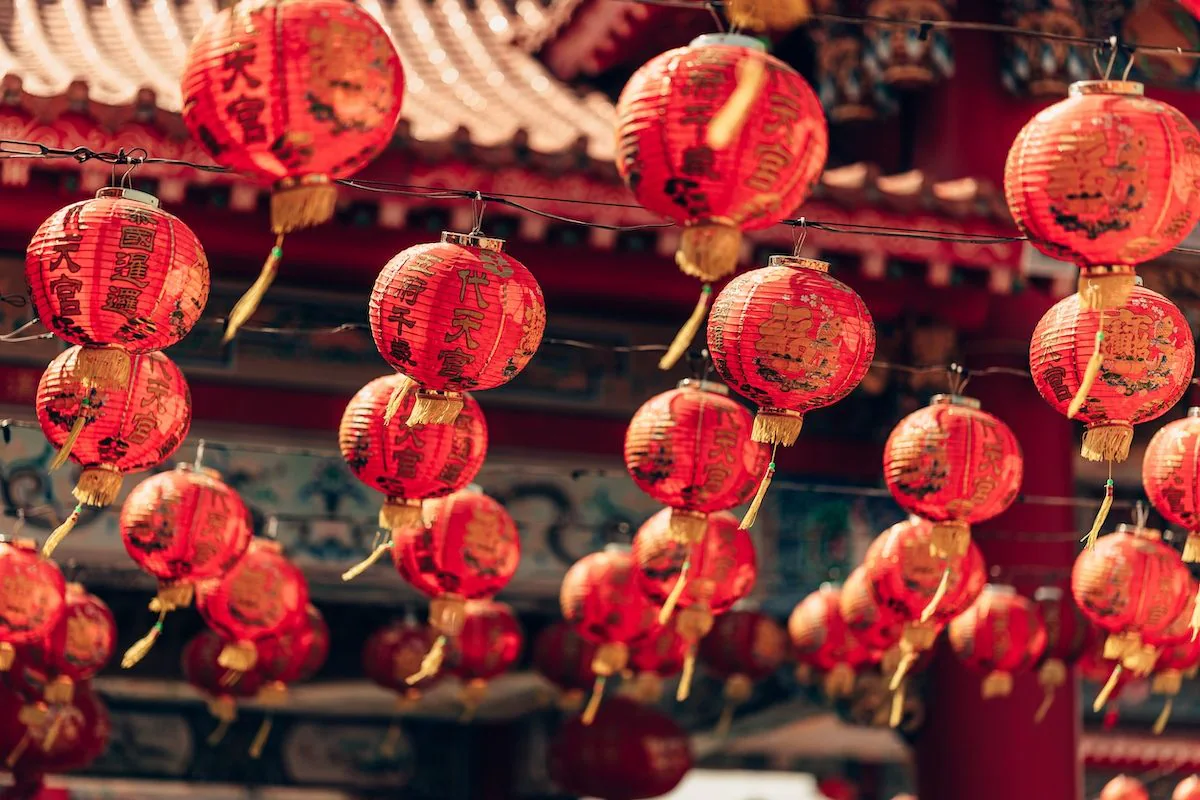
Walking through one city during the Chinese New Yearit’s almost impossible not to be impressed by the presence of red everywhere. Lanterns, decorations, gift bags, clothes and decorations transform streets and homes into a sea of scarlet shades.
In Chinain fact, the red it’s much more than just a color: it’s a symbol of prosperity, happiness, success and protection. This association, however, does not arise from a single tradition or legend, but is the result of a long historical process which intertwines philosophy, religion, politics, psychology and even the biology of perception.
From ancient dynasties to cosmology: the historical roots of red
The importance of red in Chinese culture has its roots in very ancient times. Already during the Zhou dynasty (1046-256 BC), one of the longest in Chinese history, the color was associated with power,cosmic order and state rituals.
Its centrality derives in part from Five Element theory (Wu Xing), one of the most influential philosophical systems of ancient China. According to this conception, the universe is governed by the interaction of five fundamental forces: wood, fire, earth, metal and watereach associated with a specific direction, season and color.
The red corresponded to the element firein the south and in summer, the season of maximum vital energy. Fire was seen as a positive force, capable of generating transformation, growth and prosperity.
For this reason red gradually began to be used in official ceremonies, in imperial buildings and on religious holidays. Over the course of subsequent dynasties, its positive meaning consolidated to become one of the most recognizable symbols of Chinese culture.
The monster Nian and the protective power of color
Next to historical and philosophical explanationsthere is one of the most popular legends of Chinese tradition: that of monster Nian.
According to the tale, this creature emerged once a year to attack villages, destroy crops and scare the population. However, the inhabitants discovered that the monster particularly feared the color red, flames and loud noises.
To defend themselves, they began to hang red cloths on the doors of the housesto turn on fires and to do explode firecrackers. When Nian was finally defeated, these practices became an integral part of the New Year celebrations.
Although historians consider this legend a folkloric construction relatively late, it reflects a universal phenomenon: the tendency of human societies to attribute to visual symbols a protective function against chaos or external threats. In sociology, this dynamic is defined as “apotropaic symbolism”, or the choice of elements believed to be capable of warding off evil.
What does science say? The psychology and biology of red
The particular importance attributed to red does not depend only on culture. Even the biology and psychology help explain its impact on humans.
Red has one wavelength high and is therefore perceived by the human eye as one of more intense colors and immediately recognisable.
Numerous studies have shown that its vision can increase attention, influence emotions and even appear to cause subtle physiological changes, such as an increase in heart rate.
Some researchers hypothesize that this sensitivity has evolutionary roots. In the history of the human species, red has been associated with blood, to firefruit ripening and other elements crucial for survival.
For this reason the brain tends to consider it a particularly relevant signal. What changes from one culture to another is not so much the perception of color but the meaning attributed to it biological response.
In many Western societies, red is often associated with danger, aggression or prohibition. In China, however, the same energy evoked by color is interpreted as life force, abundance and luck.
Red between philosophy, luck and prosperity
In traditional Chinese thought, luck and prosperity they are not simply random events, but the result of a harmonious balance between individual, community and cosmic forcesAnd. In this context, red has become the ideal color to represent positive energy, success and abundance.
Even the concept of yangone of the two fundamental principles of Chinese philosophyhelps to strengthen its meaning. Associated with light, heat, movement and vitality, it yang finds one of its most evident chromatic expressions in red.
This connection explains why color is used especially during moments of transition and new beginningswhen it is particularly important to attract favorable energies.
An ancient symbol in a modern society
Despite the rapid modernization of China in recent decades, the symbolism of red continues to maintain extraordinary cultural strength. During the Chinese New Year millions of people still exchange letters traditional red envelopes (hongbao) containing money as a wish for prosperity.
For scholars of cultural specificities, this persistence demonstrates how some symbols manage to survive political, economic and technological changes. Red has become a identity element which connects the present to a thousand-year-old tradition.
Its association with luck does not depend on a single cause, but on the encounter between ancient cosmological beliefs, folk tales, psychological dynamics and social practices consolidated over time. It is precisely this stratification of meanings that still makes it one of today more powerful and recognizable symbols of Chinese culture.
Sources
Eberhard W. (1986). “A Dictionary of Chinese Symbols: Hidden Symbols in Chinese Life and Thought”
Needham J. (2004). “Science and Civilization in China”
Yang L. & Ann. D. (2005). “Handbook of Chinese Mythology”
UNESCO (2003). “Convention for the Safeguarding of the Intangible Cultural Heritage”
