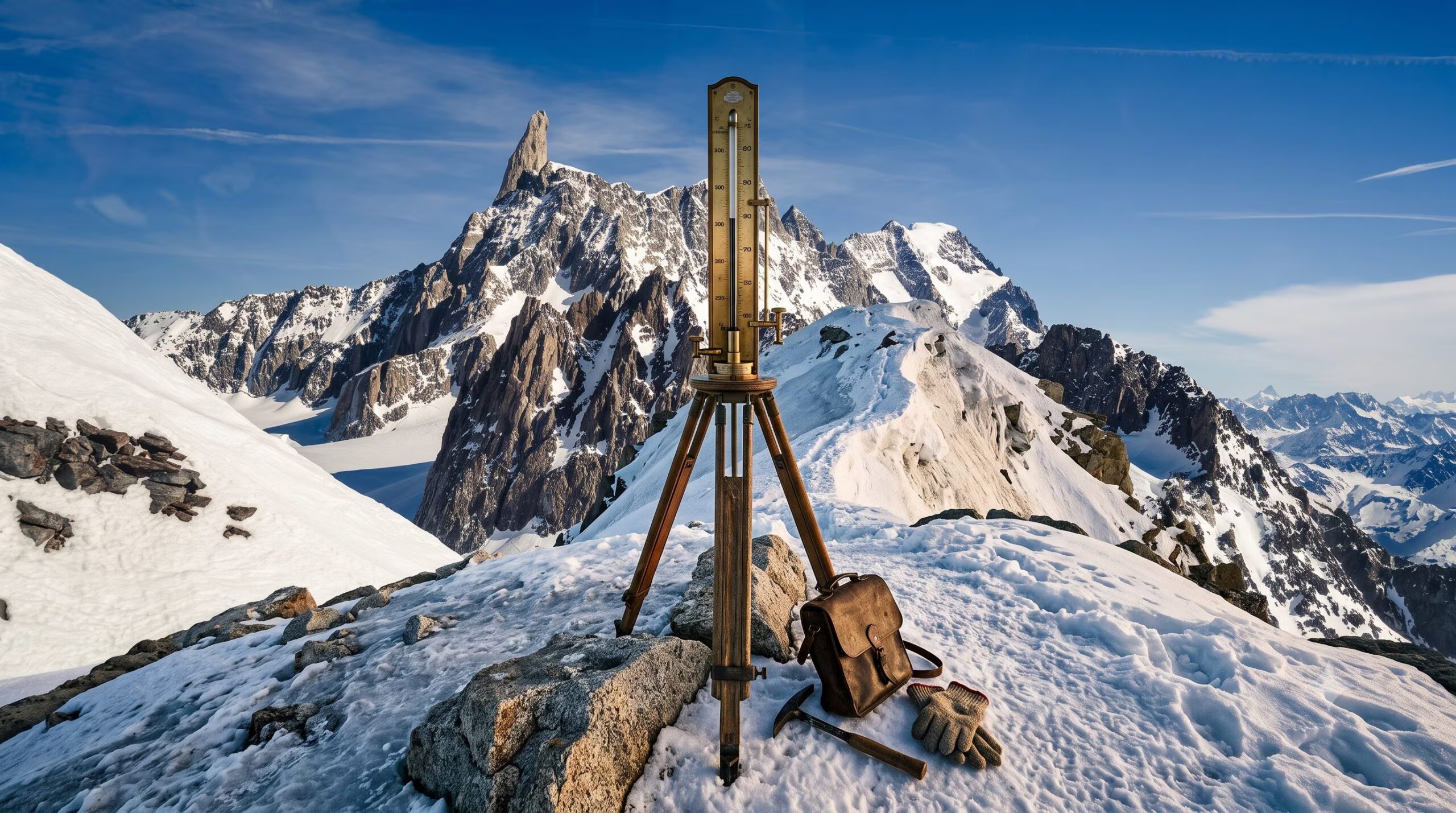
The summit of Mont Blanc – today measured at approx 4805 m – was conquered for the first time 240 years ago, on 8 August 1786, by the doctor Michel Gabriel Paccard and by the crystal seeker Jacques Balmat. Two men from Chamonix completed the feat that marked the birth of mountaineering: Jacques Balmat and Michel Gabriel Paccard, a doctor from the French town. After about 14 hours of climbing, arriving at 6.23pm and equipped with rudimentary equipment, they were the first humans to reach the highest point in the Alps and Europe (excluding the Caucasus) between rock and ice, without knowing exactly how many meters they had reached. It was not a sporting feat, but a scientific experiment conceived by the naturalist Horace-Bénédict de Saussure in one of the most uncomfortable and dangerous laboratories in history up to that point, where the two agreed to climb encouraged by the cash prize promised to anyone who had identified a viable route.
How the idea of conquering the highest mountain in Europe was born
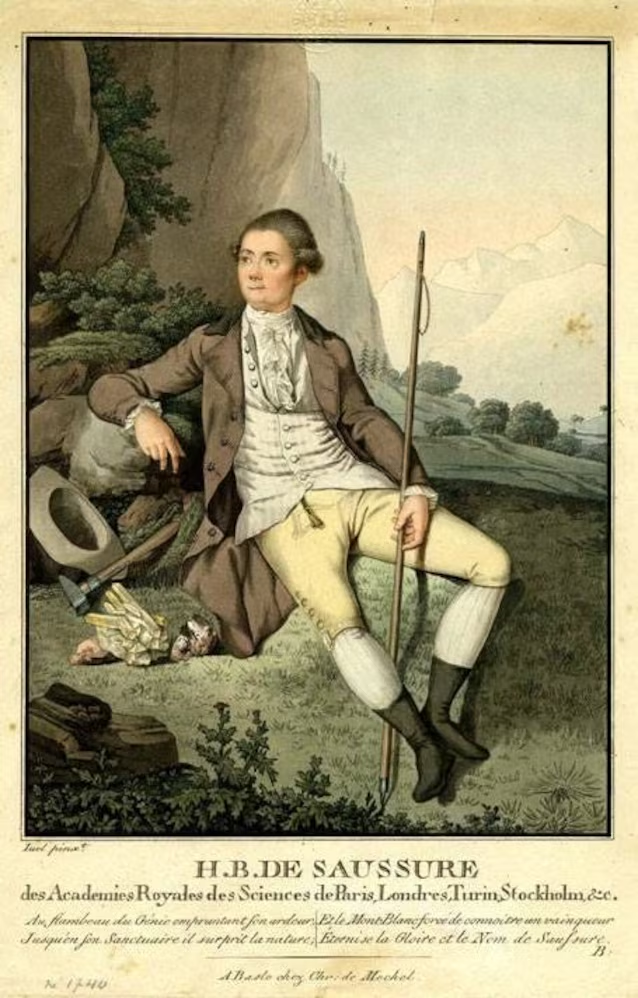
The idea of transforming the summit of Mont Blanc into a high-altitude laboratory came at the end of the eighteenth century to Horace-Bénédict de Saussure (1740-1799), a Genevan geologist and physicist who was obsessed with the whitewashed peak that he observed during his stays in the Chamonix area.
At the time, if a scientist wanted to study what the air at high altitudes is like (how much it weighs, how humid it is, what its temperature is) he ran into a practical problem: in fact, there was no way to get there by sending instruments. Hot air balloons they were in fact just born (the Montgolfier brothers’ first flight was in 1783) and were anything but precision instruments. The only instrument to make a reliable measurement was the mountain itself, rising in altitude through increasingly thinner layers of air and carrying the instruments with it to measure them step by step.
This is where the truth comes in deus ex machinof this story, de Saussure, who didn’t even climb Mont Blanc that day in 1786. Already in 1760 he had promised a cash prize to anyone who found the way to the top. For twenty-six years no one succeeded. The two who finally completed the feat and collected the prize were not the adventurers we might have expected: Jacques Balmat, a crystal seeker, e Michel Gabriel Paccardthe town doctor, both from Chamonix, were not expert climbers, but rather two men born and raised at the foot of that mountain who knew it well.
Their feat was carried out in conditions that today would seem madness: in fact the two were not equipped with ladders, ropes or protections as we understand them today. After having bivouacked at around 2,400 metreson the Montagne de la Côte, they faced the crevasses of the glacier by placing the sticks they carried with them side by side, crawling over them. With them they also had the instruments that would be used for the barometric measurements and they had to be very careful not to damage them, so as not to make the undertaking in vain.
Instruments for measurements at altitude
A barometer it is an instrument used to measure the atmospheric pressurethat is, the force exerted by the air on the earth’s surface. In fact, air has weight and above our heads there is a column of air kilometers high that presses downwards: this is atmospheric pressure. The higher we go, the less air remains above us, and therefore the pressure decreases. In short, at sea level, the column is entire while at 4,800 meters it is reduced – corresponding to just over half the pressure present at sea level.
This intuition was not new in 1786, but had been demonstrated almost a century and a half earlier, in 1648, when Blaise Pascal he had his brother-in-law Florin Périer take a barometer to the top of the Puy de Dôme, in Auvergne, France, at 1,464 meters above sea level: as he rose, the level of mercury in the tube lowered, proving that the air at high altitude “weighs” less. Mont Blanc offered the opportunity to repeat that experiment at a much higher altitude and with instruments that had in the meantime become more manageable and precise.
De Saussure did not climb with Paccard and Balmat, but reached the summit the following year, on August 3, 1787, decidedly better equipped: he left Chamonix with a group of porters carrying mainly scientific instruments, built for the occasion. It was the second ascent of Mont Blanc. Once at the top they set up tables, arranged the instruments and De Saussure got to work measuring the atmospheric pressure, using two mercury barometers almost a meter long.
The experiments of de Saussure in the high-altitude laboratory
In that exceptional laboratory he also measured the static electricity of air and the boiling point of waterto establish the height of Mont Blanc using the same principle as pressure. Water, in fact, boils when its tendency to evaporate overcomes the pressure of the air that crushes it from above: at sea level you need to reach 100°C, but at altitude, where the air presses less, water boils at a lower temperature. By precisely measuring the boiling temperature of water using a thermometer, he was able to obtain the atmospheric pressure and therefore estimate the altitude of the mountain: he determined the value of 4,775 metres, making an error of about thirty meters compared to modern measurements.
De Saussure was not content with weighing the air: he wanted to quantify everything, including the color of the sky. This is why he invented the cyanometeran instrument made of colored cards in shades of blue, from lightest to darkest, to be compared with the celestial vault. At the summit he noted that the blue corresponded to the 39th degree of his scale, the most intense he had ever measured. De Saussure understood that the color of the sky depends on how much air and how much humidity is in its wayand at altitude, where the atmosphere is thinner and drier, the blue becomes deeper. Moreover, the same man had invented or perfected a long series of instruments, fromsun thermometer tohair hygrometerthe latter to measure the humidity of the air by exploiting the fact that a hair lengthens or shortens depending on the humidity.
De Saussure collected his expeditions and experiments in the work Voyages dans les Alpespublished in 4 volumes from 1779 to 1796: his scientific observations initiated or nourished numerous disciplines, from Alpine geology to climatology, via glaciology and speleogenesis.
Sources
CAI
Voyages dans les Alpes – Horace-Bénédict de Saussure
The Alpine Club
Encyclopedia Britannica
