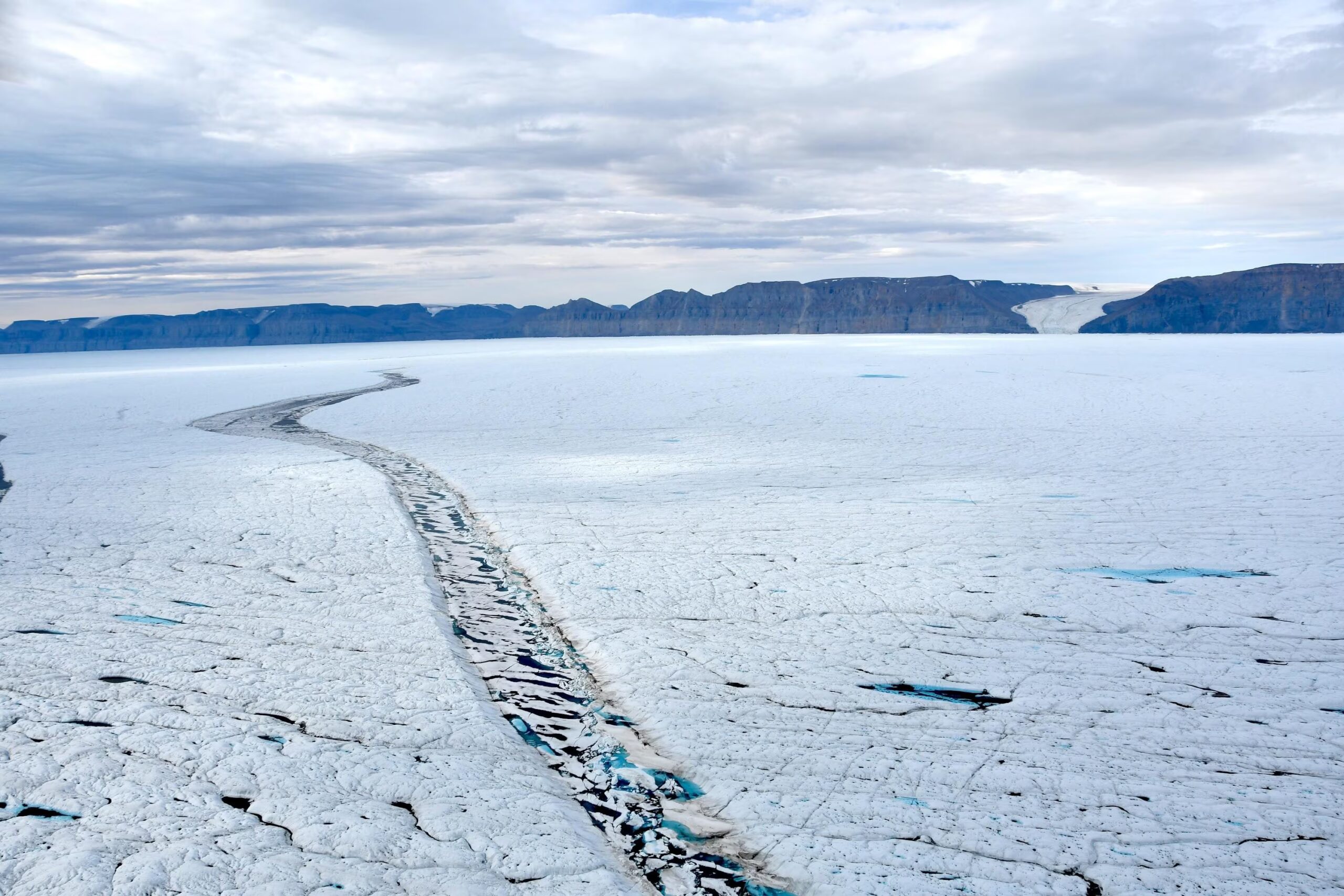
A’ice island bigger than San Marino she broke away from Petermann Glacierin Greenland, becoming the most great detachment event of icebergs in the Arctic since 2020. Detected by satellites thanks to a team from the University of Ottawa, the new tabular iceberg extends over a surface area of 76.4 km², with an estimated thickness of up to 150 meters. The phenomenon can be traced back to the mechanisms that have affected the glacier for years: the increase in atmospheric temperatures and the melting of the base of the glacial tongue by warmer subsurface Atlantic waters. This fragmentation will allow us to study the impact of climate change on polar glaciers.
The birth of an ice island: the calving of the Petermann glacier
On August 4, 2026, the Arctic was the scene of one of the most important events of calving (detachment) of recent years: a gigantic island of ice with an estimated thickness of 150 meters and surface area of 76.4 km² – a larger area than all San Marinowhich has an area of 61 km2 – broke away from the floating glacial tongue of the Petermann glacier.
The event was observed by an international research team, led by the University of Ottawa, thanks to the radars of ESA’s Sentinel-1 satellite. The ice islands Yes distinguish come on common icebergs irregularly shaped because they are tabular massesflat and very thick, which originate from posting of platforms or languages floating glacials. Formations of this type are frequent inAntarctic Oceanaround the Antarctic ice sheet, while in theArctic they stay a lot rare.
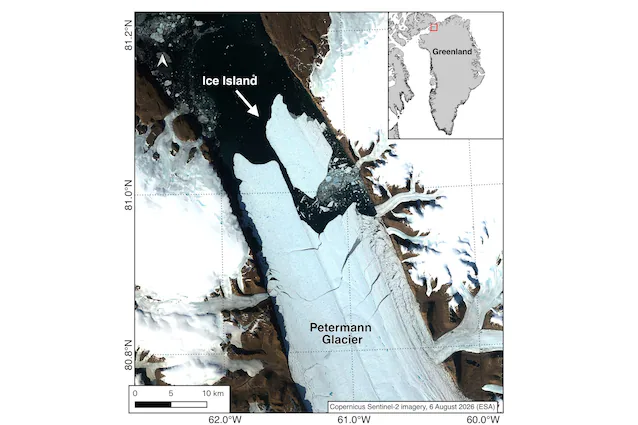
This event represents the ice loss most impressive float for the Petermann glacier since 2012 and constitutes a scientific opportunity to monitor in real time how these colossal glacial masses move, interact with marine currents and evolve in their gradual fragmentation process.
Ocean dynamics and thermal thrust: the causes of the iceberg collapse in Greenland
The formation of this new ice island is the result of complex thermodynamic and mechanical processes that scholars have been monitoring since 2019.
The main cause lies in the thermal balance of the Petermann glacier, whose tongue of floating ice extends for approximately 70 kilometers inside the fjord, held back laterally by its rocky walls. The entire structure is subjected to a double stress: on the one hand, the increase in atmospheric temperatures, which leads to the formation of streams of melt water on the surface which penetrate the crevasses, thus accentuating hydrofracturing (or fracking). On the other, a layer of water of Atlantic origin, relatively warm, which flows beneath the surface polar waters and rises along the fjord.
The thinning of the base reduces the structural strength of the ice and weakens the anchor line (the so-called grounding line), i.e. the boundary line between the ice anchored to the land and the ice floating on the sea.
The combination of these states caused the progressive widening of the cracks along the central line and the eastern margin, inevitably leading to the fracture and the birth of the ice island.
According to researchers, however it is unlikely than the recent calving of icebergs be the last. It is expected that others two large islands of ice will detach from the Petermann glacier in the near future, due to the deep cracks that continue to affect the glacial tongue. It is estimated that these future detachment events will produce Ice islands of approximately 94 km² and 84 km²: to be clear, these would be ice islands almost as large as the municipality of Florence and of Trieste. Together with the newly broken-off ice island, these islands would reduce the Petermann ice tongue by about 254 km², or 22%.
