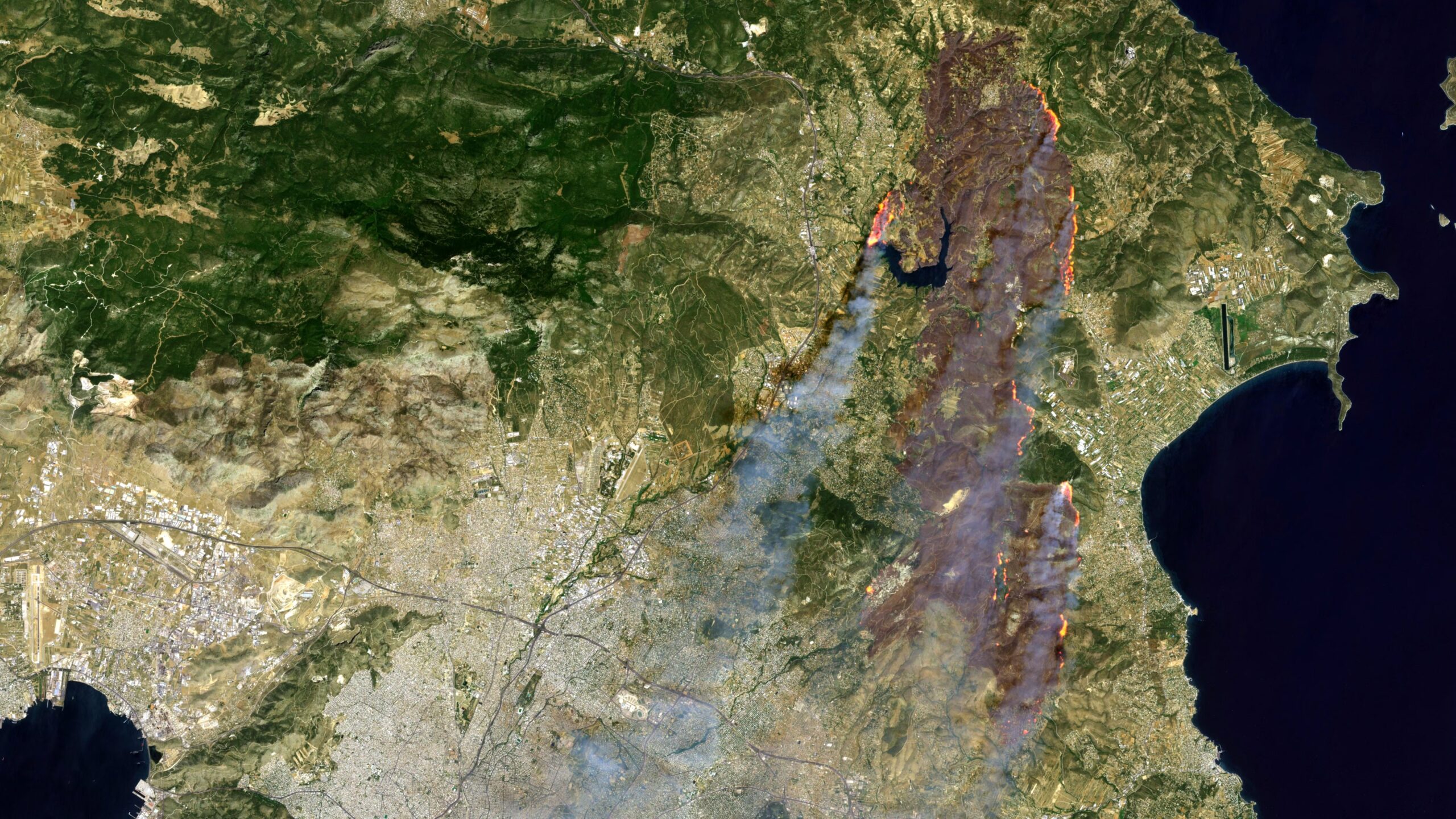
According to the EFFIS findings, the monitoring system of the European Copernicus program, among 1 January and 19 August 2026 the flames have devoured 585,531 hectares of territoryand well 78,522 of these they only went up in smoke in last seven days. The current year is proving to be a particularly difficult year in terms of the fires that are devastating Italian and European forests, fueled largely by the effects of the climate crisis and the prospects outlined by scientists leave no room for optimism, considering that by the end of the century, the European continent could find itself managing extreme fire events up to ten times more frequent than today, but they are emerging alternative solutions that can help combat the phenomenon.
How infrasound detects fires
An idea might come from one 2024 study (Infrasound produced by a small pile fire)carried out by researchers at Boise State Universitywho demonstrated that infrasound is able to detect fires early and be helpful in this monitoring activity. This is because a fire, as it burns, emits sound waves, but their amplitude is so low that our ears cannot perceive them.
The study was published in Journal of Applied Acoustics and the results tell how the “puffing” of a fire, the breath, the puff in some ways, that is, that process during which the fire releases columns of hot gases, generates pressure waves that can reach frequencies as low as 1 hertzand listening to that sound of a fire could provide crucial signals for early detection of forest fires. An interesting observation is that the frequency of these puffs seems decrease as the flame diameter increases. During the experiment, over the course of an hour, the peak frequency went from 1.3 Hz to 1 Hz, compatible with the evolution of the fire which from the initial high and narrow flames expanded to the bed of burning coals (going from approximately 1.3 to 2.3 meters in diameter).
The first test was conducted on a small scale, a pyramid-shaped pile of dry pine and fir, 6 feet high and 10 feet wide, burned in intensely cold, windless conditions near Stanley, Idaho. Registering the fire with array of infrasonic microphones placed at 50 and 600 metersthe authors demonstrated that “even small meter-scale fires can produce infrasound between 1 and 20 Hz, detectable at a distance greater than half a kilometre”.
“Our records of pile fires extend from approximately a puffing frequency of 1.0 and 1.3 Hz down to the audible band of low frequencies,” the authors write, “This remote surveillance result is encouraging, because we expect that larger and more vigorous fires can be detected at much greater distances, allowing infrasound to be developed as an effective ground-based remote sensing tool”.
The verification on a more real fire
The next step came with a new study recently published on Geophysical Research Letters. Compared to the initial test, the researchers have broadened the scope, testing the technique on larger flames and in a scenario that is closer to reality. In fact, the researchers surrounded a larger and more realistic planned fire with 90 sensorsorganized into eight infrasound arrays of 3 to 44 elements. The most interesting result concerns precisely the largest array which, despite being farthest from the fire, was the most precise in tracking the infrasound of the fire, following them over 2 kilometers away and even distinguishing them from the noise of the helicopter used to set the flames.
As the authors of the study explain, “Vegetation fires are dangerous and complex events that are difficult to monitor with ground-based instruments. Current aerial and satellite detection systems rely on techniques that require line of sight and are sensitive to the presence of smoke and the point from which the observation is made. In contrast, Sound propagation and detection are not affected by the presence of smoke and allow us to monitor sound sources almost in real time”. For this reason, according to the study, “This information, detectable even in the case of fires of modest intensity, can contribute to the monitoring of vegetation fires and provide useful data on a wide range of temporal and spatial scales”.
