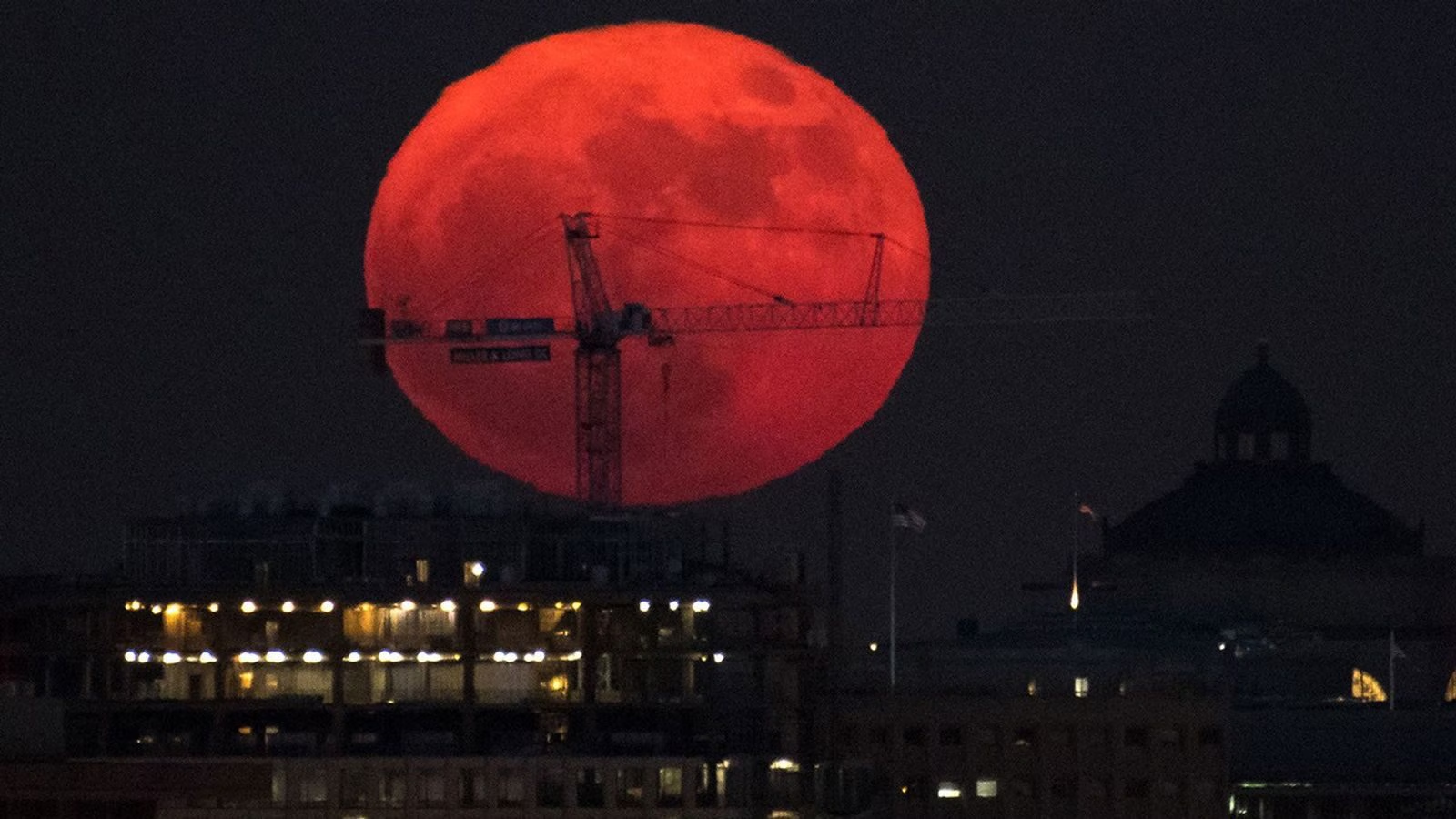
The Moon can take on a reddish colour under certain conditions, such as during a‘lunar eclipse, when it is found low on the horizon or when its light passes through a particularly rich atmosphere dust, smoke or others aerosol. In all these cases our satellite does not really change color, but the phenomenon is produced byinteraction of moonlight with the Earth’s atmosphere.
The underlying physical mechanism is similar to what makes sunsets red or daytime skies blue, i.e Rayleigh scattering or scattering. This happens whenever visible light interacts with particles (atoms or molecules) smaller than its wavelength and will also occur for the next partial lunar eclipse, which will begin at 04:34 on 28 August 2026, with maximum coverage (approximately 94%) at 06:13.
The nitrogen and oxygen in the air we breathe or atmospheric aerosols all have shorter wavelengths than visible light and are therefore subject to this diffusion effect which is all the more accentuated the smaller the wavelength of the incident light: for this reason blue and violet light are scattered much more effectively than red light. The greater the layer of atmosphere to be crossed, the greater the diffusion of the blue light which is then “removed” from the incident moonlight. The red component, however, travels longer distances in the atmosphere and can become the dominant component of the light that reaches our eyes, thus giving the characteristic reddish color to our natural satellite.
Why is the Moon red during a lunar eclipse like the one on August 28, 2026
During a lunar eclipse the Earth is between the Sun and Moon and projects into space two shadow regions: a more external and tenuous one, called twilightand a more internal and dark one, called Umbrian. The characteristic reddish color appears when part of the Moon enters the Earth’s umbra. At first glance one might expect that the portion of the Moon immersed in the shadow would become completely black, but this is not the case. A small part of sunlight passes through the outermost layers of the Earth’s atmosphere, is refracted, i.e. deviated, and manages to reach the region of space occupied by the Moon.
In its passage through the atmosphere, the blue component of sunlight is scattered much more effectively than the red one due to the effect of Rayleigh scattering (the same one responsible for the blue color of the sky). The red and orange wavelengths are therefore able to continue almost undisturbed and to be diverted within the earth’s shadow cone. When this light reaches the lunar surface and is reflected back towards us, the part of the Moon immersed in umbra takes on a copper, orange or red color.
The effect changes depending on the type of eclipse. During one total eclipsethe entire lunar disk enters the umbra and may therefore appear reddish. During one partial eclipsehowever, only the portion of the Moon that is in the darkest shadow takes on this shade, while the rest of the disk continues to be illuminated directly by the Sun. penumbral eclipsehowever, the Moon never enters the umbra and continues to receive part of the direct sunlight, consequently it tends above all to darken slightly, without generally taking on the characteristic red color of the umbral phases.
Our satellite turns orange even when it is near the horizon
However, there is no need to wait for an eclipse to be able to observe a red Moon, in fact it is very common to see the Moon take on orange or reddish hues when it is near the horizonespecially shortly after it has risen or is about to set. In this case the Moon continues to reflect the light of the Sun normally, but what changes is the path that its light must take before reaching our eyes. When the Moon is found high in the sky its light passes through one relatively small thickness of atmospherewhile when it is close to the horizonwe observe it through one much larger quantity of air because the light travels through the atmosphere in a direction almost tangential to the Earth’s surface at the place of observation.
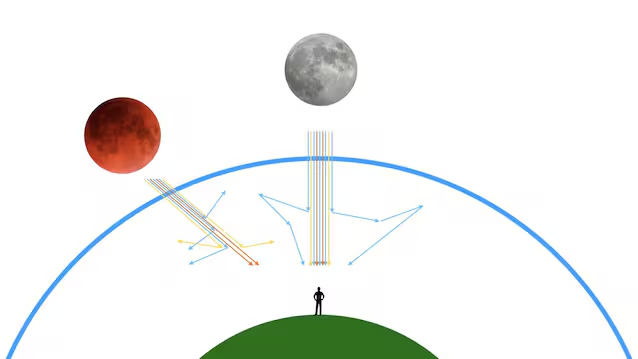
The longer the route that the moonlight travels through the atmosphere, the greater the effect of Rayleigh scattering and therefore the greater the quantity of blue light that is scattered by the molecules of the atmosphere. The red component, however, is less diffused and continues more easily in the direction of the observer. For this reason, the Moon can change from the characteristic greyish-white color it presents when it is high in the sky to yellow, orange and, in the most favorable conditions, decidedly red shades. It is the same principle that makes the Sun red or orange when it is near the horizon and that is responsible for the “reddening” effect of the light of stars and galaxies when seen through Earth’s atmosphere.
Coloring can be especially evident during the rising of a full Moon. This is because the full Moon is on the opposite side of the sky from the Sun and rises approximately when our star sets, creating one of the easiest scenarios in which it is easiest to simultaneously observe the very low Moon and a long path of its light through the atmosphere.
Dust, smoke and pollution can make the color even brighter
There composition of the atmosphere can greatly accentuate the effect. Dust carried by the wind, smoke produced by fires, volcanic ash and atmospheric particulates constitute aerosolthat is, tiny solid or liquid particles suspended in the air whose high concentration further changes the way moonlight passes through the atmosphere. The shorter wavelength components can be scattered or absorbed more effectively, making the orange and red ones prevail. This is why a Moon already low on the horizon can appear particularly red during a transport episode of Saharan dust or when there is a lot in the atmosphere smoke from fires wooded. In extreme conditions the phenomenon can occur even when the Moon is not very close to the horizon, because a very high quantity of aerosols along the line of sight can significantly alter its color.
Can it also be observed during the day?
It is not entirely correct to say that a red Moon can only be observed at night. The Moon is also visible during the day in its waxing or waning phase and when it is sufficiently low on the horizon, its light still passes through a thick atmospheric layer and can therefore take on warmer tones. From dayHowever, the effect is generally much less noticeable because sunlight scattered by the atmosphere makes the sky bright and greatly reduces the contrast of the Moon compared to the background. It is therefore much easier to notice the orange or red color during twilight or at night.
