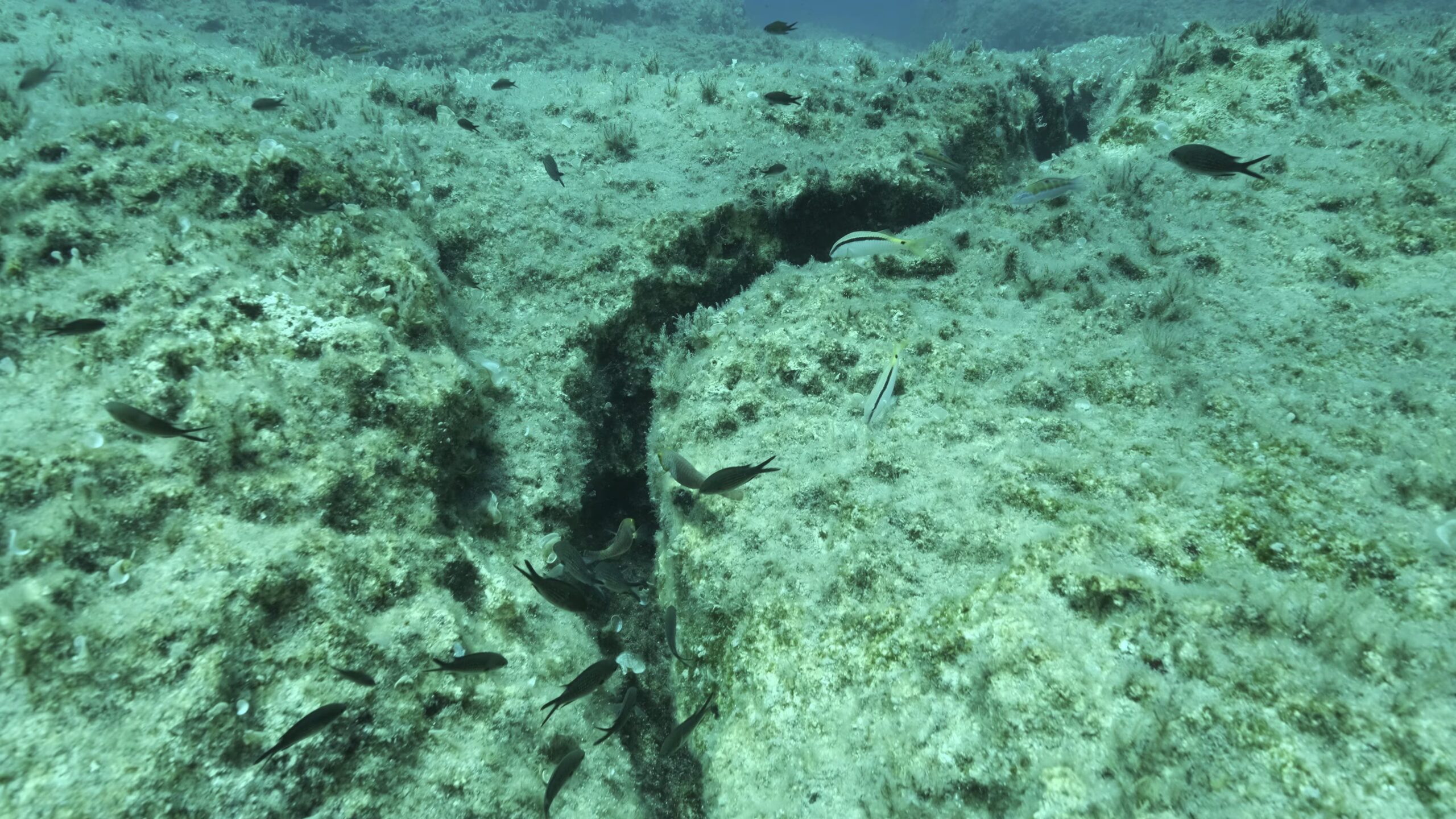
Along the Gofar submarine fault – East Pacific Ridge transform fault, located at great depth off the coast of Ecuador – la Pacific plate and that of Nazca they slide sideways to each other at a speed of approx 14 centimeters per year. Unlike most of the earth’s faults, which are unpredictable and irregular, the Gofar fault generates earthquakes magnitude approximately 6.0 every 5 or 6 yearswith breaks that almost always start and end in the same places.
For over 30 years geophysicists and seismologists have observed this phenomenon without being able to fully explain its physical mechanism. Today, research led byIndiana University Bloomington – created in collaboration with the Woods Hole Oceanographic Institution, the Scripps Institution of Oceanography of the University of California San Diego, the US Geological Survey, Boston College, the University of Delaware, Western Washington University, the University of New Hampshire and McGill University – has clarified the underlying mechanisms of this surprising regularity. The results were published in the journal Science.
Why Gofar earthquakes repeat cyclically: the study
Analyzing the data collected by seismometers installed on the ocean floor, the researchers focused on the fault sections between the main rupture segments, the so-called “barrier zones”. In these areas the fault divides into several branches, separated by small lateral misalignments of a few hundred metres. The rocks are also strongly fractured and porousa condition that favors the penetration ofsea water deep along the fault. When a magnitude 6 earthquake is triggered in one of the blocked segments, the rupture propagates until it reaches these barrier zones. Here the deformation of fluid-saturated rocks causes a sharp decrease in pore pressure, temporarily increasing the resistance of the fault and thus contributing to slow the propagation of the crack and to limit its extension. The data also showed a recurring behavior: in the days and weeks preceding major earthquakes, barrier zones are affected by aintense microseismicitywhile immediately after the shock they enter a phase of almost absolute seismic silence. The same pattern was observed in two different segments of the fault, analyzed twelve years apart.
We have known about the existence of these barriers for a long time, but the question has always been: what are they made of and why do they manage to stop earthquakes so regularly, cycle after cycle?
declared the seismologist Jianhua Gongfirst author of the study and Assistant Professor of Earth and Atmospheric Sciences at Indiana University Bloomington.
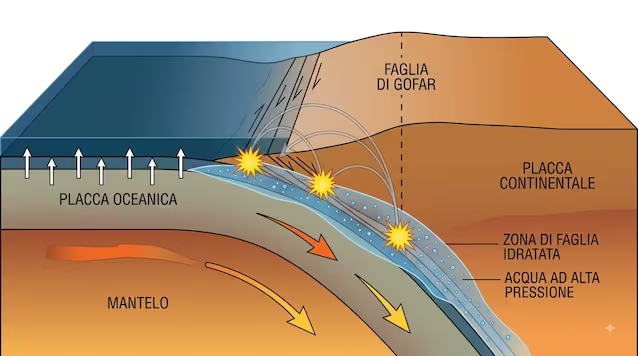
The researchers have therefore observed that these barrier zones maintain structural characteristics over time that repeatedly stop the propagation of cracks. It is precisely the persistence of these obstacles along the fault that explains why Gofar earthquakes tend to interrupt in the same points and reach, cycle after cycle, similar magnitudesaround 6. Over the last thirty years, the two barriers analyzed would have contributed to stopping approximately 15 earthquakes of this intensity.
A natural laboratory to understand continental earthquakes
Although the Gofar fault lies far from inhabited coasts and its earthquakes do not pose a direct danger to the population, the study’s findings have broader implications. Similar oceanic transform faults are widespread on the seabed throughout the world and produce earthquakes which, despite geological conditions, tend not to exceed certain magnitudes. According to the researchers, barrier zones similar to those identified at Gofar could be common along these faults and help limit the extension of ruptures through the combination of complex geometry, high rock fracturing and sea water infiltration. Better understanding these mechanisms could therefore help refine the models used to describe earthquake propagation and evaluate the seismic risk along submarine faultsincluding those close to densely populated coastal areas.
