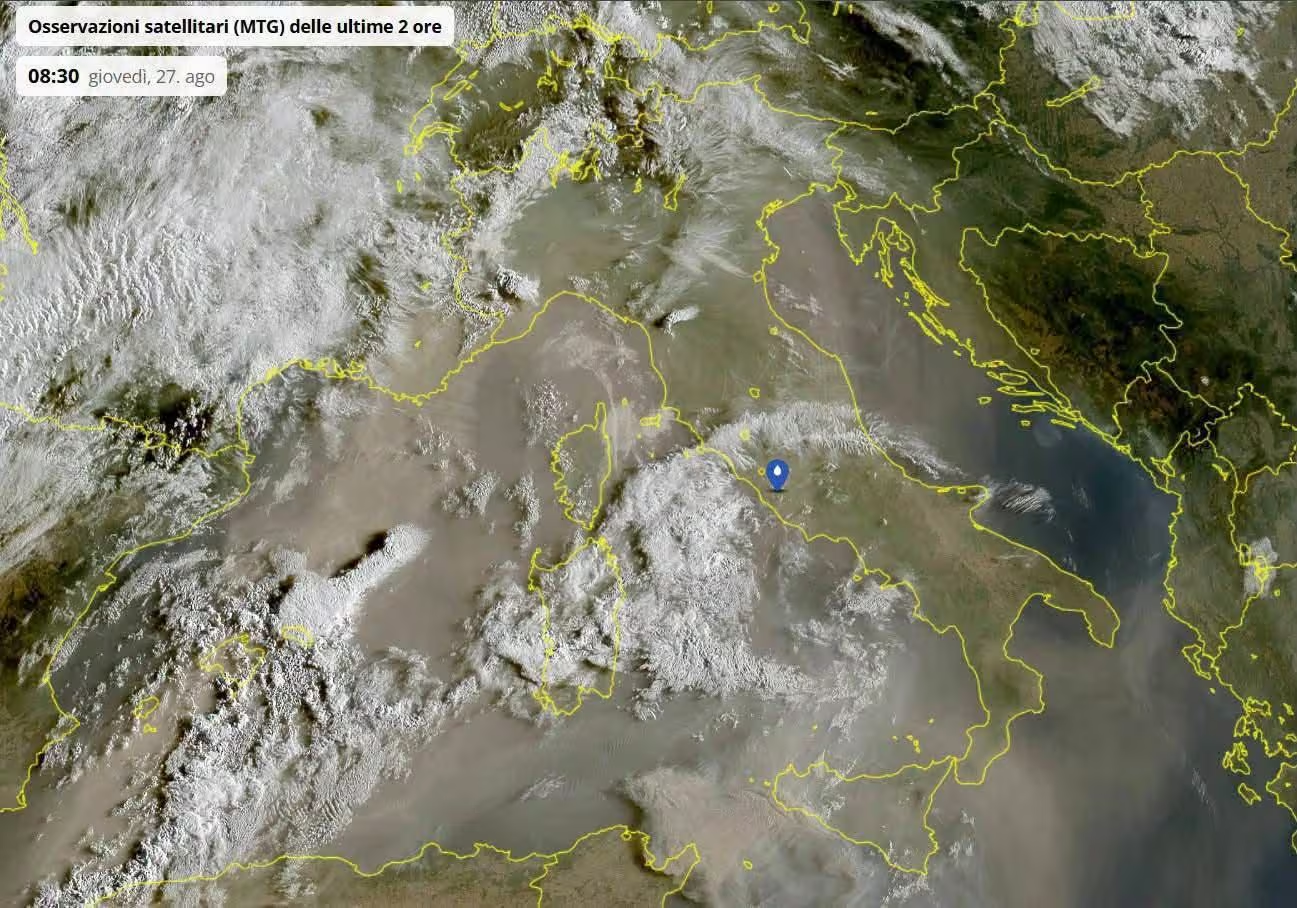
A veil between golden yellow and milky is enveloping the skies of Italy, coloring the panorama of the central-southern regions with an almost ghostly atmosphere. From Thursday 27 August, a massive Saharan dust cloud it is flying over our country, driven by high-altitude southern currents. This is not an unprecedented event for the Mediterranean basin, where The transport of dust from North Africa represents a recurring dynamic. On this occasion, however, the arrival of the dust was part of a meteorological context already marked by a strong heat wave, the fifth, with temperatures which in the internal areas of the South have already reached extreme peaks of 45-46°Cmaking the overall picture particularly intense.
The meteorological cause: the Atlantic trough and the “conveyor belt”
At the basis of this impressive advection of dust there are precise conditions linked to atmospheric pressure on a continental scale: a Atlantic sagging (a sinking of cooler, more unstable air from the ocean) sank towards the Iberian Peninsula. Working like a real gear, this system triggered an intense on its ascending flank lure of southern currents of subtropical origin. The winds at high altitude drew the air directly from the hinterland of the Sahara desert, loading themselves with very fine particles of mineral and dust and transporting them at high speed towards the Mediterranean basin and Italy.
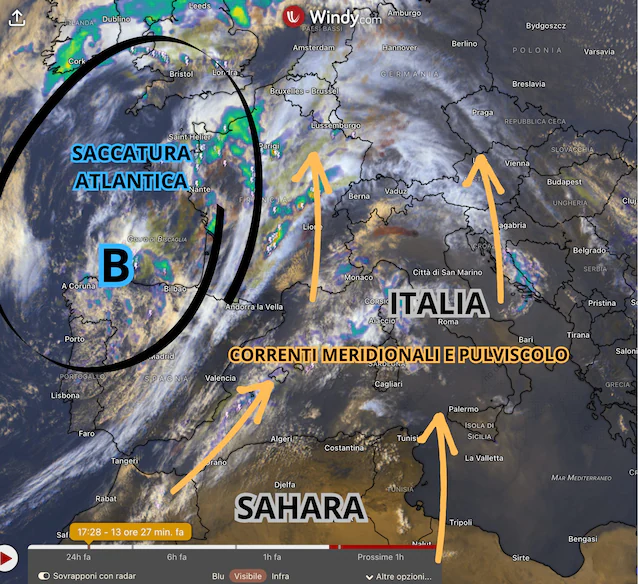
How dust travels from the desert to our skies
The Saharan dust it is composed of tiny mineral particles (such as quartz, feldspars and clays), rich in iron and oxides which give it its typical reddish colour. It often also contains nutrients such as phosphorus and fossil residues of ancient lake microalgae (for further information).
The lifting and transport mechanism responds to precise physical laws. The strong winds blowing over the Sahara Desert (often linked to local convective systems or intense pressure gradients) create strong turbulence in the lower layers. This turbulence raises enormous amounts of dust.
The heaviest particles fall almost immediately due to gravity, but the finer dust (with diameters less than a few micrometres) is pushed upwards until it reaches the medium-high troposphere, between 2,000 and 6,000 meters above sea level. Once hooked by strong air currents at high altitude, the dust can travel thousands of kilometers without settling, floating in the atmosphere until the winds lose intensity or the rain drags it towards the ground.
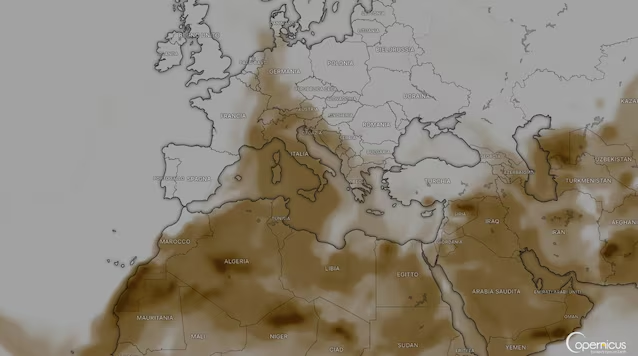
The thermal effect of dust: the “screen” during the day and the “lid” at night
The presence of a high concentration of suspended dust modifies the radiative balance of the local atmosphere, acting in two different ways between day and night:
- During the day there is the albedo and reflectance effect: the grains of dust at altitude reflect and disperse part of the incident solar radiation towards space. This “screen” means that the direct solar radiation reaching the ground is slightly less. Consequently, the maximum temperatures they may be slightly lower (often by 1-2 °C) compared to what is theoretically predicted by the models in clear sky conditions;
- At night the greenhouse effect and cover: the dust acts as a barrier to long-range infrared radiation emitted from the ground as it tries to disperse into space. By retaining heat in the lower layers, it prevents normal night-time cooling. Result: le minimum temperatures remain exceptionally high, fueling the feeling of stuffiness even during the night hours.
How long will the phenomenon last in Italy: gradual improvement from Sunday
Already from the day of Sunday 30 Augustthe progressive shift of the depression structure towards the East and the change in ventilation will favor a gradual cleaning of the skies, bringing greater atmospheric transparency and a general reduction in the most extreme thermal values.
Did you know that there are also forecasts for the arrival of Saharan dust? You can consult this site by clicking on “dust load” above.
