
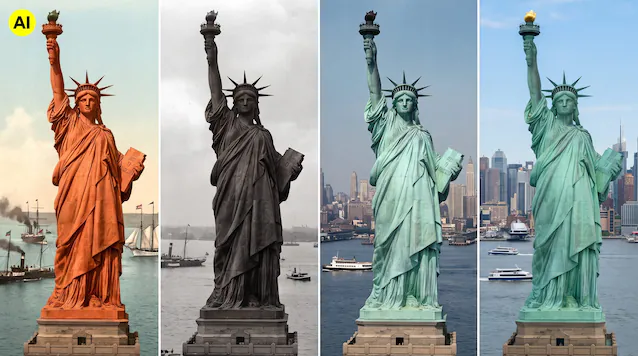
The Statue of Liberty was originally copper-colored. Its coating first darkened due to the formation of cuprite and then became covered with green brochantite thanks to the sulfur present in the air. This patina protects the metal, so much so that in almost a century the statue has lost just a tenth of a millimeter of copper.
Who has seen it at least in photos Statue of Liberty it remembers it as green-blue. Yet, when it was inaugurated in 1886, it had a completely different appearance: a red-orange color typical of copper. But why has it changed so much over the years? As usual, the answer lies in chemistry. The “skin” of the statue is made of sheets of coppera metal that first darkens in contact with air, covering itself with a thin oxide layer called cupriteand then, between rain, salt and smog, it slowly becomes covered with a green patina: In New York this process took almost 25 years. And here comes the beauty: it is precisely this patina a protect the metal and to keep the statue healthy from 140 years.
From Copper Reddish Brown to Green: What Happened to the Statue of Liberty
The statue is covered in copper plates just 2.4 mm thick, more or less as much two coins superimposed. As soon as it is exposed to air, copper reacts with oxygen and is covered with a very thin veil of oxide, called cupritewhich makes it become first brown and then almost black. And how thick is this veil? According to a study published in Corrosion Scienceto darken the metal just one layer of about a thousandth of a millimetre.
Green, however, comes with it sulfur. In the air of the cities, sulfur dioxide (SO2) produced by burning coal and other fuels ends up dissolved in droplets of rain and fog. When this water bathes the statuecopper combines with sulfur and forms new blue-green mineralsfirst of all the brochantitethe main person responsible for color. But that’s not all: to completely cover the brown, the green layer must be about fifteen times more often than the dark one. In other words, it takes years for green to take over.
The function of the green patina on the monument
One would think of patina as one kind of rust to remove. It actually is thanks to it that the statue enjoys excellent health: according to the measurements of National Park Servicethe body that manages the monument, in almost a century the copper skin has thinned by just one tenth of a millimetre. The patina, in fact, acts as shield and if we removed the exposed copper it would start to corrode again.
Yet there was a moment when this risked being green removed. According to the historical report of National Park Service, already in 1901 (not even twenty years after its inauguration) an army officer described the statue as covered in green. In 1905, however, the engineer in charge of evaluating its condition concluded that cleaning or polishing it would not have improved either the appearance or the preservation of the metalbecause the polished copper would be oxidized even more quickly. Finally, in the restoration work of 1907, the paint ran out only on the internal metal structureand the statue would remain green to the present day.
That green, among other things, it is not the same everywhere. As shown by a study published on Environmental Science & Technologythe lighter and darker patches depend on the windwho decides which parts of the statue come wet from the rain and which ones aren’t. What if the air changes? Then the color of the statue also changes! In fact, with the decrease in smog in the city, these differences may have become more evident than in the past.
The golden torch and the Italian “cousin”.
However, there is one detail that it’s not greenor the torch flame. During the restoration of the 1980s it came redone from scratch and replaced with a copper copy 24 carat gold coated. The original one is now exhibited in the statue museum. The reason? Over the years the original flame had been perforated and filled with glass panels to illuminate it from withinbut those glasses, becoming ruined, began to give way and let in rainwatermaking the flame the point from which the most water entered the entire statue.
To see a “relative” of the Statue of Liberty, we don’t need to cross the ocean. In Arona, on Lake Maggiore, the Sancarlone (or Colossus of Saint Charles Borromeo)just over 30 meters tall if we count the statue and pedestal, was built with same techniquethat is, copper sheets embossed on an iron skeleton. An article published on Materials he compares it precisely to New York statue and, as a study on Heritage, also the statue of San Carlo it was “dressed” in green brochantite on the parts exposed to the rain. In short, if you happen to pass through Arona, look up towards Sancarlone and you will be able to admire the same greenery as the Statue of Liberty without having to fly to New York!
