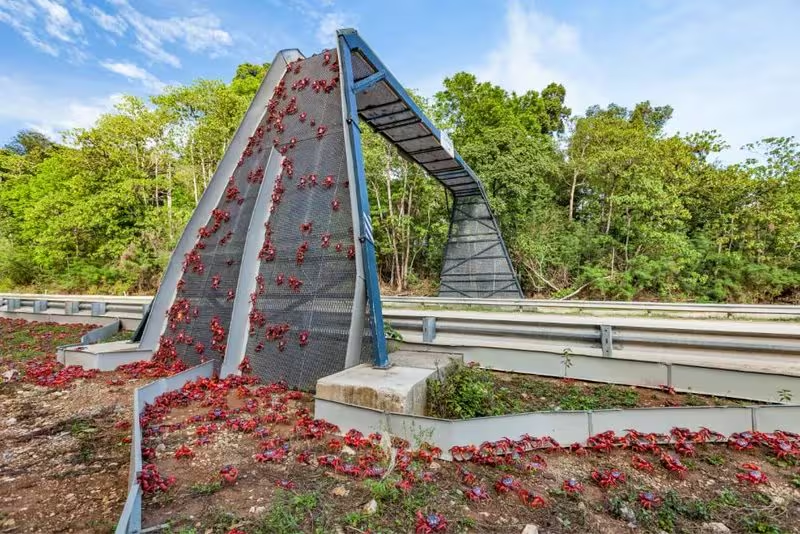
Every year tens of millions of red crabs, endemic to Christmas Island, migrate from the forest to the sea to lay their eggs in the sea. In 2026 the journey began around November 15th with the first rains: the females will release their eggs into the sea in the last quarter of the Moon. Roads are closed and special bridges have been created to let them pass.
Every year, between October and December, tens of millions of red crabs (Gecarcoidea natalis) leave the forest ofChristmas Island or Christmas Island, an Australian territory in the Indian Ocean, and come down to the coast to breed. The larvaeIn fact, they can only develop in salt water. This year the migration began around November 15, triggered by the first rains of the wet season. Females will spawn in the sea during the last quarter of Moonwhen the difference between high and low tide is minimal.
For a few weeks streets, gardens and beaches are covered with a red carpet and the islanders reorganize their daily lives around this event. On the Parks Australia YouTube channel, daily live streams are broadcast showing the phases of the long journey.
The red crab is an endemic land crab: lives only on Christmas Island. Its carapace measures approx 12 centimetres and males are typically larger than females (sexual dimorphism). It feeds mainly on leaves, fruits, flowers and seedlings, significantly contributing to the health of the island’s rainforests.
While living “dry”, he needs humidity to breathe and for this reason it comes out en masse when it rains. Migration it is led by maleswho arrive first and dig the dens near the shore, where mating with females will take place. Each can carry up to 100,000 eggs in a pouch under its abdomen and remains in the moist burrow for about two weeks. The time of release is before dawn and can last for 5-6 consecutive nights with the high tide that retreats during the last quarter of the Moon.
The females shake their eggs in the sea and they hatch as soon as they touch the water. In some stretches of coast they can be counted up to 100 crabs per square meter.
The larvae spend about a month in the waves and those that are not eaten by whale sharks, manta rays or fish become megalope (last larval stage), they gather along the shore and become little crabs of about 5 millimetres. It takes them about 9 days to travel back inland, where they remain hidden for the first three years of their life.
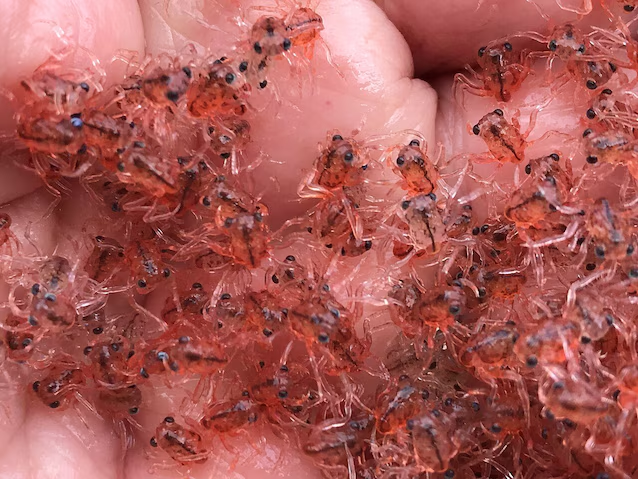
Almost every year there is little or no return. Once or twice a decade, however, survival is very high and the population renews itself.
It is difficult to say exactly how many there are and estimates have changed over time. The Australian Museum indicates approx 45 million individuals.
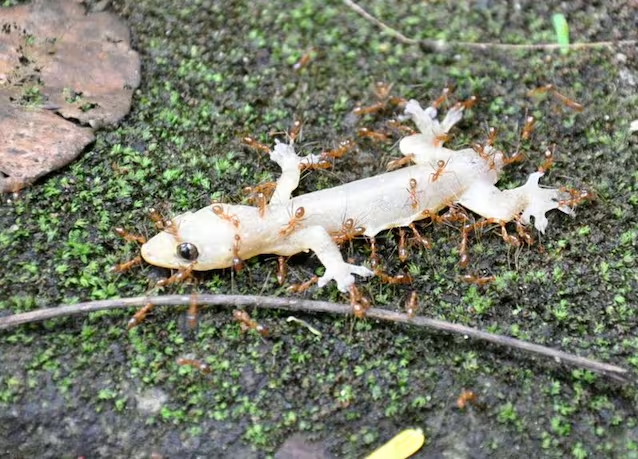
At the beginning of the 2000s a study published on Ecology Letters he estimated that the yellow crazy ant (Anoplolepis gracilipes), an invasive species that arrived on the island in the 1900s, already had killed 10-15 million crabsbetween a quarter and a third of the population.
These ants form supercolonies which arrive at over 1,000 individuals per square meter and spray formic acid on the eyes and mouths of crabs, which typically die within 48 hours.
To stop them, after having tried with poisoned bait, Parks Australia And La Trobe University they focused on biological struggle (use another insect to attack the crazy ants’ food source). Since 2016 they have introduced a Malaysian microwasp about 2 millimeters (Tachardiaephagus somervillei) which parasites the cochineal (Tachardina aurantiaca) which produces the honeydew that the ants feed on: less scale insects, less food for the ants.
In 2025, park managers talked about more 100 million of migrating crabs, and some estimates exceed 180 million. They are numbers to be taken as orders of magnitudenot as precise censuses.
During peak migration some roads are closedeven at short notice. There are some along the most popular routes barriers that funnel crabs into underpasses and a real one crab bridge that crosses the roadway.
