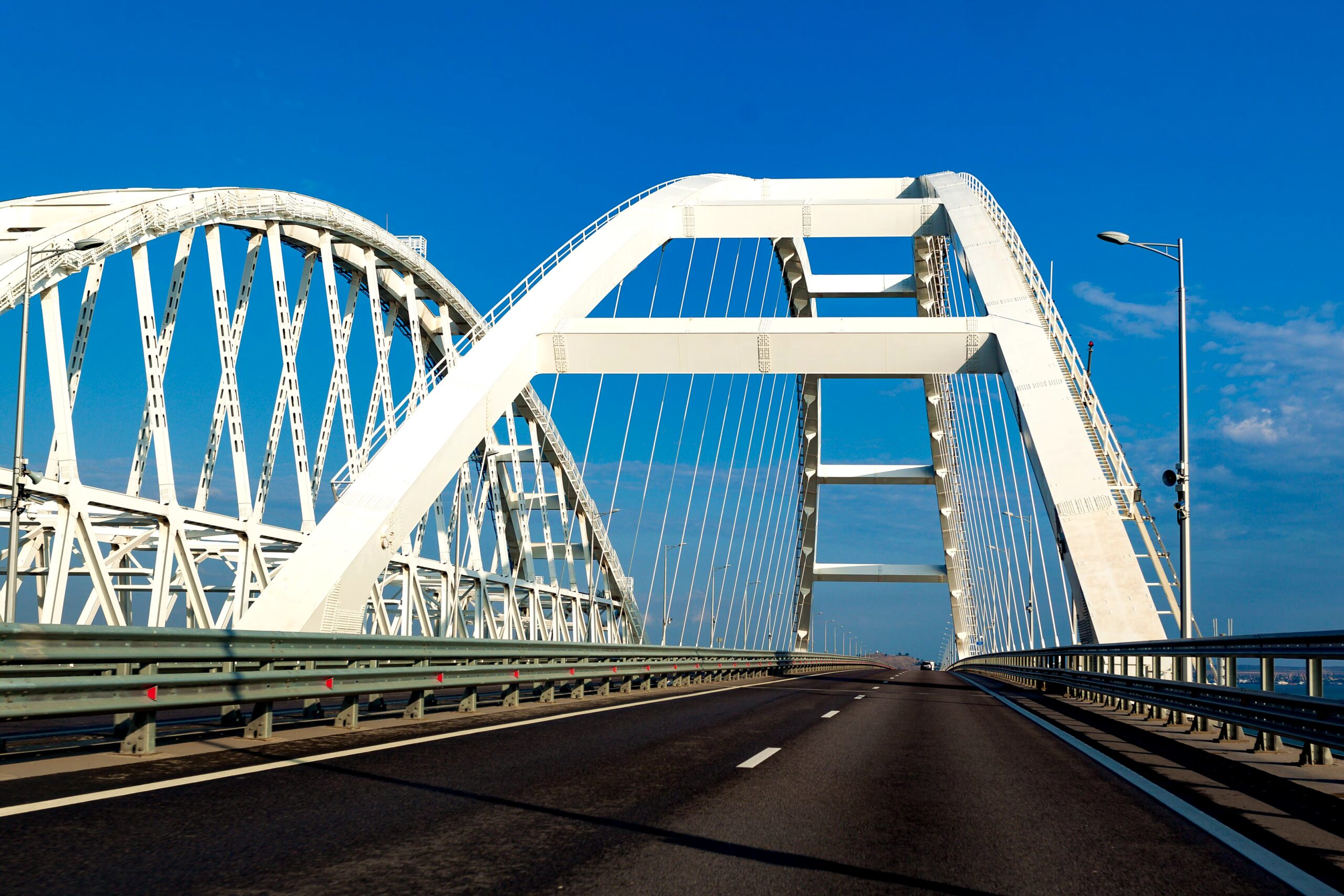
After the attacks on November 16 and 17, the 227-meter road span above the Kerch waterway collapsed. The bridge connects Russia to occupied Crimea and is a supply route for Russian forces.
The Crimean Bridge was hit again by Ukrainian forces on 16 and 17 November 2026. The strategic infrastructure, already damaged in the October 2022 attack and hit again in July 2023 and June 2025, connects mainland Russia to occupied Crimea via the Kerch Strait. The road and rail connection extends for approximately 19 kilometers. During the last offensive, the span and arch of the road section collapsedwhile the railway deck and arch remained standing, despite having suffered damage. The sections of the bridge not affected by the collapse are currently being monitored and checked to ensure their stability and assess the risk of future failures.
How long is the bridge connecting Crimea to Russia: technical point of view
The Crimean Bridge (or Kerch Bridge) is 19 kilometers long and from an engineering point of view it consists of two statically independent parallel structureswith distinct decks hosting respectively the road traffic on four lanes and that railway on double track. Corresponding to the navigable canal, their piers rest on common foundations. The system is made up of deep piles and has the peculiarity of being partially embedded in the ground: the piles, in fact, penetrate the seabed only for a stretch, while the remaining part develops in the water and rises up until it connects to the base of the piles. Because the plinth is above the water level and the piles are largely submerged, the base of the bridge appears to almost float.
The strategic attack on arched structures
The Ukrainian attack on the night between November 16th and 17th hit the section of the Crimean Bridge that spans the navigable channel of the Kerch Strait. The road arch and related deck collapsed into the water, while the railway arch sustained damage. The collapse affected the longest road span of the bridge, the one that leaves room for the passage of ships.
The static scheme of the arches
The crossing of the 19 km of strait is achieved through a dual structural system and most of the spans are supported by simply supported beams between two consecutive stacks. In the road section there are also continuous beams on multiple supports. The piles then transmit the loads to the foundations. The “simply supported beams” scheme presents limits linked to the load-bearing capacity of the structure and its deformability under load, including its own weight. The span that can be achieved with this scheme depends on the characteristics of the deck and the loads it must support: essentially, the scheme can no longer be used beyond a length which, in the most challenging cases, is around a hundred metres. To overcome larger spans it is advisable to adopt another static scheme, as happens in the two spans above the navigable canal. Here one was in fact chosen lower arched structurein which the road and railway decks run in the lower part of the respective arches. The abandonment of the supported beam scheme in favor of the arch derives from the need to guarantee the transit of large vessels without placing intermediate stacks in the channel. There The design span of the spans is 227 metreswhile the passage useful for navigation is wide 185 meters and tall 35 meters on the water level.
https://www.istockphoto.com/it/photo/panoramic-view-of-the-white-bridge-of-crimea%C3%A0-and-the-strait-of-kerch-del-mar-gm1180398525-330679481?phrase=ponte%20crimea&searchscope=image%2Cfilm
The attack on piles and foundations
According to the Ukrainian authorities, they were used in the attacks on November 16 and 17 drones and missiles. It remains to be seen whether the piles and the support structures of the arches: limited, critical and vulnerable target. These substructures in fact support the central spans, absorbing considerable vertical loads and horizontal thrusts. The hydrodynamic thrusts and impacts generated by a possible explosion near the piers or foundation piles can compromise the static balance of the two twin decks. In this specific case, the collapse only affected the road span that was the object of the bombing.
The consequences for traffic and navigation
The attack caused the suspension of road and rail traffic. According to the Russian Ministry of Transport, the November 18th the trains were running according to time againwhile the road remained closed. Part of the collapsed structure would have ended up in the navigable canal and it remains to be ascertained to what extent the debris limits the passage of ships and whether the damage to the railway arch has compromised the stability of the structures or the deck, with possible consequences for the safety of navigation under the bridge.
The complexity of replacement
To restore an ordinary deck with simply supported beams, they can be used prefabricated elementsprovided that the supports are still usable. This is a relatively quick operation. An arched span of this size is instead atailor-made work. The complexity affects both design and manufacturing, from assembly to launchthat is, the positioning of the structure on the supports. In 2017 the two arched spans of the Crimean Bridge were assembled on land, transported by water and installed over the canal. It goes without saying that the processing and production times of the elements, to be considered even in the case of simply supported beam spans, are much more penalizing in these conditions.
The behavior of steel in the event of fire
Although the elements that have emerged so far on the dynamics of the collapse give little support to the hypothesis of failure due to fireit is worth underlining that, in general, this structural typology appears more susceptible to collapse due to exposure to high temperatures. Since the deck is suspended from the arch structure by a large number of hangers of reduced cross sectiona possible fire triggered by the explosion – and the consequent loss of resistance and stiffness on the part of the steel – could trigger a progressive collapse of the bridge. In fact, if one of the individual tie rods supporting the deck were to give way, it would instantly transfer a substantial increase in load to the adjacent hangers, bringing them in turn into crisis in a chain reaction. Whether the failure propagates depends on how the span is designed to absorb this redistribution.
