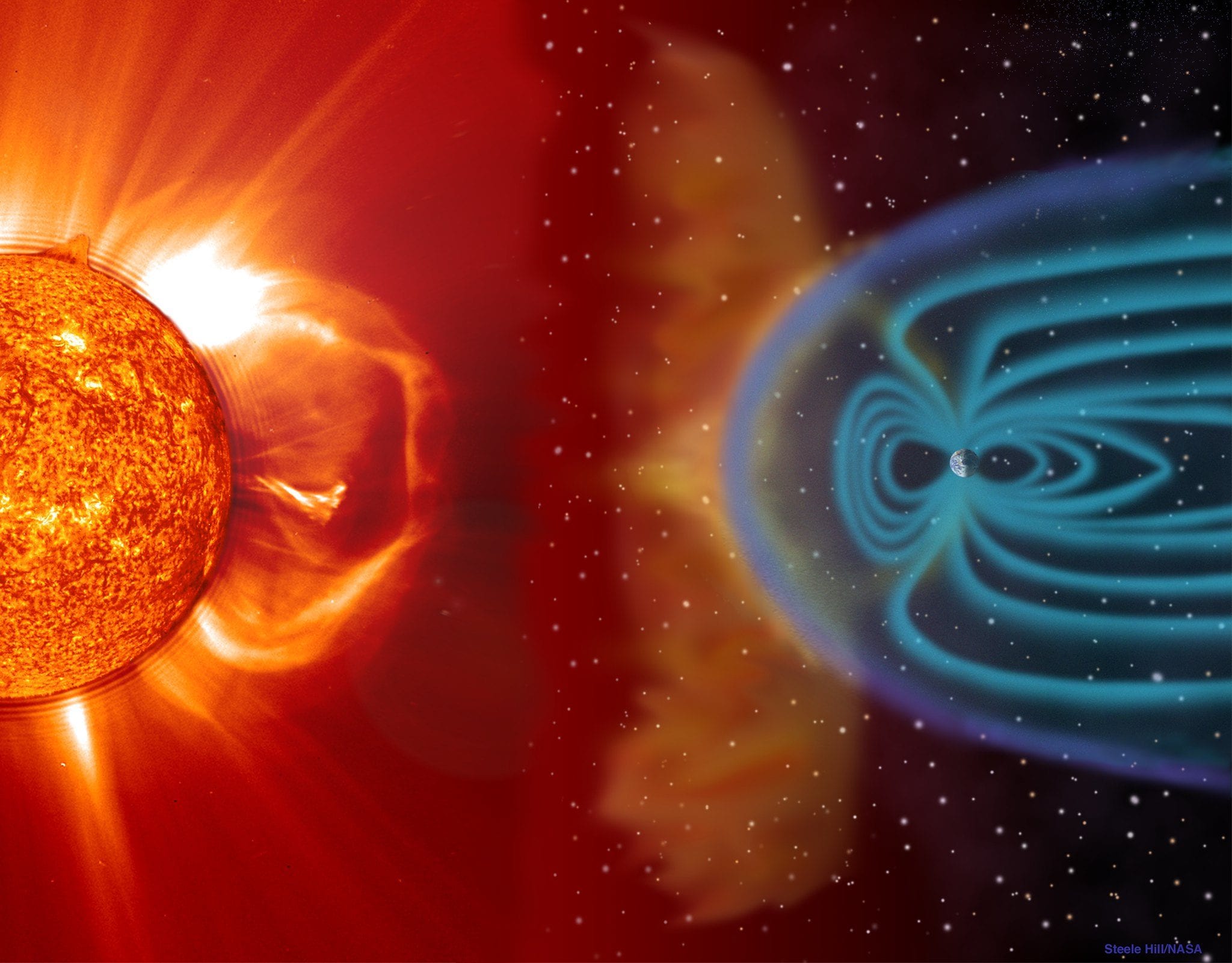
There climate history of the Earth it might have been influenced not only from what happens on our planet, but also from the history of the Sun and from the journey of the whole Solar system through the Milky Way. This is what emerges from two recent NASA studies, which investigate two completely different eras of Earth’s history.
The first study reconstructs through numerical simulations the movement of the Solar System through the interstellar medium of the Milky Way over the past few million years and suggests that some encounters with dense clouds of gas and dust may have temporarily reduced the size of the heliosphere, directly exposing the Earth to the interstellar environment and contributing to climate changes that occurred millions of years ago.
The second study instead goes back billions of yearswhen the Sun, recently born, was about 70% of current brightnessbut with greater activity than today. Research shows how the particles produced by frequent superflares may have favored the training in the earth’s atmosphere of powerful greenhouse gaseshelping to maintain liquid water on the surface of our planet.
The results therefore show two sides apparently opposite of the influence of our star on Earth. In relatively recent times, on a geological scale, the movement of the Sun in the Milky Way may have contributed to episodes of cooling of the earth’s climatewhile billions of years ago the intense activity of the “young” Sun may have helped warm an Earth which otherwise would have had to be frozen.
Dense interstellar clouds may have left Earth without the protection of the heliosphere
We are used to thinking of planets as bodies that orbit around the Sun, but our star is also constantly moving. The Solar System orbit in fact around the center of the Milky Way with a period of approximately 230 million years and, during this journey, crosses regions of our galaxy with very characteristics differentsome nearly empty and others occupied by relatively dense and cold clouds of interstellar gas and dust.
THE bodies within the Solar System However, they do not normally come into contact directed with this material, as the Sun emits a stream of charged particles that expands in all directions (known as solar wind). The latter creates a gigantic bubble called around our star heliosphere: this structure envelops and acts as a shield for all the bodies of the Solar System and currently extends up to about 120 astronomical units (about 18 billion km) from the Sun. To be clear, our Planet is located 150 million km from the Sun, about 1 astronomical unit.
The size of this bubble can vary over time depending on the balance between the pressure exerted outwards by the solar wind and that exerted inwards by the interstellar material crossed by the Solar System. If the Sun enters a much denser region, the external pressure increases and theheliosphere may therefore shrink. And that’s exactly what, according to new astrophysics-led NASA research Merav Opher from Boston University, it would have happened several times in the Earth’s recent geological past.
Using numerical simulations and reconstructions of the Sun’s path in the Milky Way, Opher’s group simulated how theheliosphere it could be changed in the last million years. The results indicate that the Solar System would have encountered gods at least three times cold and very dense interstellar cloudsapproximately 13-14 million, 6-7 million and 2-3 million years ago.
The pressure exerted by these clouds would have been high enough to compress the heliosphere up to dimensions smaller than those of Earth’s orbit. In these periods the Earth would therefore have found itself temporarily outside the heliospheredirectly immersed in the interstellar medium, as confirmed by the presence of isotopes of interstellar origin such as iron-60 and plutonium-244 found in deep ocean sediments.
Paleoclimate reconstructions show important phases of global cooling precisely in correspondence with the previously mentioned periods, in which our Solar System would have encountered interstellar clouds. According to NASA simulations, when the Earth is directly immersed in a cold, hydrogen-rich interstellar cloud, the material coming from the cloud can change the composition and the dynamics of the upper layers of the atmosphere. The models indicate changes in water vapor content and atmospheric chemistry, which can propagate to change surface climate conditions.
However, it is important to underline that the temporal coincidence does not prove that meetings with interstellar clouds have caused these cooling. The same authors still define debated the mechanisms responsible for the observed climate variations and point to the temporary collapse of the heliosphere as a possible external factor to be added to the mechanisms already studied, such as variations in the Earth’s orbit or the concentration of greenhouse gases.
The “young” Sun’s superflares may have produced a powerful greenhouse gas in Earth’s atmosphere
The second NASA study concerns a much older phase of Earth’s history and tries to solve a problem known for decades as paradox of the young weak Sunor Faint Young Sun paradox. About 3 billion years agowhen the Sun was less than two billion years old, our star only emitted the 70% about from the its current brightness. All other things being equal, such a small amount of energy should have make the Earth cold enough to keep much of the surface water frozen. However, geological evidence shows that on our planet stable liquid water already existed long before then.
A possible clue as to how this is possible comes from the observation of young stars similar to the Sun. The data collected by telescope space Kepler of NASA have shown that stars of this type are much more magnetically active compared to the current Sun and can very frequently produce enormous eruptions called superflares. In the hypothesis that the young Sun behaved in the same way, events of this type could occur large quantities of high-energy particles towards the planets of the Solar System and may have played a fundamental role in making the primordial Earth habitable.
To test this hypothesis, the group led by Kensei Kobayashi and Vladimir Airapetian of Goddard Space Flight Center from NASA has recreated one in the laboratory possible atmosphere of the primordial Earth, using a mixture containing molecular nitrogen, ammonia, carbon dioxide and carbon monoxide.
The researchers then bombarded the mixture with protons, simulating the energetic particles that would hit the atmosphere during the frequent superflares of the young Sun. The irradiation triggered a series of chemical reactionsincluding the production of large quantities of nitrous oxide (N₂O)a extremely effective greenhouse gasapproximately 300 times more potent than carbon dioxide.
However, the young Sun also emitted a lot ultraviolet radiationcapable of destroying part of the nitrous oxide produced. So the team used photochemical and climate models to see what would happen if only one fraction of the N₂O had managed to survive in the atmosphere. The result was that even barely maintaining 10% of the nitrous oxide produced in the experiments, the equatorial regions of the early Earth could have reached temperatures around 5°Chigh enough to keep water in a liquid state even though the Sun was much dimmer than today.
Particle bombardment may also have had a second effect. The experiments produced precursors of organic moleculesshowing that the same solar activity that contributed to warming the planet could simultaneously provide energy to the reactions of prebiotic chemistry, that is, the chemical processes that preceded the appearance of life. The study also suggests that temperatures just above the freezing point could encourage the formation of complex chains of amino acids.
