A recent study published in Nature Communications, fruit of the joint work of the CNR Nano of Modena, the University of L’Aquila, Princeton University and the Max Planck Institute, has proposed a new model to finally clarify the mechanism by which plants they transform light (luminous energy) into chemical energy during the photosynthesis. For years, this particular stage of the process has been a source of scientific debate due to experimental data on the speed of the process that seemed to contradict each other. Today, thanks to the use of computational models and quantum dynamics calculations, researchers seem to have solved the enigma by revealing that the electron transfer process is not divided into multiple paths, but follows only one path, that of chlorophyll. The unexpected breakthrough was discovering that it is the rapid movements of the protein structure and the orientation of water molecules internal to adjust speed and efficiency of this energy flow.
Photosynthesis and its two phases
With the deadline photosynthesis means the process of transforming light energy into chemical energy following the following formula: 6CO₂ + 6H₂O + sunlight → C₆H₁₂OR₆ + 6O. The photosynthetic process is divided into two distinct but strongly related phases:
- Bright phase: Radiant energy (coming from the sun’s rays) is used to produce chemical energy.
- Dark phase: the products obtained from the light phase are used to transform inorganic precursors (e.g. carbon dioxide) into organic compounds (e.g. sugars).
To understand the scope of the discovery, we need to take a step back and understand how plants capture sunlight. Everything happens thanks to photosystemsmulti-protein complexes composed of two main elements that work synergistically:
- THE’antenna: it is made up of pigment-protein complexes and its purpose is to collect light and channel it towards the reaction center.
- The reaction center (RC): it is a pigment-protein complex in which we find the photochemically active pigment, i.e. the one that absorbs light at a longer wavelength than the antenna and acts as the final collector of all the energy collected by the photosystem. This is exactly where it happens charge separation reaction that generates chemical energy necessary for the plant.
In plants this process occurs through two photosystems that work in series: the Photosystem I (PSI) and the Photosystem II (PSII). The passage at the center of the study in question is the one that interests the PSII, that is, the one responsible for water splitting and oxygen production.
The previous scientific debate on the two pathways: P680 and accessory chlorophyll
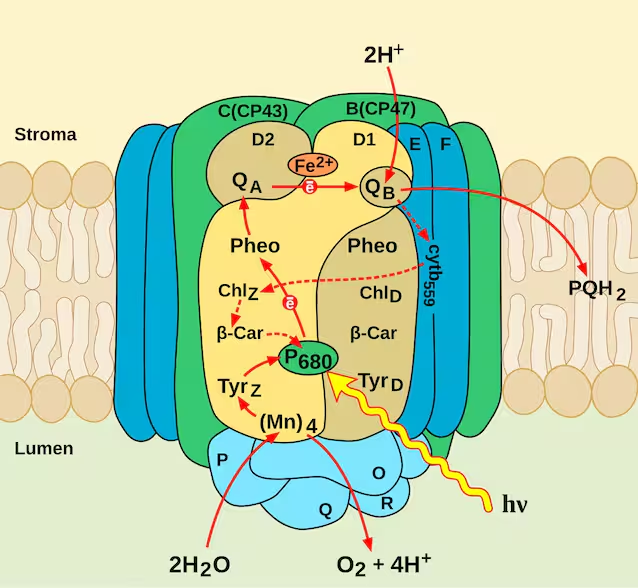
In the PSII RC, six key pigments (four chlorophylls and two pheophytins) cooperate to convert solar energy into electrical current through the electron transfer: in practice, during this process, an electron moves from one molecule to another giving rise to a current flow. To date, the scientific community has been divided on what the exact sequence of this step was:
- the way of the P680: hypothesized that the primary electron donor was the central nucleus of the photosystem (called P680). This transferred the electron to accessory chlorophyll (ChlQ1) which in turn passed it to pheophytin (PheoQ1).
- the accessory chlorophyll pathway: he hypothesized that it was the accessory chlorophyll that first gave up the electron to the pheophytin, oxidizing. Immediately afterwards, P680 intervened by giving up its electron to the accessory chlorophyll to fill the “void” and stabilize the system.
Complicating the picture were the experimental measurements. By analyzing the process they had been detected two different reaction speeds: one extremely fast (in the order of femtoseconds) and one much slower (in the order of picoseconds). To explain this difference, experts had hypothesized that plants used both pathways in parallel. However, it was a theoretical compromise that left many doubts open.
The discovery in the new study
The study published on Nature Communications undermines the hypothesis of the two parallel paths. Through computational simulations and quantum dynamics calculations, the researchers demonstrated that the first theory, the P680 route, is thermodynamically unfavorable at room temperature and, in fact, it does not affect the process.
Charge separation therefore occurs through a single main route: accessory chlorophyll gives the electron to pheophytinand only subsequently does the P680 intervene to fill the electronic gap.
The experimentally detected speed variation does not depend on different chemical pathways, but on the physical fluctuations of the surrounding environment that influence the route:
- The rapid motions of the protein (femtosecond): the very rapid thermal vibrations of the protein structure continuously modify the distances and mutual orientation of the molecules, allowing the electron to jump ultra-rapidly.
- The slow motions of water (picoseconds): Water channels are present within the photosystem and the reorganization and orientation of these water molecules occur on longer time scales. This movement changes the electrostatic field around the pigments, acting as a regulator that slows or speeds up electron transfer.
The novelty of this study lies in this functional coupling: water molecules are not only chemical elements used for the production of oxygen, but they actively contribute to the process by regulating speed and efficiency by which sunlight is converted into chemical energy.
