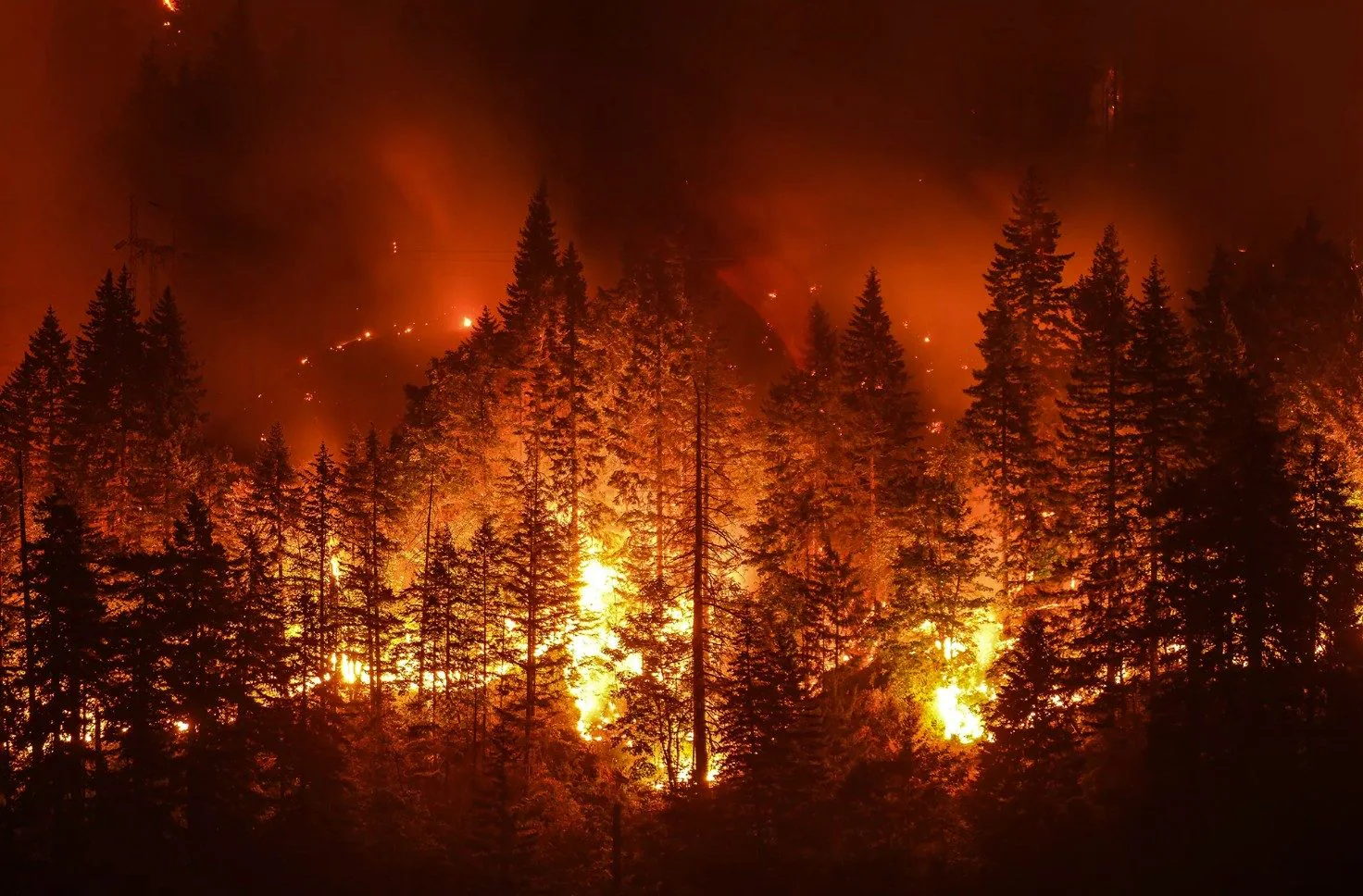
Sicily is still the protagonist of the fire emergency in Italy. Between Saturday 29th and Sunday 30th August the Regional Forestry Corps counted 198 fireswith 20 authorized aerial interventions between Canadair and helicopters, and on September 1st the wave of fire was recorded the first victim: Salvatore Giglia, 26 years old, died at the Civic hospital in Palermo from burns suffered while trying to put out the fire that broke out near his home in Ciminna. But the Sicilian crisis is only the hottest front of a season that satellite data describes as exceptional: according to the extraction of EFFIS data, the European fire monitoring system of the Copernicus programme, as of August 26, 2026, 95,345 hectares have gone up in smoke in Italyalmost double the 2006-2025 average at the same date (48,758 hectares) and an area now equivalent to that burned in the whole of 2025which at 96,539 hectares was the fifth worst year since 2006.
What’s happening now in Sicily: no province spared
In Sicily the firefighters carried out over 800 interventions since Friday 28 Augustwith approximately 750 units in service plus 120 fire campaign operators, e all affected provinces. The flames touched numerous homes in Taormina and on September 1st the most difficult day was recorded in the Messina area, with simultaneous fires in Gallodoro, Letojanni, Taormina, Tortorici and above all Castelmola, where Canadair, Erickson and Falco helicopters and reinforcements from the commands of Catania, Enna and Syracuse intervened.
In Palermo, the shutdown operations at the Conca d’Oro shopping center required ten teams and a helicopterwhile the regional Civil Protection maintains the red alert in the provinces of Agrigento, Caltanissetta and Enna and the orange one in the other six. The President of the Region Renato Schifani has meanwhile extended the ordinance on thermal stress until September 30, which prohibits work exposed to the sun between 12.30 pm and 4 pm in the most at-risk sectors.
EFFIS does not publish data on a regional basis, but the ISPRA monitoring built on the same satellite observations photographs the weight of Sicily: As of July 28, 2026, the Island had 510 square kilometers of territory covered by fire out of a national total of approximately 741, and together with Calabria (78 km²) e Puglia (48 km²) concentrated 73% of all the burned surface in Italy. In the province of Agrigento alone the various outbreaks have reached more than 67 km² 9,400 football pitches.
Fires in Italy: the fire slows down but does not go out, the data
Outside Sicily the pressure is lower, but no less alarming. Weekly EFFIS data shows that in the seven days ending August 26 in Italy they burned 7,575 hectaresalmost double the historical average for that period (4,021): the late summer fire remains above usual levels. However, the picture is not uniform. In Campania the regional civil protection recorded 1,191 fires covering 2,239 hectares between 15 June and 30 August, with 321 fewer fires than in 2025 and in the Salerno area an 87% reduction in the surface burned. In Sardinia, however, approximately 10 thousand hectares went up in smoke in six months with 1,550 fires.
At a national level, the National Fire Brigade closed August with almost 74 thousand hectares protected from flames and over a million overall interventions since the beginning of the year, also paying two lives: an air rescue worker from the Alghero flight department and a department head succumbed to a heart attack while coordinating the extinguishing of a fire in San Cataldo, in the Nisseno area.
Recomposing this picture, moreover, is an exercise that each organization does on its own: a regional bulletin here, a fire brigade statement there, with perimeters and definitions that never coincide. What Italy lacks is a public and unified information system: open data, in almost real time, accessible by citizens and journalists like EFFIS. Operational monitoring exists – regional operations rooms, daily danger bulletins from the Civil Protection, air fleet coordinated by the Unified Air Operations Center – but to find out how much the country is burning today, you have to go to Brussels: it is the European platform, not an Italian one, that provides the only homogeneous and updated series on national fires. It is no coincidence that Legambiente has long been asking the government for a transparent national system on the EFFIS-Copernicus model, with updated data on burned areas, damage and costs of firefighting and prevention.
The balance of the summer: 2026 has already equaled all of 2025
The EFFIS data for Italy, available until August 26, allow us to measure the season with a homogeneous series, referring to fires above 30 hectares. The 2026 total is 95,345 hectares, 96% more than the twenty-year average on the same date. The figure remains below the historical maximum of the series (146,017 hectares, reached in 2007), but the trajectory tells of an anomalous year from the beginning: already in the week of 6 May they had burned 820 hectares in one daythe highest value ever recorded in that period. The breaking point, however, is the week of July 22, when 49,835 hectares went up in smoke in seven days: More than half of all acreage burned in 2026, more than double the previous all-time high for that week (23,692 hectares) and eight times the average.
And the European situation is not the best either: the continent burns twice as much as normal. 637,901 hectares went up in smoke in the Union as of 26 August, +104% on the averagehowever below the record of 2025 (983,367 on the same date). Spain is at 295,675 hectares, almost four times its average; France is the only major country above its 20-year highwith 96,461 hectares against a previous record of 61,573: in absolute terms, this year France has burned more than Italy.
He is the man behind 98% of fires: the reasons
According to ISPRA monitoring for 2025, in Italy natural causes – essentially lightning – account for around 2% of fires: everything else is of anthropogenic origin. The same estimate comes from the Forestry Fire Prevention Information Unit of the Forestry Carabinieri, according to which malicious and negligent cases represent approximately 98% of the total. When we try to separate the two components, the available data indicates a prevalence of voluntariness: the latest Ecomafia Report by Legambiente records for 2024 a relative majority of arson fires among the crime reports (1,197 out of 2,612, 45.8%), 95% against unknown persons, while in Sardinia the Regional Forestry Corps estimates for 2026 60% of arson fires against 40% of negligent ones.
On the national 2026, however, a real budget does not yet exist: the official division between intentional and negligent is only consolidated at the end of the year, with the series of the Carabinieri Command for Forest Protection updated to 31 December and event files that can be published up to 45 days after each fire. It’s a structural delay that makes it impossible, in peak season, to say how much of the fire is criminal.
And the problem is not just Italian. The European Union can map fires from space and coordinate relief efforts across borders, but has no common understanding of who sets the arson fires and why: there is no harmonized definition of arson, criminal law remains national jurisdiction and Eurostat does not produce comparable statistics on the phenomenonunlike what happens with murders or robberies. EFFIS has developed common categories for causes, but the quality and availability of national data varies too much to allow comparisons, and the European Court of Auditors recalls that half of forest fires have unknown origins; of the other half, only 4% is natural. Some countries have at least tried to remove the economic incentive: Spain restricts the destination of burned forest land for 30 years, Portugal for 10to break the cycle that links fire to land speculation. In Italy the equivalent tool, the register of areas affected by fire provided for by law 353 of 2000, remains entrusted to often delayed municipal updates – and it is one of the requests that Legambiente has put back at the center of its appeal for a national fire prevention plan based on prevention.
