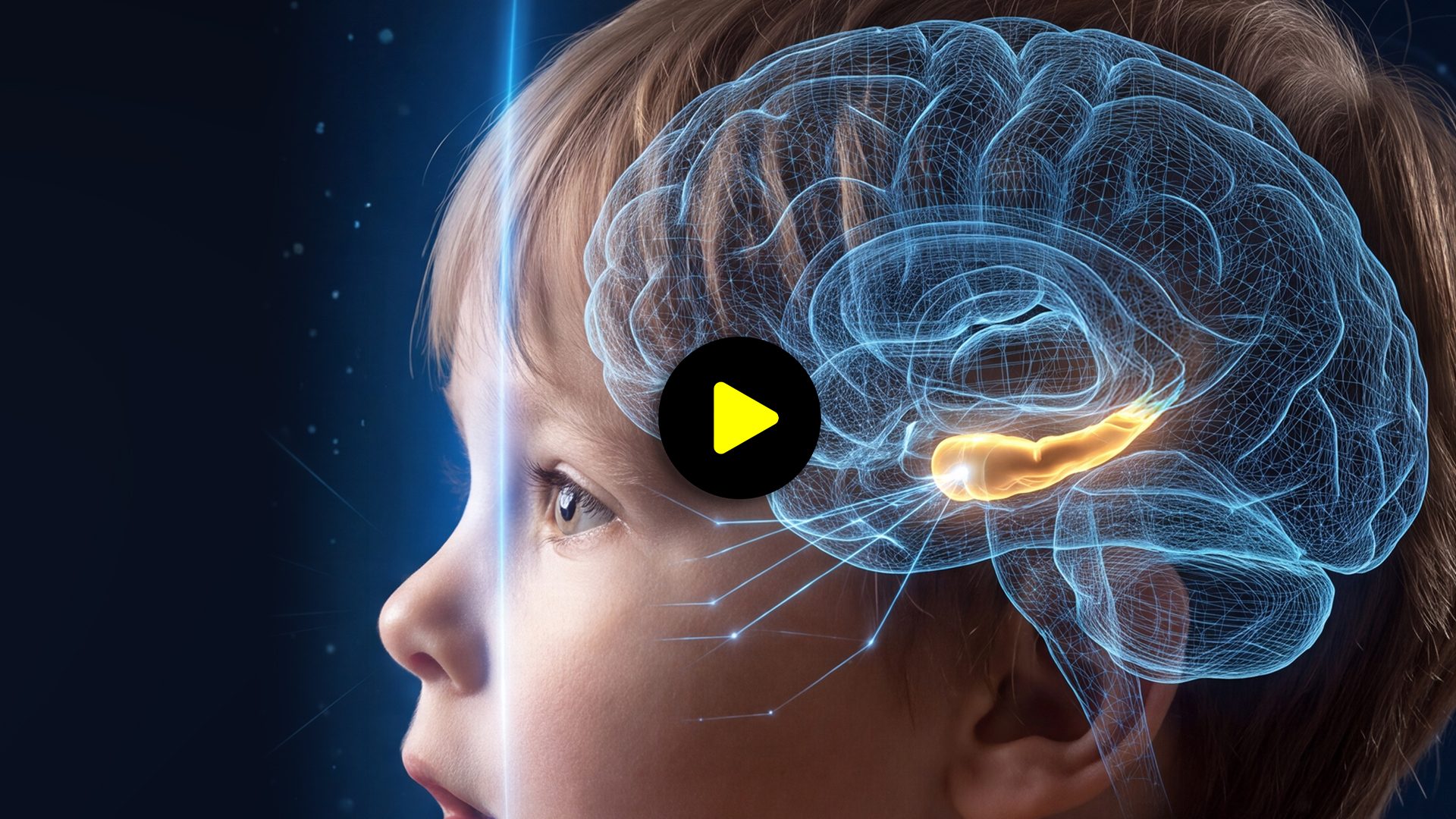
As adults we remember almost nothing before the age of 3, a phenomenon called infantile amnesia. Newborns form memories, but are unable to retain them: the hippocampus and its connections to the cortex are still immature, the birth of new neurons reshuffles the circuits, and they still lack a sense of self and language.
If you try to look for your first memory, the most distant one you have and the cradle, the first steps or the first words come to mind, it is very likely that it is not a memory of that moment. Let alone birth: no one is able to really remember the day he came into the world.
As adults, on average, the first memories we can recover date back to around three, three and a half years old. Yet, in a survey of 6,641 people, 38.6% placed their first memory at two years old or earlier. According to the authors, in most cases these are reconstructions made later, with photos, videos and family stories.
This “black hole” of the early years has a name: infantile amnesia. that is, the almost total inability on the part of adults to remember the episodes of their lives experienced in the very first years of childhood. And to understand why this happens we must start from how the brain builds a memory.
When babies start to remember: Memory begins as early as pregnancy
Memory doesn’t begin at three years old. Already during the pregnancy the fetus forms memory traces of the sounds to which it is exposed, such as music And voices. Towards the end of pregnancy, for example, he reacts differently to his mother’s voice than to that of a stranger.
Even after birth, children learn and remember. In psychologist Carolyn Rovee-Collier’s experiments, newborns learned that by kicking they moved a mobile tied to the ankle with a ribbon. 2-month-olds retained this learning for a couple of days, those of 6 months for about two weeks. It is a simpler form of memory than that of episodes. But around the first year of age the hippocampus it also begins to record individual episodes, and these memories can last weeks or months. The problem is that they don’t reach adulthood: as they grow they become increasingly difficult to recover, until they disappear.
How a memory is born: the role of the hippocampus
The memories of the episodes of our life, those with a “What”, a “Where” and a “When”, depend above all on thehippocampus. It is a small curved structure on the inside of the temporal lobe, one in each hemisphere. The name comes from Hippocampusthe genus of the seahorse, which it resembles in shape: the Bolognese anatomist was the first to notice it Giulio Cesare Aranziin the sixteenth century.
During an experience, each sense sends information to a different area of the cortex: the view in one, hearing in another, the sense of smell in yet another. The I rememberat the beginning, is therefore fragmented. Before arriving at the hippocampus, these fragments pass through the entorhinal cortexwhere you add information about the “Where” and on “When”. Here are located grid cells, neurons that function as a coordinate system of space. Their discovery, together with that of hippocampal place cells, earned the 2014 Nobel Prize in Medicine to John O’Keefe, May-Britt Moser and Edvard Moser.
The role of the hippocampus: 3 main functions
- Tie the fragments together in a single episode.
- It keeps a sort of index of it. The fragments remain in the cortex, and the hippocampus keeps track of where they are and how to put them back together. One of its areas, the dentate gyrusassigns different patterns of neural activity to very similar experiences, so that memories do not overlap.
- Recompose the memory starting from a clue, such as a smell or a sound.
Over time, and especially during sleep, memories stabilize in the cortex.
The importance of the hippocampus emerges from the case of Henry MolaisonThe patient “HM”. In 1953, to treat severe epilepsy, a large part of the internal region of both temporal lobes, including the hippocampi, was surgically removed. From then on he could no longer form new memories of episodes. Subsequent MRIs showed that a posterior part of the hippocampus remained, but probably not functioning.
Why we forget the early years: childhood amnesia
The first years of life, and in particular the so-called “first thousand days”, from conception to two years of age, are the period in which the brain grows and transforms faster than in any other phase of life. THE connections between neurons they form at an impressive speed but they are also very unstable: many come strengthenedmany others eliminatedin a continuous process of “pruning” Such a dynamic brain is perfect for learnbut a lot less For keep. And this is precisely where it was born childhood amnesia.
If we looked at the memory regions in the brain of a young child, we would see that the system that transforms an experience into a long-term memory it is not yet complete. The hippocampal circuits and their connections with the bark they mature gradually, with mechanisms different from those of adults. The result is that the transition from experiencing an event to storing it in long-term memory is more easily interrupted. Added to this is the prefrontal cortexinvolved in organizing memories and retrieving them, which will continue to develop into adulthood. On the one hand, therefore, it is difficult to consolidate memories; on the other hand it is difficult to find them again.
Not all parts of the hippocampus, however, mature at the same rate. The subiculumfor example, a substructure of the hippocampus, is already relatively mature in the first months of life. The dentate gyrusthe area that holds separated the memories similar, has instead a particularly development longwhich continues for years after birth. This is why some memory capacities appear very early: the implicit memorythe one we use for walk or to use cutlery, and the ability to recognize familiar faces and objects. There memory of the episodeshowever, needs the whole system, and arrives later.
And it is precisely in the dentate gyrus that another mechanism comes into play: the neurogenesisthat is, the production of new neurons. In humans it is very intense in early childhood and much more reduced in adulthood, although not completely absent. New neurons are used to learn, but by inserting themselves into existing circuits they can reshuffle the connections that hold memories.
Sense of self and language: what is needed for first memories
To form a memory autobiographical you also need a “hero“: the awareness of being a person distinct from the rest of the world. According to psychologist Mark Howe, it is the birth of this sense of self, which manifests itself between 18 and 24 months, that makes the first autobiographical memories possible. The classic signal is recognition in the mirror.
Finally there is language. According to developmental psychologist Katherine Nelson, words and conversations with adults about the past help children organize experiences into longer-lasting memories. A meta-analysis confirms that children of parents who ask open and elaborate questions about the past recount richer memories over the years. Furthermore, memories formed before words tend to remain “silent”: even after learning the right terms, children do not use them to recount episodes experienced when they did not yet know them.
Language, however, does not explain everything by itself: even animals that do not speak, such as rats and mice, show a form of infantile amnesia. The forgetfulness of the early years is probably the result of several factors together: a brain under construction, the continuous birth of new neurons, a sense of self that is still absent and a language that is not yet developed.
In a certain sense, therefore, our first memory is not the first thing we experienced, but the first we were able to talk about.
