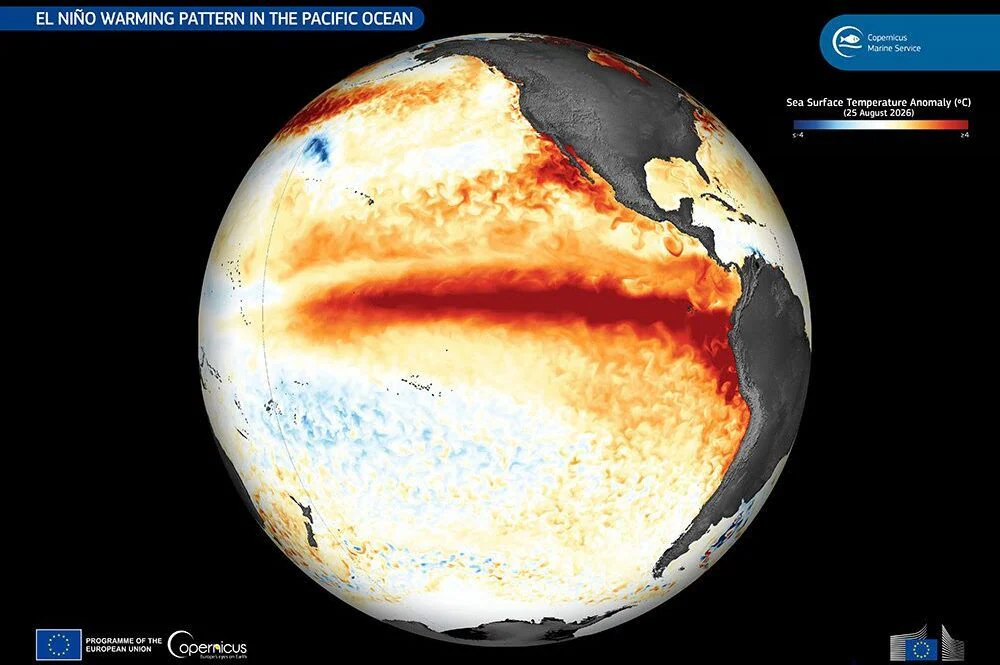
The Secretary General of the UN António Guterres raises the alarm on the climate situation: “El Niño is assuming gigantic proportions. The planet is in uncharted waters“. Global temperatures continue to rise and the world finds itself fully projected into danger zone for extreme weather phenomena. The United Nations climate agency estimates that El Niño is almost certain to persist until February 2027threatening to make the next year the hottest on record in Earth’s history and pushing the entire global climate system towards new heat records.
It is essential to remember that El Niño does not act as a deterministic mechanical switch: from a scientific point of view, it represents a risk factor that alters the statistical probabilities of extreme eventsincreasing the frequency and intensity of certain meteorological anomalies without guaranteeing a 100% unique association for each individual region.
This phenomenon is likely to produce some indirect repercussions also on the Mediterranean basin and about Italy, with temperatures above the historical average during the autumn and winter months and extreme weather events linked to a warmer than normal Mediterranean.
What will happen to the planet according to the UN in 2026-2027
Driven by exceptionally high sea surface temperatures in the equatorial Pacific, where water thermal anomalies are recorded between +1.5 °C and +2.5 °C above the historical average, El Niño should not only be considered a natural cyclical oscillation, but an event strengthened by anthropogenic global warming which risks causing the critical threshold of temperatures to be permanently exceeded (as never happened before). 1.5°C of global warming compared to the pre-industrial era.
Estimates provided by the World Meteorological Organization (WMO) indicate a probability close to 100% that the phenomenon of weather-climate alteration continue his grip until to the first quarter of 2027. Driven by exceptionally high sea surface temperatures in the tropical and equatorial Pacific, El Niño should not be considered just a natural cyclical oscillation, but a event enhanced by anthropogenic global warming.
Since this is a probabilistic scenario, the United Nations scientific community highlights that the following dynamics could occur more frequently on a global scale in the coming months:
- Floods and heavy rainfall: in various regions of South America, the Horn of Africa and southern Asia we could see a greater frequency of intense rainfall, increasing the probability of hydrogeological instability and overflows.
- Prolonged droughts and fire risk: on the contrary, areas such as Australia, Indonesia and large swathes of Central America would see an increased risk of prolonged dry periods and a potential resurgence of forest fires.
- Rising global average temperatures: Since the heat released by the oceans adds to the underlying trend of greenhouse gases, the coming years would have a high probability of setting new historical temperature records on a planetary scale.
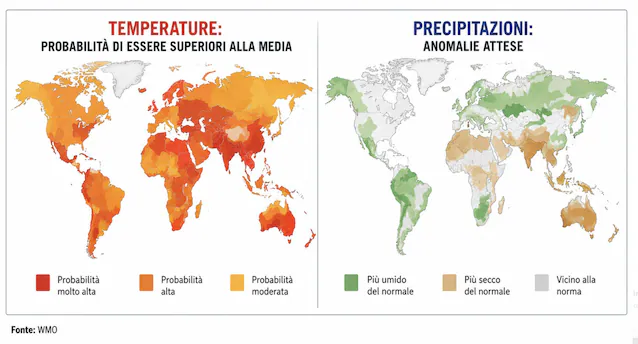
Because the effects of El Niño will extend from the Pacific to Italy
Although El Niño originates in the heart of the equatorial Pacific Ocean, Earth’s climate operates as a highly interconnected system. Variations in the equatorial atmospheric circulation trigger so-called “teleconnections” capable of influencing the weather on a global scale, with possible indirect repercussions also on the Mediterranean basin and about Italy.
The alteration of the Walker Cell in the Pacific modifies the trajectory of the Jet Stream (the Polar-Atlantic jet stream) driving the disturbances towards Europe. Consequently, the following probabilistic scenarios could be encountered on Italian and European territory:
- Alteration of atmospheric disturbances and blocks: any deviation of the jet stream would increase the likelihood of long periods of blocking. This could favor an exasperated alternation between anomalously dry phases and episodes of very concentrated rainfall in Italy.
- Seasonal thermal anomalies: the release of heat on a global scale would reduce the possibility of lasting cold periods, more likely favoring autumns and winters characterized by temperatures above the historical average, with possible negative impacts on the Alpine snow cover.
- Pressure on the hydrological cycle: a Mediterranean that is possibly warmer than normal would tend to release a greater quantity of water vapor into the atmosphere. As colder air masses arrive, the statistical risk of intense meteorological events localized across the national territory would increase.
